Economic, Social and Labor Council Hosts Forum with Labor Law Associations
"Urgent Need to Establish a Normative System of Autonomy and Responsibility"
There has been a call to establish a regulatory framework that enables labor and management to respond to the rapidly changing employment and labor environment. The proposal includes the need to shift from traditional, uniform regulations to flexible and individualized regulatory approaches, as well as the necessity for protective legislation that encompasses workers in new forms of employment.
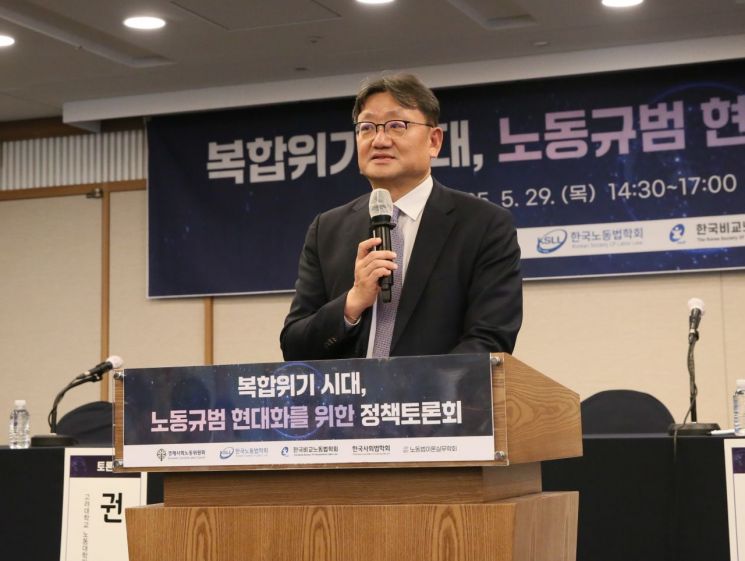 Kwon Kisup, Chairman of the Economic, Social and Labor Council, is delivering the opening remarks at the "Policy Forum for Modernizing Labor Norms in the Era of Complex Crises" held on the 29th at the Press Center in Jung-gu, Seoul. Economic, Social and Labor Council
The Economic, Social and Labor Council, a presidential advisory body for social dialogue, held the "Policy Forum for Modernizing Labor Norms in the Era of Complex Crises" on the 29th at the Korea Press Center in Jung-gu, Seoul, in collaboration with four major labor law associations: the Korean Labor Law Association, the Korean Comparative Labor Law Association, the Korean Social Law Association, and the Labor Law Theory and Practice Association.
The forum was organized to diagnose the structural limitations faced by existing labor norms amid a complex array of changes, including the spread of artificial intelligence (AI), low birth rates and population aging, and diversification of employment types. It also aimed to explore ways to modernize labor law and the overall social security system.
Kim Heeseong, a professor at Kangwon National University and a presenter on the topic of modernizing labor norms, argued, "The collective and uniform regulatory approach based on the traditional labor law paradigm must be changed to a flexible and individualized regulatory method." He further stated, "It is necessary to shift toward expanding the autonomy of parties in determining working conditions, reflecting the characteristics of companies and businesses as well as the needs of workers."
Kwon Ohsung, a professor at Yonsei University and another presenter, said, "Current laws and regulations do not sufficiently reflect the constitutional concept of 'worker'." He emphasized, "Protective legislation is needed to encompass all individuals attempting to enter the labor market." He also pointed out the need for "a transition to an industry-level (supra-enterprise) bargaining system, which would move the main arena of union activities outside individual companies, and for the introduction of legally mandated worker representatives and improvements to the rules of employment system at the workplace level."
During the discussion that followed the presentations, participants explained, "If all labor relations become dependent on legal interpretation, there is a risk that the normative force of the law may be undermined." They added, "A system in which labor and management, taking responsibility, autonomously regulate through supra-enterprise collective agreements and workplace-level accords, in conjunction with the law, will form the foundation for the sustainable development of the economy and society."
Namgoong Jun, a research fellow at the Korea Labor Institute and the presenter on inclusive protection measures in response to the diversification of employment types, said, "There is a growing number of workers in the labor market who do not fit the typical profile of standard employees, so comprehensive protective legislation that includes new concepts such as 'labor providers' is needed." To this end, he suggested, "It is necessary to consider expanding the application of the Labor Standards Act, applying individual labor relations laws to non-wage workers, and broadening the personal coverage of the employment insurance system."
The discussants agreed with the proposal to structurally address the blind spots in labor law. They also stated, "It is necessary to amend labor-management relations laws so that working people can collectively negotiate and reach agreements with the parties who determine their working conditions."
Kwon Kisup, Chairman of the Economic, Social and Labor Council, said, "In the face of the digital era and rapid demographic changes, it is urgent to establish a 'normative system of autonomy and responsibility' that enables both labor and management to actively respond to environmental changes." He added, "We will do our best to modernize labor norms and overcome the limitations of enterprise-level labor-management relations through social dialogue." The Economic, Social and Labor Council plans to incorporate the opinions and suggestions raised at this forum into future agenda-setting and discussion design.
© The Asia Business Daily(www.asiae.co.kr). All rights reserved.












