Calls to Expedite Insurance Coverage
for Innovative New Drugs
Highlighting Patient Blind Spots and
the Need for Systemic Improvements
There have been calls to expedite the inclusion of innovative new drugs for intractable diseases under the national health insurance system.
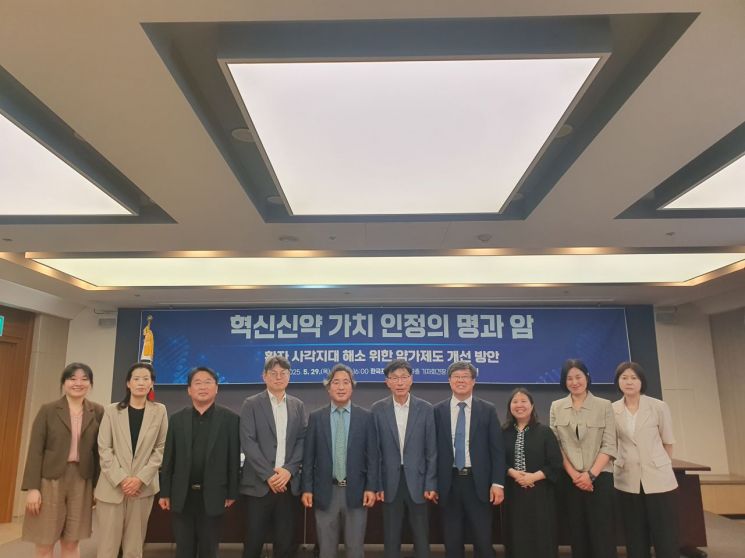 On the 29th, attendees of the forum titled "The Pros and Cons of Recognizing the Value of Innovative New Drugs and Improvement Measures for Drug Pricing Systems to Eliminate Patient Blind Spots" held at the Korea Press Center in Jung-gu, Seoul, are taking a commemorative photo. Photo by Korean Medical Bio Journalists Association
The Korea Blood Cancer Association and the Liver Patient Association released the results of a survey of 119 patients and caregivers at the forum titled "The Pros and Cons of Recognizing the Value of Innovative New Drugs and Improvement Measures for Drug Pricing Systems to Eliminate Patient Blind Spots," held on the 29th at the Korea Press Center in Jung-gu, Seoul. They emphasized that the inclusion of innovative new drugs in the national health insurance reimbursement system is necessary to improve survival rates and quality of life.
Innovative new drugs are pharmaceuticals that can treat diseases through mechanisms of action different from existing therapies or that address unmet needs where no treatment options previously existed.
According to the medical community, as of 2022, it takes an average of 608 days (approximately 20 months) for an innovative new drug to be listed under the national health insurance after receiving approval from the Ministry of Food and Drug Safety in Korea. This is a longer period compared to Germany (281 days), Japan (301 days), and France (311 days) in the same year.
In the survey, 66% of respondents said they had either hesitated or postponed making decisions about cancer treatment due to new drugs not covered by insurance. In addition, 87% reported feeling marginalized during their treatment process because "innovative new anti-cancer drugs" already in use overseas were not available domestically due to lack of insurance coverage.
Park Jeongsuk, Secretary General of the Korea Blood Cancer Association, stated, "All respondents agreed on the need for institutional improvements to enable faster reimbursement of innovative new drugs," and added, "This symbolically demonstrates how desperately both patients and caregivers are hoping for change, and we hope these sentiments will be reflected in policy reforms."
At the forum, Jeon Hongjae, Professor of Hemato-Oncology at Bundang CHA Hospital, remarked, "Although innovative new drugs such as immuno-oncology agents have been approved for a variety of cancer types, actual patient access remains extremely limited."
He particularly pointed out that, in the case of bile duct cancer, although Korea has much higher incidence and mortality rates than other countries, there are currently no immuno-oncology agents covered by national health insurance for first-line treatment, which severely restricts access to innovative new drugs.
© The Asia Business Daily(www.asiae.co.kr). All rights reserved.












