3rd Plenary Session of the Minimum Wage Commission Held
Labor and Management Remain at Odds
"High Uncertainty... Efforts Needed for Agreement"
The plenary sessions of the Minimum Wage Commission, which is responsible for setting next year's minimum wage, have been held three times, but labor and management remain at odds without reaching a consensus. There are significant differences not only regarding the expansion of minimum wage coverage, but also over the issue of differentiated payment by industry.
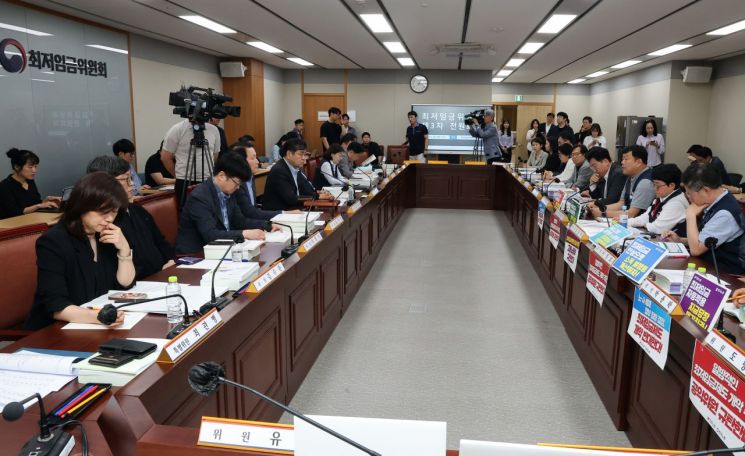 The scene of the 3rd plenary meeting of the Minimum Wage Commission held at the Government Sejong Complex on the 29th. Photo by Yonhap News
On May 29, the Minimum Wage Commission held its third plenary session at the Government Sejong Complex. After the first plenary session on April 22 and the second session on May 27, the commission convened again just two days later for the third meeting. Of the 27 registered members, 23 attended the meeting, including 8 labor representatives, 7 employer representatives, and 8 public interest representatives.
During the opening remarks, the business community highlighted the difficulties faced by small business owners due to high minimum wages. They also argued that, rather than expanding minimum wage coverage to special types of workers, there needs to be discussion on differentiated application by industry.
Ryu Kijeong, Executive Director of the Korea Employers Federation, stated, "Small and medium-sized enterprises and small business owners are experiencing management difficulties to the extent that they cannot even afford labor costs." He pointed to "the high level of the minimum wage and the indiscriminate application without distinction by industry" as the causes. He also noted, "The acceptance rate in the industrial field has dropped significantly," adding, "The proportion of workers earning less than the minimum wage, which was only 4.3% in 2021, rose to 12.5% last year." He went on to say, "I hope that the minimum wage, which is set artificially by the state, does not undermine the business owners' motivation to operate their businesses."
Ryu also said, "The Minimum Wage Commission cannot uniformly determine the employee status of workers in specific occupations." He expressed the view that "for special-type workers recognized as employees by the courts, it is not only practically impossible but also inappropriate for the commission to determine a new minimum wage for them." He continued, "There needs to be an in-depth discussion on a rational minimum wage system that can reflect the significant differences in minimum wage acceptance across industries through differentiated application by industry."
The labor community called for the expansion of minimum wage coverage to contract workers. They also opposed the demand from the Korea Federation of Micro Enterprises for a freeze in next year's minimum wage and for differentiated payment of the minimum wage.
Ryu Kiseop, Secretary General of the Federation of Korean Trade Unions, said, "The number of low-wage workers, including special employment, platform, and freelance workers, is increasing every year, reaching up to 8.62 million according to the National Tax Service's business income payment standards, but in reality, they are unable to receive even the minimum legal protection." He added, "Major countries such as the United Kingdom, the United States, and France already recognize these workers as employees and apply labor laws to them." He continued, "I hope that, as discussions progress, the minimum wage system will be resolved as a preemptive measure to protect these workers."
Ryu also stated, "The only sure way for small business owners, micro-entrepreneurs, and low-wage workers to coexist is the minimum wage, which is the most effective means of revitalizing the domestic economy." He said, "The unrealistic demand for a freeze is not a fundamental solution." He added, "We will do our best to ensure that the minimum wage becomes the frontline for a society where conflicts among the vulnerable are overcome, solidarity among them is strengthened, and working people are protected from poverty."
Attending as a representative of the public interest members, Kwon Soonwon, Professor of Business Administration at Sookmyung Women's University, stressed that labor and management should seek common ground rather than confrontation in the face of difficult economic conditions. Kwon noted, "The Bank of Korea lowered its economic growth forecast for this year from 1.5% to 0.8%," adding, "Depending on the economic situation for the remainder of the year, it may be further adjusted." He continued, "Given these difficult and highly uncertain circumstances, I hope that the labor and management representatives will strive for an agreement from an integrative perspective that considers each other's positions."
© The Asia Business Daily(www.asiae.co.kr). All rights reserved.












