"Restructuring the Wage System Is Essential This Year"
Urging Labor and Management by Citing Daejeon and Busan Cases
"The Only Standard for Seoul Is System Reform"
The Seoul Metropolitan Government has appealed to both labor and management of the Seoul city bus system, who have been in ongoing conflict over the issue of ordinary wages, to return to the negotiating table on the condition of restructuring the wage system. The city expressed concern that if the wage system is not restructured this year to include bonuses in the base salary, conflicts will be repeated every year during the wage bargaining process, leading to a waste of administrative resources.
Yeo Jangkwon, Director of Transportation at the Seoul Metropolitan Government, held a briefing at Seoul City Hall on the 29th, referencing the wage system reforms of the Daejeon bus union in 2012 and the Busan bus union on the 28th, and urged both sides to negotiate. Yeo said, "Since 3 a.m. on the 28th, when the union had announced a strike, more than 200 employees have been dispatched to the field, and with police officers and citizens closely monitoring the situation, it must be extremely stressful for everyone involved." He added, "I hope labor and management can start discussions as soon as tomorrow and continue with substantive negotiations."
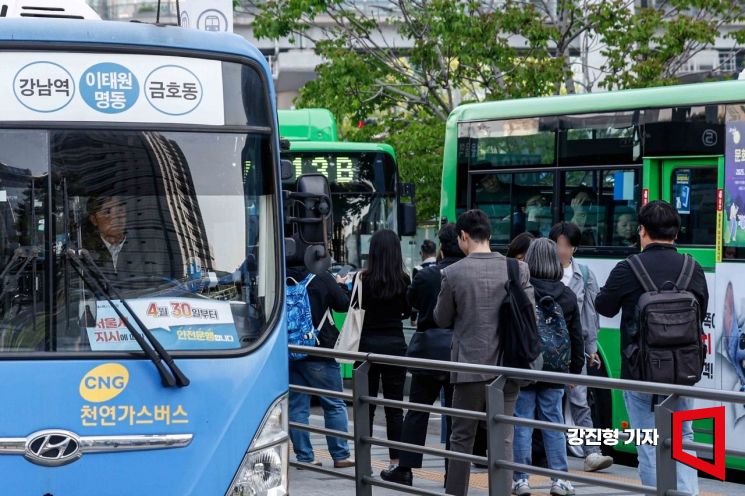 On April 30, 2025, as negotiations between the Seoul city bus labor union and management broke down, the union began a lawful operation strike. A notice related to the strike was posted on a bus at the Seoul Station Bus Transfer Center in Jung-gu, Seoul. Photo by Kang Jinhyung
The city believes that, as in Daejeon and Busan, it is essential to restructure the wage system by including bonuses?which have been a source of conflict in the calculation of ordinary wages?into the base salary. In 2012, the Daejeon city bus union and management incorporated bonuses, summer vacation allowances, and driver insurance premiums into the base salary, resulting in a 3.2% wage increase. After restructuring the wage system, an additional wage negotiation raised the base salary by 3.75%, leading to a total wage increase of about 7%.
On the 28th, after an eight-hour strike, the Busan bus union and management reached an agreement on a mediation proposal presented by the Labor Relations Commission. By abolishing bonuses and summer vacation allowances and including them in the base salary, the wage system was restructured, and the ordinary wage increased by 10.48%. Without any separate negotiations to raise the base salary, simply including bonuses in the base salary resulted in a wage increase of about 10%.
The proposal presented by the Seoul Bus Transportation Business Association consists of two stages. The first stage sets the average annual salary of 62 million won as the "total amount" standard and incorporates bonuses into the base salary within this standard. After restructuring the wage system in this way, the second stage would involve negotiating the rate of wage increase. The Seoul Metropolitan Government considers this approach similar to the Daejeon model, as it involves two stages: restructuring the wage system and then increasing the base salary.
However, the union criticizes the proposal to set a total amount and reflect bonuses in the base salary as "in effect, a wage cut." Currently, if all bonuses are included in the base salary, as in the Busan case, wages naturally rise. However, under the management's proposal, the first stage of wage system restructuring would be carried out in a way that eliminates this increase. Therefore, the union has a positive view of the wage system restructuring implemented in Busan.
The Seoul Metropolitan Government emphasized that the "total amount standard" in the management's proposal is just one way to expedite negotiations and that various options are open for discussion. Yeo explained, "When converting bonuses into the base salary, the amount can vary greatly depending on how working hours are calculated. Since there are disputes over how to set the working hours standard, the business association excluded the time standard and used the total amount as the basis." He added, "The Seoul Metropolitan Government's position is that restructuring the wage system is a prerequisite, but we are not insisting that the total amount standard must be maintained."
The city stressed that this is an opportunity that must be seized to restructure the wage system in the Seoul bus industry. Yeo stated, "Some say we should wait for the court ruling on the ordinary wage-related lawsuits, but if the ruling is delayed, it could take years. If we continue to carry this issue for several years, there will be wasteful debates every year during wage negotiations, and the social costs will be significant. Therefore, the Seoul Metropolitan Government believes it is right to resolve this issue decisively now."
© The Asia Business Daily(www.asiae.co.kr). All rights reserved.












