Large Numbers of Low Earth Orbit Satellites Needed to Secure 'Access to Space'
The Hegemonic Power: U.S. and the Close Pursuit by China
India, a Global 'Top 3' Power, Prepares for the Future with Reusable Launch Vehicles
Korea Aims for $2,500 per Kilogram by 2035
Last year, a total of 261 launch vehicles were sent into space worldwide. Rockets are now being launched almost daily. Of these, 60% were accounted for by the United States. The frequency of launches has increased, and expectations for the speed and efficiency of launches demanded by the market continue to rise.
With conventional expendable (single-use) launch vehicles, it has become difficult to meet these expectations. Humanity has now entered an era where we must launch "more, and more often."
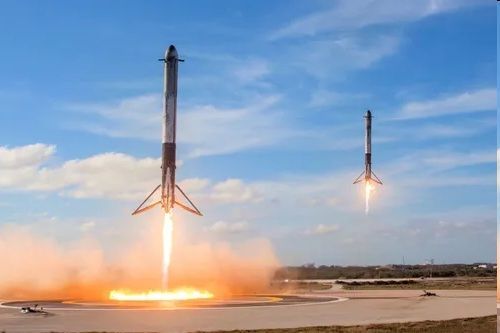 Recovery of the first-stage rocket of SpaceX's reusable launch vehicle 'Falcon Heavy'. Photo by SpaceX
Large Numbers of Low Earth Orbit Satellites Needed to Secure 'Access to Space'
Advanced industries and national security systems, such as 6G communication infrastructure, precision weather observation, high-performance navigation devices, and constellation-based reconnaissance systems, all require large numbers of low Earth orbit satellites.
At the same time, the diplomatic landscape surrounding low Earth orbit is becoming increasingly bloc-based. Countries that try to rely on shared satellite networks, as in the past, must now accept significant risks. Ultimately, the ability to autonomously launch national satellites with domestically developed launch vehicles has become a condition for future survival.
This changing environment has transformed the technology of "reusable launch vehicles" from a simple innovation into a strategic asset. The ability to launch more frequently at lower cost directly translates to access to space.
Launch vehicles have evolved from consumables into platforms. Led by the United States and China, major space powers are devoting all their resources, believing that the future of their countries depends on building this platform.
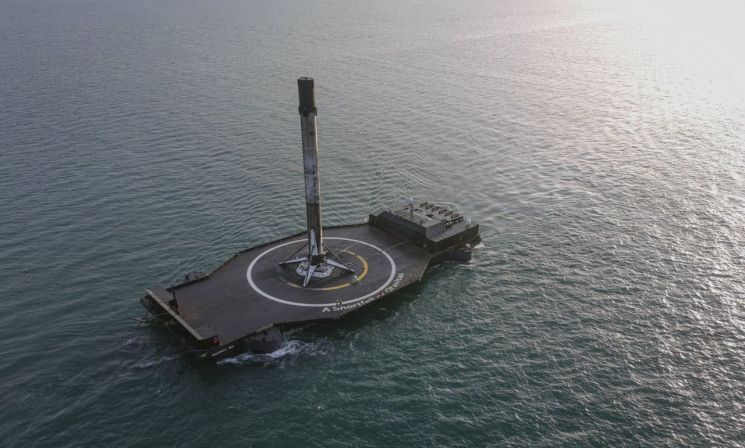
The United States has already secured market dominance through SpaceX's "Falcon 9" and "Starship." As of the end of May, Falcon 9 had achieved a cumulative 477 launches, 432 first-stage recoveries, and 402 reuses. There has been only one launch failure.
The Hegemonic Power: U.S. and the Close Pursuit by China
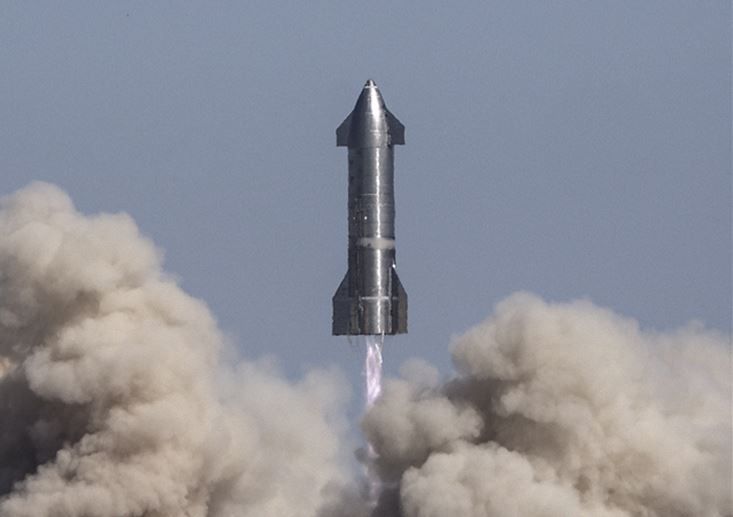
Currently, the United States plans to operate expendable launch vehicles through next year, then gradually phase them out, and from 2028, transition to a system centered on "Starship," the successor to Falcon 9. Starship, which is currently undergoing test flights, is a super-heavy reusable launch vehicle with a payload capacity of 100 to 150 tons?more than ten times that of Falcon 9. NASA plans to use this system for crewed lunar exploration and other missions.
The United States is evaluated as having achieved both technological innovation and commercialization, thanks to an ecosystem centered on private companies.
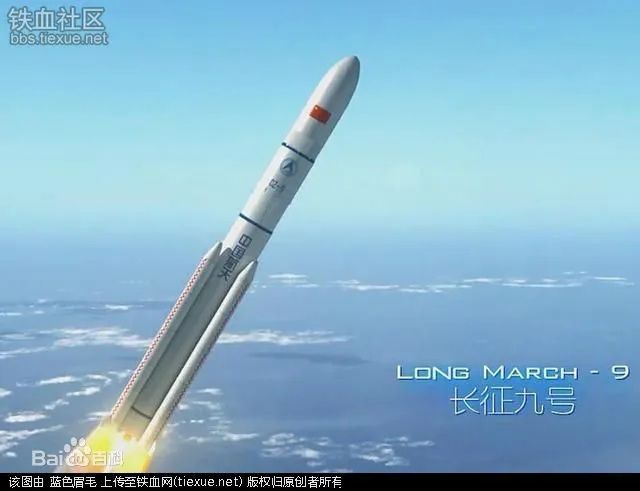
China is focusing on securing reusable technology with methane-fueled launch vehicles such as "Zhuque-3 (ZQ-3)" and "Changzheng-9 (CZ-9)." The private startup LandSpace has already succeeded in the world's first methane rocket launch, and at the Hainan Commercial Space Launch Site, infrastructure is being built to enable weekly launches.
CZ-9 is a super-heavy reusable launch vehicle with a payload capacity of 130 tons, scheduled for launch in 2033. With the central government leading the technology development system, China is making rapid progress in the field of reusable launch vehicles and is closely following the United States from a technological perspective.
Russia is developing the reusable launch vehicle "Amur," targeting its first launch in 2030. However, there are analyses suggesting that Russia's technological assets have been depleted and that its actual technological capabilities are unproven. For this reason, some argue that the development of Amur may serve only as a political message, and it remains uncertain whether it will yield real results.
India, a Global 'Top 3' Power, Prepares for the Future with Reusable Launch Vehicles
Europe suffered several years of stagnation due to the development and launch delays of "Ariane 6," but has announced plans for the operational deployment of the next-generation launch vehicle "Ariane Next" in the early 2030s, marking its return to the reusable launch vehicle race. Although Europe has a solid technological foundation, the slow pace of development due to multinational coordination is cited as a limitation.
Japan is currently operating the H3 launch vehicle and plans to develop a first-stage reusable version by the mid-2030s and a fully reusable launch vehicle by the 2040s. A reusable launch vehicle with a payload capacity of 150 tons (name yet to be determined) is scheduled for launch in 2033. Although development is steady, the lack of a clear strategy is seen as a weakness.
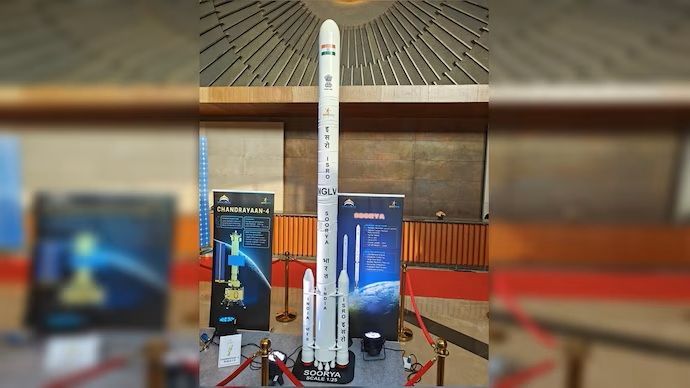
The Indian Space Research Organisation (ISRO) is developing the next-generation launch vehicle "Surya (SOORYA)," targeting a launch in 2034. India's expendable launch vehicles, such as PSLV, GSLV, and LVM3, are emerging as alternatives to SpaceX in the medium- and large-sized launch vehicle market, based on price competitiveness and high success rates.
Despite being expendable, the launch cost of these vehicles is comparable to that of the reusable Falcon 9, making them highly cost-effective. India's entry into reusable launch vehicle development, despite being recognized as a "global top 3" player in the space industry, is seen as preparation for a future market where its current strategy of low-margin, high-volume sales may no longer be effective.
Korea Aims for $2,500 per Kilogram by 2035
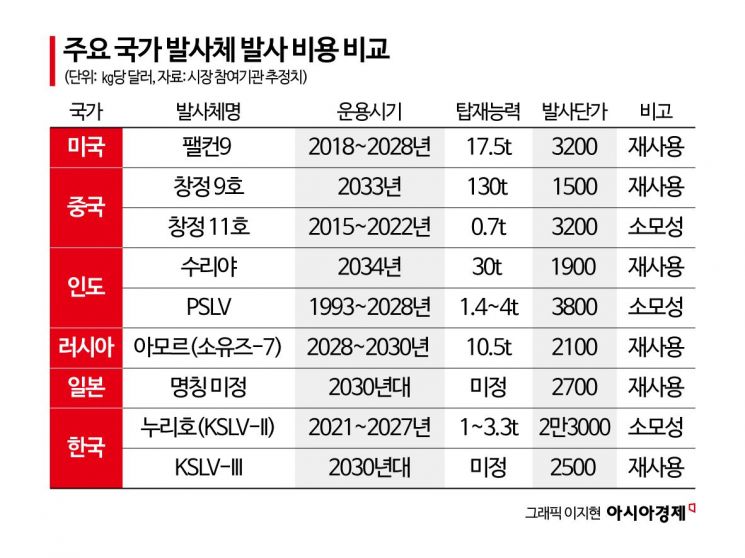
The technological gap between countries translates directly into differences in launch costs. Because satellite launch contracts vary widely depending on conditions, it is difficult to obtain precise statistics. However, according to estimates from the Korea Aerospace Administration and Payload Research, the launch cost of Falcon 9 is about $3,200 per kilogram, China's Changzheng-11 is about $10,000 per kilogram, and the under-development Changzheng-9 aims for $1,500 per kilogram.
India's PSLV is estimated at $3,800 per kilogram. In comparison, Korea's Nuri rocket costs about $23,000 per kilogram?seven times more expensive than Falcon 9 and about six times more than PSLV. Japan and Russia also plan to reduce costs to the $2,000?$2,700 per kilogram range through reusable technology.
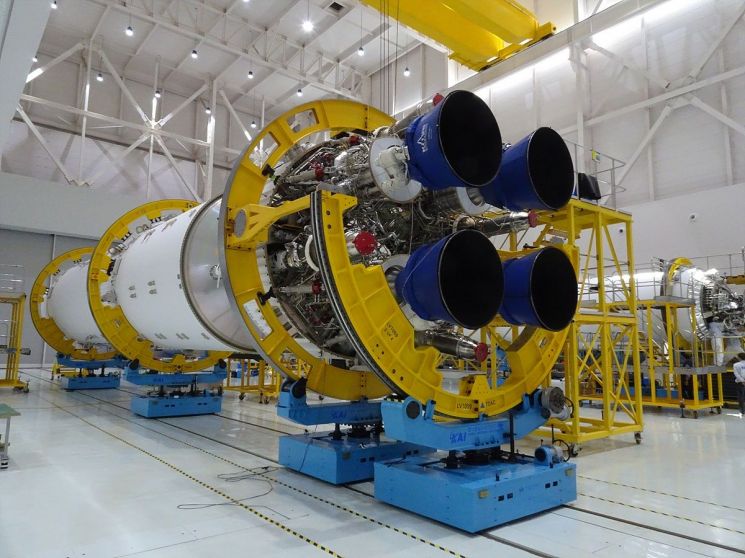 Nuri 4 being assembled at the Naro Space Center assembly building. Provided by the Korea Aerospace Research Institute
This "reusability" is drawing attention not only for cost reduction but also for its role in forming a new space industry ecosystem. As of 2022, the global private satellite launch market is estimated at about $10 billion, with annual growth projected at 8?10%. The industry is closely linked not only to launch vehicle manufacturing but also to high-value-added sectors such as fuel, engines, navigation control, materials, and software. In other words, dominance of the "platform" in space is expanding into overall industrial leadership.
Korea is also recently shifting its launch vehicle development direction from expendable to reusable. The existing next-generation launch vehicle (KSLV-III) was based on a multi-stage combustion kerosene engine, but a switch to a methane-fueled gas generator engine is now under consideration. The government aims to lower the launch cost to $2,500 per kilogram by 2035 and to conduct the first launch of a Korean reusable launch vehicle in that year.
The Korea Aerospace Administration plans to accelerate efforts to secure long-term independence through reusable technology, alongside its goal of launching a lunar lander in 2032. Yoon Youngbin, head of the Korea Aerospace Administration, stated, "Advanced countries are expected to secure reusable launch vehicles by the early to mid-2030s. If we secure them by the mid-2030s, we can catch up with the technological gap."
© The Asia Business Daily(www.asiae.co.kr). All rights reserved.