Lee Jaemyung Stresses Expansion of State-Led Investment and AI Integration
Kim Moonsu Designates Pharmaceuticals and Bio as One of Five Advanced Technologies
Lee Junseok Proposes Direct Adoption of Leading Countries' Regulatory Standards in Korea
With just five days remaining until the 21st presidential election, the main candidates have unanimously identified the pharmaceutical and bio industries as "future growth engines," unveiling policy pledges such as increased investment and regulatory easing. Lee Jaemyung of the Democratic Party and Kim Moonsu of the People Power Party have presented contrasting policy directions: Lee advocates for state-led investment expansion, while Kim emphasizes private-sector-driven system improvements. However, critics point out that these pledges have emerged only days before the election and lack concrete methodologies.
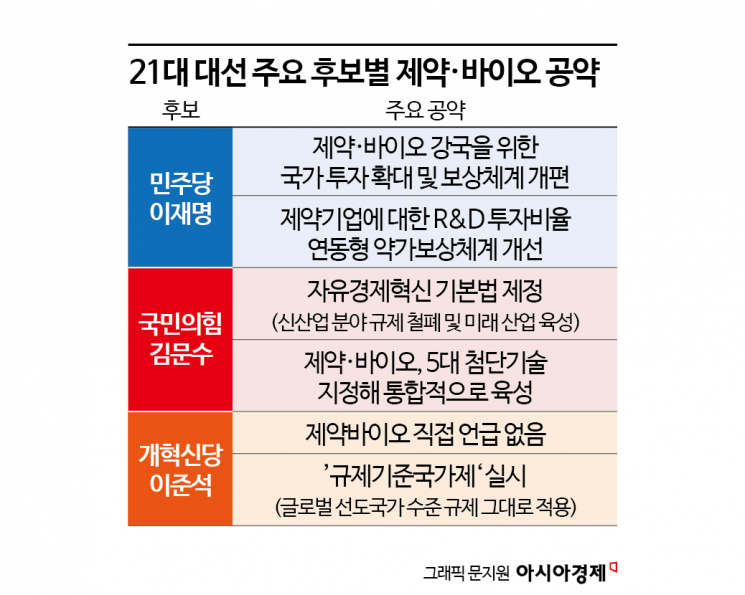
According to the Democratic Party’s presidential election policy platform released on May 29, candidate Lee Jaemyung has designated the pharmaceutical and bio industries as one of the "Top 10 Key Tasks for Fostering New Industries such as AI," making clear his strategy of expanding state-led investment. He plans to support this through the establishment of a strategic R&D investment system and the creation of a bio-specialized fund. In addition, he has pledged to introduce a compensation system that allows for higher drug prices with increased R&D investment, and to lower data access barriers, such as for new and variant data, for globally launched new drugs.
Lee Jaemyung has identified the bio industry as a core growth engine in his "Jalsanazm" vision. In his speech at the National Assembly’s plenary session in February this year, where he effectively declared his presidential bid, Lee stated, "National investment is necessary to secure global top-five competitiveness in bio in the future," promising region-specific development in areas such as Incheon and Chungcheong, as well as R&D and financial support, and strengthening the ecosystem by nurturing medical professionals. He also emphasized the need to integrate AI and bio-healthcare, announcing plans to create a public-private fund totaling 100 trillion won to invest in advanced industries.
Kim Moonsu, as his first pledge, has proposed "freedom-driven growth and a business-friendly nation," promising to eliminate all regulations in the pharmaceutical and bio sectors. His aim is to minimize government intervention and foster the bio ecosystem through corporate autonomy and innovation. He also proposed establishing a presidential "Future Technology 3+1 Committee" to build a new drug development ecosystem that integrates advanced technologies such as bio, AI data, and biofoundries. On the global strategy front, he has focused on strengthening export competitiveness. In his recent "Top 5 Export Powerhouse" pledge, Kim identified bio as a promising export industry and committed to its intensive development.
Kim Moonsu has emphasized industrial autonomy and private innovation capabilities, presenting a strategy centered on nurturing "innovative pharmaceutical companies." He has pledged to overhaul the certification system for innovative companies and design a new drug price compensation system linked to companies’ ongoing R&D investment. He also plans to strengthen the social responsibility of pharmaceutical companies and expand indirect support to diversify the bio venture ecosystem.
Lee Junseok of the Reform New Party has proposed creating an innovation ecosystem based on regulatory relaxation and private autonomy. He has pledged to lower entry barriers for new industries by introducing a "Regulatory Benchmarking System," which would adopt the regulatory standards of leading countries such as the United States and the United Kingdom directly into domestic policy.
The requests of the pharmaceutical and bio industry are also aligned with the main candidates’ pledges, such as expanding R&D support budgets. Last month, the Korea Pharmaceutical and Bio-Pharma Manufacturers Association submitted policy proposals to each party and candidate, urging them to increase the proportion of R&D budget allocated to corporate support from the current 13% to the 30% range, and to help establish an ecosystem for new drug development support. The association stated, "It takes 9 to 17 years and hundreds of billions to trillions of won to develop and launch a new drug, but the success rate is only about 1 in 23,000." They also requested the continuous expansion of a 5 trillion won mega-fund to foster blockbuster new drugs (those generating over 1 trillion won in sales).
© The Asia Business Daily(www.asiae.co.kr). All rights reserved.
![Clutching a Stolen Dior Bag, Saying "I Hate Being Poor but Real"... The Grotesque Con of a "Human Knockoff" [Slate]](https://cwcontent.asiae.co.kr/asiaresize/183/2026021902243444107_1771435474.jpg)
















