Comparison of Healthcare Policy Pledges by Party Candidates
Lee Jaemyung: Plans for Public Medical Schools in Incheon, South Jeolla, and North Jeolla
Kim Moonsu: "Medical School Quota Expansion to Be Reconsidered by Future Medical Committee"
As the final policy pledges of the 21st presidential election candidates were released, Lee Jaemyung of the Democratic Party of Korea and Kim Moonsu of the People Power Party unveiled plans to strengthen public healthcare, including the establishment of new regional medical schools. The three leading candidates, including Lee Junseok of the Reform New Party, expressed confidence in resolving the ongoing conflict between the government and the medical community that has persisted since last year, as well as addressing the healthcare crisis caused by medical service gaps. However, they revealed limitations by failing to present concrete solutions or methodologies.
Two Leading Candidates Push for 'New Medical Schools'
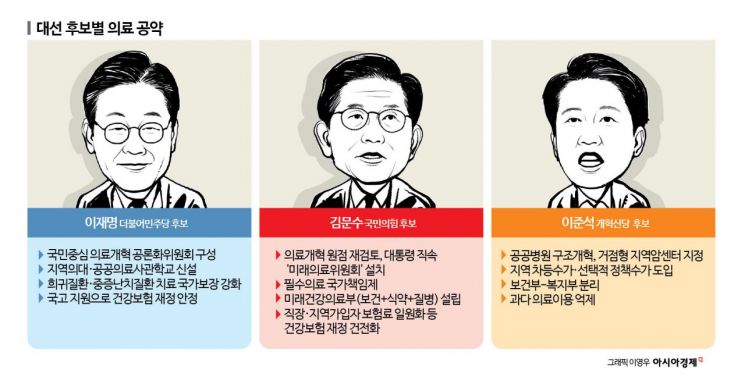
According to political and medical circles on the 29th, Lee Jaemyung’s top healthcare policy is to "revitalize regional, essential, and public healthcare so that people can receive proper treatment anywhere in Korea." He pledged to establish new regional medical schools and public healthcare academies in four cities and provinces. He is considering the establishment of a public medical school and an infectious disease specialty hospital in Incheon, and is also pushing to establish public medical schools in North Jeolla and South Jeolla provinces. His pledge for North Gyeongsang Province includes reviewing the establishment of a medical school and supporting the attraction of a tertiary general hospital.
Kim Moonsu’s pledges also include the establishment of a national medical school and a tertiary general hospital in South Jeolla. In Jeju, he pledged to designate a tertiary general hospital and expand funding and staffing for a regional trauma center, aiming to strengthen regional medical infrastructure.
In contrast, Lee Junseok’s pledges do not include the establishment of new medical schools. Instead, he promised to reform public hospital structures, promote regionally specialized medical services, and designate regional cancer centers in major zones to improve access for cancer patients, thereby dispersing regional patient concentrations.
Regarding the conflict between the government and the medical community that has continued for over a year since the government's decision in February last year to increase medical school admissions, Lee Jaemyung pledged to "pursue genuine medical reform with the public and strengthen cooperation among healthcare professionals." He also promised to establish a "Public-Centered Medical Reform Deliberation Committee." Kang Cheonghee, chair of the Democratic Party’s Special Committee on Health and Medical Care, who attended the "21st Presidential Election Candidate Science-Health Care Policy Debate" hosted by the Korea Science Journalists Association the previous day, said, "Ultimately, the most important thing for resolving the healthcare crisis is the return of medical students and residents. The best way to prevent further chaos is for both students and residents to return to their schools and medical sites as soon as possible."
Kim Moonsu pledged to establish a "Future Medical Committee" under the direct control of the president, with the participation of medical students, to rebuild the healthcare system within six months. He stated that the plan to expand medical school admissions would be reviewed by the committee with field experts, and that the allocation of quotas by school and adjustment of necessary personnel would also be flexibly considered. Kim Seonjeong, head of the Healthy Health and Welfare Headquarters of the People Power Party’s Policy Headquarters, said, "Rebuilding the healthcare system within six months is due to the urgency and seriousness of the issue. Many unfortunate incidents are occurring. The most important thing is the life and health of patients."
On the other hand, Lee Junseok emphasized normalizing medical education and training rather than giving special privileges to medical students and residents. Lee Jooyoung, co-chairman of the Reform New Party’s joint election campaign committee, said, "When a proper pledge to provide quality education and training is realized, healthcare professionals will return, and the healthcare crisis can be resolved immediately."
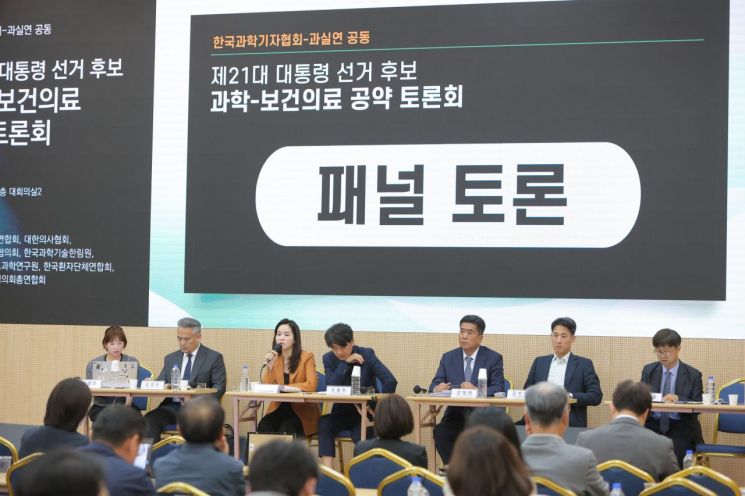 On the 28th, at the Korea Science and Technology Center in Gangnam-gu, Seoul, Lee Jooyoung, co-chairman of the Reform New Party's joint election campaign committee, is speaking at the "21st Presidential Election Candidate Science-Health Care Policy Debate." Photo by Korea Science Journalists Association
Divergent Party Pledges on Health Insurance Finances and Caregiving Burden
The three candidates presented differing views on health insurance finances and the burden of caregiving costs. Lee Jaemyung pledged to "eradicate illegal hospital operators that cause proxy surgeries, overtreatment, and fraudulent claims, which worsen health insurance finances." He also promised to "expand integrated nursing-care services and apply health insurance to caregiving costs for patients admitted to long-term care hospitals, thereby reducing the caregiving burden on the public."
In contrast, Kim Moonsu pledged to "unify health insurance premiums for workplace and regional subscribers, and reform health taxes on the three major risk factors for public health: smoking, drinking, and sugar-sweetened beverages." He also promised to "provide incentives for those who use hospitals and clinics less frequently and to reform health insurance benefits by reducing excessive and non-essential payments."
Lee Junseok proposed measures to stabilize health insurance finances by curbing excessive use of medical services. He explained that the threshold for excessive use, which is subject to a 90% co-payment rate, would be strictly limited from the current annual 365 visits to over 120 visits, and that the co-payment rate for mild diseases would be increased.
In addition, Lee Jaemyung’s healthcare pledges include: strengthening state responsibility for essential medical accidents, stabilizing health insurance finances through government funding, expanding support for rare and intractable diseases, and strengthening state responsibility for childhood obesity and childhood diabetes. Kim Moonsu’s pledges include: establishing a state responsibility system for essential medical care, creating a Ministry of Future Health and Medical Care (combining health, food and drug, and disease functions), and expanding sickness benefits nationwide. Lee Junseok’s pledges include: introducing regionally differentiated and selective policy fees, and separating the Ministry of Health from the Ministry of Welfare.
© The Asia Business Daily(www.asiae.co.kr). All rights reserved.













