"Dependence on China and India for Basic Pharmaceuticals Must Be Reduced"
Minyoung Kim, CEO of Dong-A Socio Holdings, stated on the 28th that significant achievements could be made if Korea's rapid R&D (research and development) speed and Japan's experience and capital strength are combined, based on regulatory innovation.
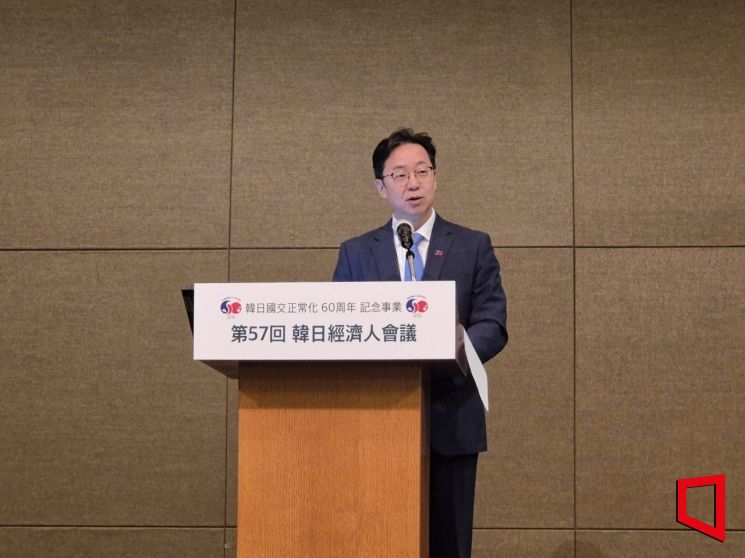 Minyoung Kim, CEO of Dong-A Socio Holdings, is giving a presentation titled "Cooperation Strategies for the Korea-Japan Biohealthcare Industry" at the 57th Korea-Japan Business Meeting held on the 28th at Lotte Hotel Seoul in Jung-gu, Seoul. Photo by Taewon Choi
Kim made these remarks during a presentation titled "Cooperation Strategies for the Korea-Japan Biohealthcare Industry" at the 57th Korea-Japan Business Meeting held at Lotte Hotel Seoul in Jung-gu, Seoul, on the same day.
Kim cited the example of ST Pharm Bio, a subsidiary jointly invested in by Dong-A Socio Holdings and Japan’s Meiji Seika Pharma, and said, "Medicines developed by ST Pharm Bio have been approved and are being sold in the United States and Europe, but they have not yet received approval in Korea and Japan." She urged, "In Korea and Japan, the regulatory requirements are higher, such as demanding additional data beyond clinical results for approval, so there is a need to reform the regulations to the level of the United States or Europe."
Kim also emphasized that regulatory reform is urgent to strengthen the overall competitiveness of the pharmaceutical and bio industries. She explained that, in China, where regulations are relatively lax, clinical trial approvals are granted easily, allowing for rapid new drug development. In contrast, in Korea and Japan, very high standards regarding the safety of medicines are required even before clinical trials involving humans, which results in significant time and cost.
Kim further noted, "From my experience working with Japanese companies, I realized that Korea has a culture of moving quickly, while Japan places great importance on procedures." She added, "Speed is crucial in modern industries, and I believe Korea has a strong advantage in this area."
She also stated that Korea and Japan should work together to reduce their dependence on China and India for basic pharmaceuticals. This is due to the growing global uncertainty in pharmaceutical supply chains, including tariff issues raised by U.S. President Donald Trump.
Kim identified low drug prices as the background for the decreased self-sufficiency in basic pharmaceuticals. She explained, "In Korea and Japan, the rapid increase in healthcare costs due to aging populations has led to a heavier burden on health insurance. This is why governments are pressuring for lower drug prices and encouraging the use of cheaper medicines." She added, "As a result, pharmaceutical companies are increasingly sourcing cheaper raw materials from China or India, or importing finished medicines."
Kim argued, "During the COVID-19 pandemic, we already experienced a severe shortage of essential basic medicines due to supply chain disruptions." She insisted, "Korea and Japan must cooperate to reduce their dependence on China and India for basic pharmaceuticals."
© The Asia Business Daily(www.asiae.co.kr). All rights reserved.

![Clutching a Stolen Dior Bag, Saying "I Hate Being Poor but Real"... The Grotesque Con of a "Human Knockoff" [Slate]](https://cwcontent.asiae.co.kr/asiaresize/183/2026021902243444107_1771435474.jpg)















