Productivity of New Variety 'Spider' Increased by 14%
Securing Seed Drying and Hay Production Technology
The Rural Development Administration announced on May 28 that, following the development of new varieties of Italian ryegrass (IRG), a winter forage crop, it has established a full-cycle domestication technology system covering seed production, hay processing, and distribution.
Im Kisoon, Director of the National Institute of Animal Science at the Rural Development Administration, stated, "This achievement is the result of a convergent collaboration project aimed at reducing livestock farmers' production costs, which was promoted as an agricultural research and development (R&D) innovation task by the Rural Development Administration. It is the first case in which the entire process of domestic forage production has been completed using domestic technology." He further explained, "Through this, it is now possible to simultaneously address the issues of inconsistent quality, import dependence, and price volatility, which have long been weaknesses in the domestic forage industry."
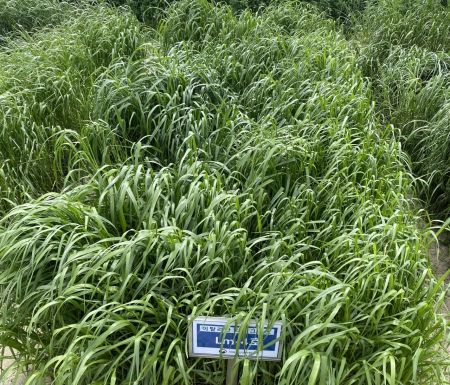 The Italian ryegrass new variety 'Spider' developed by the Rural Development Administration in 2024. (Photo by Rural Development Administration)
Italian ryegrass is the most widely cultivated winter forage crop in Korea. It accounts for about 66% of the total forage crop cultivation area and approximately 86% of the production volume among winter forage crops. The cultivation area increased from 46,000 hectares in 2016 to 89,000 hectares in 2023, and seed consumption has also steadily increased during the same period (from 4,945 tons to 8,089 tons).
However, Korea relies on imports for about 75% of its seeds, and even most domestic varieties are produced overseas, making the industry vulnerable to external factors such as climate or logistics instability.
In response, the Rural Development Administration developed a new Italian ryegrass variety called 'Spider' in 2024. Spider yields 10.1 tons of dry matter per hectare, which is about 14% higher in productivity compared to the imported variety 'Florida 80.' It is also suitable for the paddy-upland double cropping system, which allows cultivation after rice harvesting. Currently, demonstration cultivation is underway in five regions nationwide?Yeongam (Jeonnam), Jinju (Gyeongnam), Goseong (Gyeongnam), Namwon (Jeonbuk), and Nonsan (Chungnam)?covering a total of 42 hectares. Technology transfer has been completed to two seed companies, laying the foundation for distribution.
The Rural Development Administration has also developed a seed dryer. The newly developed seed dryer uses drum rotation and hot air to evenly dry more than 2 tons of seeds per unit per day. It can be used to dry seeds of various forage crops such as alfalfa, tall fescue, and forage millet, making it highly versatile. The Rural Development Administration expects that seed drying, which was previously difficult due to the overlap of the seed harvesting season with the rainy season and the lack of drying facilities, will become much easier.
The Rural Development Administration has, for the first time, integrated the hot-air hay production technology developed in 2021 into the full-cycle technology system, establishing a link between production and distribution. With this technology, Italian ryegrass can be rapidly dried to a moisture content of around 15%, producing hay that is uniform in quality and has excellent storability. The quality is comparable to imported hay, while the price is about 36% lower, helping livestock farmers reduce feed costs.
Currently, in cooperation with the Korea Racing Authority, Italian ryegrass hot-air hay is being supplied to public equestrian centers. The Rural Development Administration plans to build large-scale hot-air hay production facilities in connection with future policy projects and to expand and distribute the product throughout the livestock industry by cooperating with local agricultural cooperatives.
Director Im stated, "By establishing a domestic seed production base centered on the domestic forage variety Spider, and simultaneously strengthening the domestic hot-air hay production base to replace imported hay, we will be able to accelerate the establishment of a stable self-sufficient forage supply system." He added, "With the completion of a technology system that connects everything from variety development to distribution, a practical breakthrough has been achieved to resolve the chronic problems of import dependence and price instability."
© The Asia Business Daily(www.asiae.co.kr). All rights reserved.

![Clutching a Stolen Dior Bag, Saying "I Hate Being Poor but Real"... The Grotesque Con of a "Human Knockoff" [Slate]](https://cwcontent.asiae.co.kr/asiaresize/183/2026021902243444107_1771435474.jpg)















