Lost Attitude Control After About 30 Minutes of Flight
Disintegration Suspected After Atmospheric Reentry
SpaceX, the space company led by Tesla CEO Elon Musk, has failed its ninth orbital test flight of the large spacecraft Starship, which is being developed for Mars exploration.
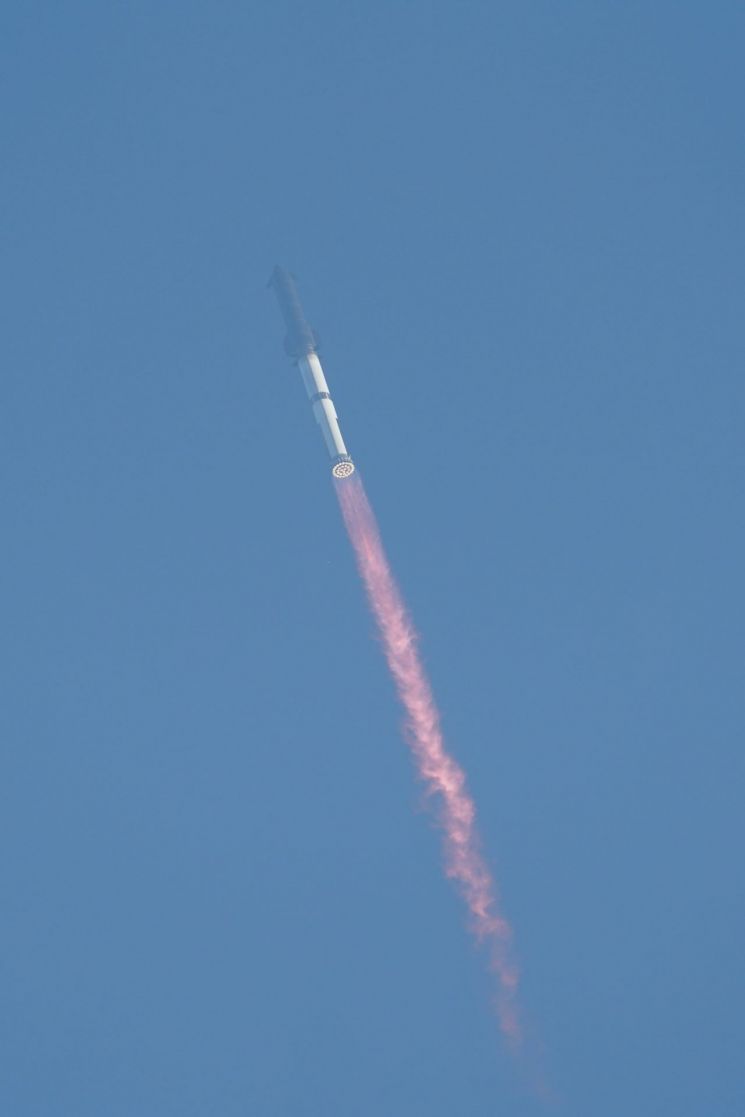 The SpaceX Mars exploration spacecraft Starship launched in Texas, USA, on the 27th (local time). Photo by Reuters Yonhap News
According to Bloomberg News, SpaceX launched Starship toward low Earth orbit at 6:36 p.m. on the 27th (local time) from its Starbase facility in southern Texas.
About three minutes after launch, the first stage rocket booster, Super Heavy, and the second stage spacecraft separated smoothly. Super Heavy fell into the Gulf of Mexico (formerly known as the Gulf of Mexico), but only some of its engines reignited, causing a rapid descent and the disintegration of the vehicle. However, SpaceX explained that this rocket was reused from the seventh test flight and that some level of vehicle loss was anticipated.
After separating from Super Heavy and entering orbit, the spacecraft was scheduled to fall into the Indian Ocean after about 67 minutes of flight. However, about 30 minutes into the flight, it lost attitude control and began to spin. A SpaceX engineer, who was providing a live broadcast of the flight, stated, "There was a leak in part of Starship's fuel tank system," adding, "This reduces the likelihood of a controlled (atmospheric) reentry as planned." The spacecraft then entered the atmosphere in an uncontrolled state, and communication was lost about 50 minutes after launch.
SpaceX posted on X (formerly Twitter), "Starship experienced a rapid unscheduled disassembly," and added, "Our team will continue to review the data and work toward the next flight test."
During this flight, Starship attempted to deploy eight model satellites similar in size to Starlink satellites into orbit, but the attempt could not be made because the spacecraft's door did not open. However, after the test flight, CEO Musk positively evaluated the mission on X, saying, "Starship achieved the planned engine cutoff, which is a significant improvement over the previous flight, and there was no severe loss of heat shield tiles during ascent." He continued, "During the (atmospheric) reentry phase, there was a loss of tank pressure due to a main fuel tank leak," and added, "There is a lot of good data to review, and the interval between launches will be shorter for the next flight."
The second stage spacecraft of the Starship launch vehicle is 52 meters long and 9 meters in diameter, designed to carry about 100 people and 100 tons of cargo inside. The entire launch vehicle, called Starship, refers to the combination of this spacecraft with the Super Heavy rocket (71 meters long). The total length of the launch vehicle is 123 meters.
Since April 2023, SpaceX has attempted uncrewed orbital test flights of Starship. Of the eight attempts so far, four have been largely successful in achieving the planned orbital flight, while the other half ended in failure. In particular, in the launches conducted in January and March of this year, the second stage spacecraft lost communication and exploded in midair less than ten minutes after launch.
In March, to mark the 23rd anniversary of SpaceX's founding, CEO Musk posted on X, "Starship will depart for Mars with Optimus (a humanoid robot) on board by the end of next year. If the landing goes well at that time, a crewed landing (with people on board) could begin as early as 2029. However, it is more likely to happen in 2031."
© The Asia Business Daily(www.asiae.co.kr). All rights reserved.
![Clutching a Stolen Dior Bag, Saying "I Hate Being Poor but Real"... The Grotesque Con of a "Human Knockoff" [Slate]](https://cwcontent.asiae.co.kr/asiaresize/183/2026021902243444107_1771435474.jpg)
















