Six Researchers Selected for Leader Research Program
Fourteen Leading Research Centers to Receive Support from Ministry of Science and ICT
Six of the nation’s top researchers, including Park Moonjung, a professor at Pohang University of Science and Technology, have been selected for the "Leader Research" program, while 14 research centers?including the Global Tissue Sensory Immunity Research Center?have been chosen as "Leading Research Centers," which represent Korea’s premier research groups. Each Leader Researcher will receive intensive support of about 800 million won per year for nine years, and each Leading Research Center will receive annual research funding of 1.5 to 2 billion won per center for seven years.
The Ministry of Science and ICT announced on May 28 that it has selected the top domestic researchers and research groups for the 2025 Basic Research Program, including the Leader Research and Leading Research Centers, and will begin supporting the six selected Leader Researchers and 14 leading research groups starting June 1.
The Leader Research program, which the Ministry of Science and ICT has operated for 28 years since 1997, provides support exclusively to world-class researchers. This year, 94 candidates applied and six were ultimately selected.
The six researchers?Park Moonjung (Pohang University of Science and Technology, Precision Polymer Self-Assembly Research Group), Hwang Ildoo (Pohang University of Science and Technology, Plant Energy Network Redesign), Kim Jongoh (Yeungnam University, Development of RNA Nanovaccines Mimicking Antibiotic-Resistant Bacteria), Ko Seunghwan (Seoul National University, Soft, Customized, High-Density Neural Interfaces at the Cellular Level), Lim Sanghyuk (Korea University, Breakthrough Energy Applications via Dimensional Engineering Research Group), and Lee Taewoo (Seoul National University, Hierarchical Core-Shell Quasi-Quantum Crystal Optoelectronic Devices)?will receive a total of 37.4 billion won to pursue innovative research that could change the future.
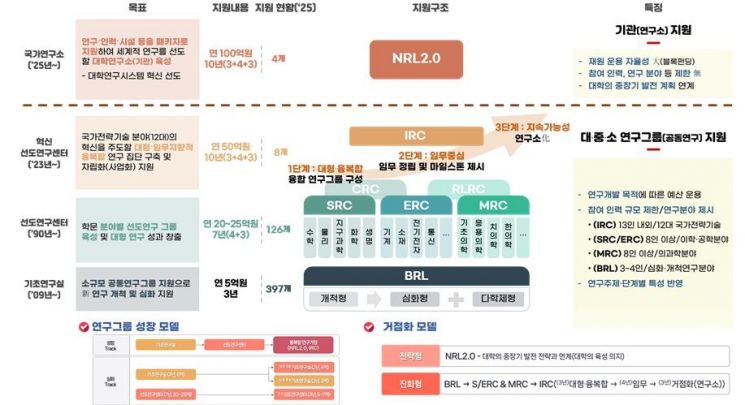
The Leading Research Center program, launched in 1990 and a cradle for outstanding group research teams, provides mid- to large-scale joint research support for groups of about 10 to 15 researchers. This year, 124 centers from 46 universities applied, and 14 centers were selected. In particular, the "Innovation Research Center (IRC)"?aimed at fostering large-scale, multidisciplinary research groups in national strategic technology fields?will receive 5 billion won annually for 10 years.
The 14 selected centers, which will receive a total of 190.1 billion won, are: the Global Tissue Sensory Immunity Research Center (Hanyang University), the Marine Material Circulation Process Global Research Center (Hanyang University ERICA), the Electrochemical Molecular Transformation Research Center (Pusan National University), the Plant Immunity Research Center (Seoul National University), the Bio-Ice Interface Control Biopreservation Enhancement Center (Korea University), the Robot Functional Skin and Super-Sensory Research Center (Kookmin University), the Artificial Intelligence Plus K-Construction Infrastructure Resilience Research Center (Sungkyunkwan University), the Sustainable Solar Energy Utilization Research Center (Pusan National University), the Cardiovascular Remodeling Disease Innovation Control Medical Science Research Center (Chonnam National University), the Cardiometabolic Disease Center (Inje University), the Data Intelligence-Based Integrated Disease Research Center (Yonsei University), the Pulmonary Fibrosis Biopharmaceutical Convergence Research Center (Chungbuk National University), the Energy Conversion and Storage Device Resource Recycling Regional Innovation Leading Research Center (Chosun University), and the Space Service and Manufacturing Research Center (KAIST).
The Ministry of Science and ICT plans to actively support "group research that is truly group research" and "group research that contributes to enhancing university research competitiveness," distinguishing it from individual research. To this end, the ministry will promptly raise stagnant group research funding, support the growth of group research teams (from small to medium to large scale), and promote the establishment of organizations and hubs within universities. These efforts will be further reinforced through the 2026 budget allocation and other initiatives.
© The Asia Business Daily(www.asiae.co.kr). All rights reserved.
![Clutching a Stolen Dior Bag, Saying "I Hate Being Poor but Real"... The Grotesque Con of a "Human Knockoff" [Slate]](https://cwcontent.asiae.co.kr/asiaresize/183/2026021902243444107_1771435474.jpg)
















