A Growth Prediction Model Tailored to Korean Children
LG Chem Develops AI-Based Tool to Guide Treatment for Short Stature Patients
LG Chem has independently developed an artificial intelligence (AI) model that predicts height growth after growth hormone therapy, aiming to improve the domestic treatment environment for children with short stature.
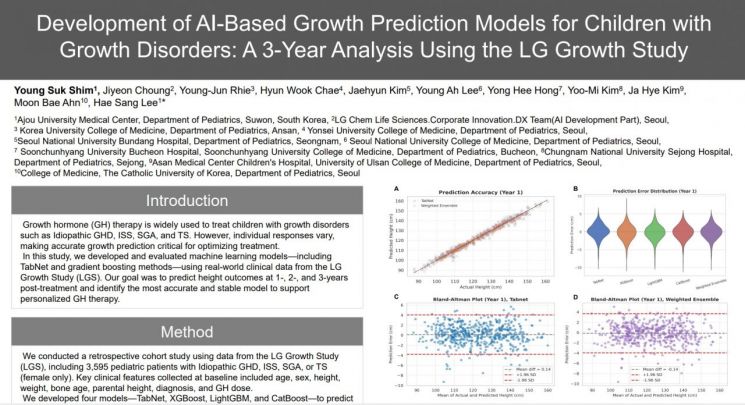
On May 28, LG Chem announced that it had presented a poster on the topic of "Development of an AI-Based Growth Prediction Model" at the European Society for Paediatric Endocrinology and European Congress of Endocrinology held in Copenhagen, Denmark. The research team included Professor Shim Youngseok of Ajou University Hospital and Jeong Jiyeon, head of LG Chem's DX Team.
As the presenter, Professor Shim stated, "There is a growing demand in clinical practice to predict the effectiveness of growth hormone therapy for children with short stature," and explained, "We have advanced the height growth prediction AI model by utilizing the large-scale treatment data accumulated through LG Chem's long-term safety study of Utropin (LG Growth Study)."
LG Chem built an ensemble AI model by combining and recombining multiple existing deep learning models, trained it with treatment data from 3,045 children with short stature (Training Dataset) to improve prediction performance, and used actual growth data from 550 patients (Test Dataset) to validate the AI's performance and assess prediction stability for the first to third years of treatment. The short stature conditions included in the study were growth hormone deficiency, idiopathic short stature, small for gestational age, and Turner syndrome (female patients).
To evaluate the performance of the AI-based model, the researchers compared its growth predictions with those from traditional statistical models, and confirmed that the AI model demonstrated more accurate prediction performance. Notably, the AI-based model was able to predict the first-year growth outcome with an average error of 1.95 cm using only the initial clinical measurements (such as height, weight, and prescribed dose of growth hormone).
LG Chem plans to further stabilize the prediction performance so that the model can serve as a useful clinical tool for presenting changes in height percentiles resulting from growth hormone therapy, and is considering ways to apply it in medical practice.
Yoon Sooyoung, Head of Life Sciences and Business Innovation at LG Chem, said, "It is significant that we have developed a growth prediction model tailored to Korean children, based on domestic data from patients with short stature," and added, "We expect that LG Chem's achievements in customer value innovation will serve as a compass for treatment in actual clinical settings."
Since 2012, LG Chem has been conducting the "LG Growth Study (LGS)" to secure long-term growth hormone treatment data for Korean pediatric patients for the first time in the country. LGS is a large-scale project that aims to recruit 10,000 children over 20 years, until 2032, to observe long-term safety and efficacy. Based on the accumulated research data, clinical papers are being published that help establish trust in growth hormone therapy.
© The Asia Business Daily(www.asiae.co.kr). All rights reserved.

















