Changwon Citizens Find It Hard to Relate to the Current Situation
Changwon Special City in South Gyeongsang Province announced that a strike had occurred as the second and third rounds of mediation between city bus labor and management, held at the South Gyeongsang Regional Labor Relations Commission, ended in a final breakdown. As a result, the operation of 669 buses from nine city bus companies was suspended.
The second round of mediation, which began at 2:00 p.m. on May 27, was extended until 3:00 a.m. with the agreement of both labor and management, allowing for a third round of mediation and additional negotiations. However, in the end, the parties failed to reach an agreement, and the talks broke down.
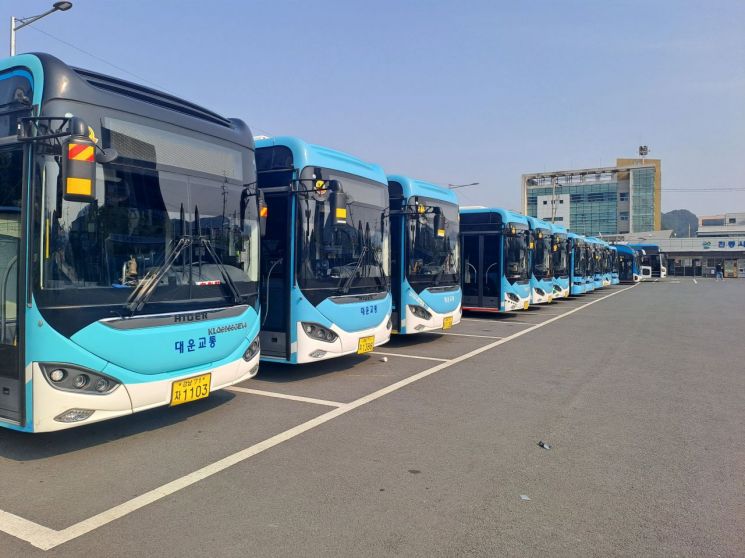 Buses Stopped at Bus Transfer Center in Jindong-myeon, Masanhappo-gu, Changwon Special City. Photo by Jonggu Song
Initially, the Changwon city bus labor and management continued negotiations to first organize a collective agreement aimed at improving working conditions for employees, judging that it would be difficult to prepare a settlement while major metropolitan cities such as Seoul and Busan were unable to find alternatives regarding ordinary wages and wage negotiations.
However, the union continued to present additional demands until the final negotiation deadline of 3:00 a.m. the following day, refusing to accept the management's proposals. At the last stage of negotiations, the union even raised the issue of ordinary wages?a topic that could not be realistically discussed under the current circumstances?causing significant difficulties for both Changwon City and management.
As a result, the South Gyeongsang Regional Labor Relations Commission determined that further mediation was impossible and decided to halt the process.
The management expressed frustration with the union, stating that although they had conducted the negotiations with unprecedented sincerity, the union continued to give false hope, broke trust, and rejected management's proposals. Unlike in other regions, management in Changwon had proactively presented alternatives to prevent a strike, but given the outcome, they now believe that last-minute bargaining is the only way to negotiate with the union in the future.
Changwon City, which observed the negotiations on-site, shares the same position.
The city had hoped for normal operations and reduced budgetary strain, as the progressive negotiations between labor and management appeared to be producing alternatives for improving employee conditions. However, the union ultimately dashed these expectations.
Despite management's unusual move to proactively propose measures to improve working conditions in order to prevent a service suspension, the Changwon bus union proceeded with the strike, drawing widespread criticism.
Even in Seoul, where negotiations over ordinary wages were the most intense, the union refrained from striking despite a breakdown in talks. The decision by the Changwon bus union to strike is seen as disregarding the inconvenience to citizens.
Only the unions in Changwon and Busan participated in this strike. In the case of the Ulsan bus union, negotiations are still ongoing, but the first buses have already started operating.
Metropolitan governments in Incheon, Gyeonggi, and Jeju have extended the mediation deadlines, while Daegu and Daejeon did not apply for mediation, effectively ruling out the possibility of a strike.
The city stated that the bus union has taken citizens hostage and undermined the foundation of the quasi-public operation system, and declared its intention to respond firmly going forward. The union is seen as taking too lightly its responsibility for city bus operations, which are mainly used by young people and socially disadvantaged groups.
The scale of financial support for Changwon city buses increased by about 27 billion won, from 58.6 billion won in 2020 before the introduction of the quasi-public system to 85.6 billion won in 2024. Of this increase, 19 billion won, or 70% of the total, was due to wage costs for drivers. If the 33 billion won increase in labor costs resulting from ordinary wage and wage increases is fully reflected, the total financial support will soar to 120 billion won, a 40% increase from the previous year.
The city emphasized that regarding the current city bus wage negotiations and the ordinary wage issue, which are controversial nationwide, the union's refusal to engage in reasonable dialogue and insistence on its own position?while demanding that all costs be covered by citizens' taxes?fails to gain public sympathy and cannot be accepted by the city.
© The Asia Business Daily(www.asiae.co.kr). All rights reserved.
![Clutching a Stolen Dior Bag, Saying "I Hate Being Poor but Real"... The Grotesque Con of a "Human Knockoff" [Slate]](https://cwcontent.asiae.co.kr/asiaresize/183/2026021902243444107_1771435474.jpg)
















