2nd Plenary Meeting of the Minimum Wage Commission Held
Clear Division Between Labor and Management
Debate Intensifies Over Industry-Specific Application
As discussions to determine next year's minimum wage have entered full swing, labor and management remain sharply divided on key issues. The business community argued that the minimum wage should not be excessively increased, citing the difficult economic situation. In contrast, labor representatives called for an expansion of minimum wage coverage, describing it as a lifeline for low-wage workers.
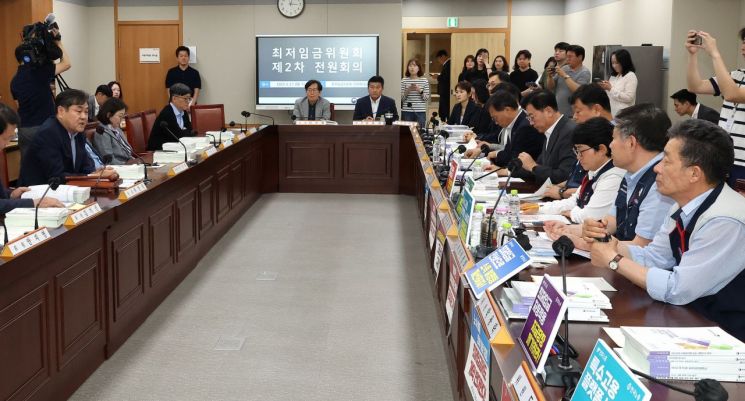 The scene of the 2nd plenary meeting of the Minimum Wage Commission held at the Government Sejong Complex on the 27th. Photo by Yonhap News
The Minimum Wage Commission held its 2nd plenary meeting at the Government Sejong Complex on the 27th. This was the second meeting following the first plenary session held on April 22, and discussions included not only the determination of the minimum wage, but also the application of differentiated rates by industry and the application to subcontracted workers.
From the opening remarks, both labor and management took opposing stances. The business side argued that the minimum wage is already high and that the recent difficult economic situation must be taken into account. They especially emphasized the need to provide conditions for small business owners and self-employed individuals, who are struggling, to survive.
Ryu Kijeong, Executive Director of the Korea Employers Federation and employer representative, stated at the meeting, "The minimum wage has already reached a high level, and the bleak economic situation is exacerbating the difficulties faced by stakeholders." He also noted, "Many small business owners are in a situation where their income is lower than that of the workers they employ."
He added, "The state-mandated minimum wage should not further burden or ignore the difficulties of small and micro-enterprises and small business owners who are already at their limits," and stressed, "I hope that the minimum wage discussions will be conducted in depth, taking all these circumstances into consideration."
Another employer representative, Lee Myungro, Director of the Human Resources Policy Division at the Korea Federation of SMEs, said, "The minimum wage in our country is high in absolute terms and remains high even in international comparisons." He explained, "This year, the minimum wage surpassed 10,000 won, a long-standing demand of labor, but it is higher than in competitor countries such as Japan and Taiwan, and it exceeds the average of the G7 countries. If weekly holiday allowances are included, the gap widens further."
Lee further pointed out, "Next year, the payment capacity of SMEs and small business owners is expected to decline further," and "Due to the tariff crisis, exports are expected to decrease significantly, making it difficult to expect any trickle-down effect." He also said, "Through differentiated application by industry, we must create conditions that allow small business owners and the self-employed, who are at their limits, to comply."
The labor side criticized the proposal released on May 15 by the Minimum Wage System Improvement Research Group, which consists of former and current public interest members of the Minimum Wage Commission. They demanded an apology, arguing that the proposal?which included reducing the number of commission members from 27 to 15 and the possibility of differentiated minimum wages by industry?was inappropriate.
Ryu Kiseop, Secretary General of the Federation of Korean Trade Unions and labor representative, stated, "The minimum wage is a lifeline for low-wage workers, including those in special employment, platform work, and freelancers," and added, "The expansion of minimum wage coverage, as confirmed in the field, is a task of our times." He continued, "Differentiated application by industry or region only serves to stigmatize low-wage sectors and regions."
He emphasized, "I am convinced that the minimum wage is the key tool for achieving mutual prosperity with small business owners and micro-entrepreneurs," and added, "Stimulating consumption through increased disposable income is the first step toward shared growth." He also said, "I hope the minimum wage will serve as a barometer for responding to upcoming domestic and international economic crises, resolving the domestic economic downturn, and addressing income inequality and polarization following the launch of the new government."
Another labor representative, Lee Miseon, Vice President of the Korean Confederation of Trade Unions, said, "Yesterday, we submitted a complaint to the Ministry of Employment and Labor regarding violations of the minimum wage for special employment and platform workers, whose hourly wages remain at around 8,220 won." She pointed out, "These workers receive no compensation for travel or waiting time and must bear various costs and insurance premiums themselves, putting their livelihoods at risk."
She continued, "The Minimum Wage Commission is not just a place for setting numbers," and stressed, "We must uphold the spirit of the Constitution and the Minimum Wage Act, eliminate blind spots, and guarantee wages that ensure a dignified life." She further emphasized, "We must fundamentally change the structure in which low wages become the highest wages for a lifetime, and in which special employment and platform workers are not protected by law."
On this day, 24 out of the 27 commission members attended the plenary meeting. The members reviewed the results of recent field opinion hearings and discussed the findings of the commission's subcommittees, including the Cost of Living Subcommittee and the Wage Level Subcommittee. Topics included the analysis of living expenses for single, unmarried workers, the analysis of the effects of minimum wage application, and wage status analysis. The 3rd plenary meeting is scheduled to be held at the Government Sejong Complex on the 29th.
© The Asia Business Daily(www.asiae.co.kr). All rights reserved.












