Establishing a 'Basic Plan for Local Autonomy' to Expand Citizen Participation
Introducing Cooperative Project Evaluation System... Making Resident General Assembly Permanent
Gwangmyeong City in Gyeonggi Province is accelerating efforts to strengthen local autonomy by expanding citizen participation. The city plans to establish a 'Basic Plan for Local Autonomy' and introduce a range of policies to realize this goal.
On the afternoon of the 27th, Gwangmyeong City held a policy briefing in the city hall's medium conference room and announced its vision for expanding local autonomy.
Ha Taehwa, Director of the Autonomous Administration Bureau of Gwangmyeong City, stated, "We plan to pursue policies with the goal of making local autonomy an everyday practice by 2027," and added, "Based on the foundation and capabilities we have built so far, we will realize everyday democracy in which citizens participate in every stage of policy-making."
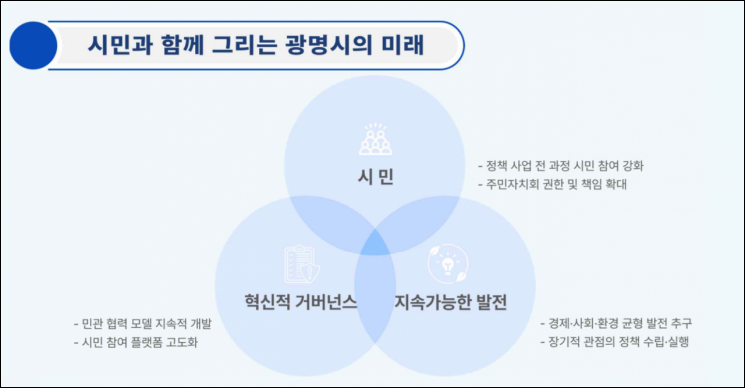
To achieve this, the city has set the vision of 'Sustainable Gwangmyeong Led by Citizens.' It aims to become a city where local autonomy is part of daily life by 2027 through four main strategies: branding itself as a leading city for local autonomy, expanding citizen participation in all stages of policy-making, restoring the community through open resident self-governance, and completing deliberative democracy through citizen cooperation.
As a first step toward city branding, the city will establish the '3rd Basic Plan for Local Autonomy,' reflecting local characteristics and past experiences with local autonomy. This plan will serve as the basic framework for the city's local autonomy policies for three years, from next year through 2028.
The city will also strengthen citizen participation in all stages of policy-making, including planning, decision-making, implementation, and evaluation. By introducing the 'Departmental Cooperative Project Evaluation System,' the city aims to increase citizen participation rates at each stage of projects and institutionalize citizen cooperation throughout the administration.
In the second half of this year, the city will hold a large-scale citizen forum on local autonomy. The forum will focus on ways to enhance the effectiveness of the basic plan and promote citizen participation.
The annual resident general assembly, currently held once a year, will become a permanent institution starting in 2027. The city also explained that it will gradually institutionalize this by establishing the necessary legal and regulatory foundations related to local autonomy.
 Ha Taehwa, Director of the Autonomous Administration Bureau of Gwangmyeong City, is explaining the plan to strengthen local autonomy at a policy briefing held on the 27th in the city hall's medium conference room. Provided by Gwangmyeong City
Previously, in 2018, the city enacted the 'Ordinance on the Promotion of Public-Private Cooperation,' and in the following year, it established the '1st Basic Plan for Local Autonomy.' In 2020, the city transformed the 'Resident Autonomy Committees' in its 18 administrative districts into 'Resident Autonomy Councils,' thereby systematizing a practical citizen participation system. The Resident Autonomy Councils play a direct role in solving community issues, such as implementing village projects funded by the resident tax every year.
The city is currently operating various systems to establish and expand local autonomy, including the 'Local Autonomy University,' 'Democratic Citizenship Education for Resident Autonomy,' and 'Community Revitalization Education.'
The 'Local Autonomy University,' held every fall, provides both theoretical and practical education on local autonomy. Since its launch in 2018, a total of 1,882 citizens have participated in the program through both online and offline courses up to last year.
The 'Democratic Citizenship Education for Resident Autonomy,' aimed at members of the Resident Autonomy Councils, is a program focused on democratic communication methods and enhancing participation capabilities. This program supports the smooth operation of the Resident Autonomy Councils.
Additionally, the city is running the 'Community Preparatory School,' a customized education and consulting program for residents participating in community problem-solving activities.
© The Asia Business Daily(www.asiae.co.kr). All rights reserved.













