Development of Functional Glass Material Technology
Supporting Marine Ecosystem Restoration
Expanding as a Competitive B2B Business
LG Electronics is strengthening its functional advanced materials business, led by its independently developed water-soluble glass powder "Marine Glass," which promotes the growth of marine organisms.
On the 27th, LG Electronics announced that it had signed a memorandum of understanding (MOU) for "technology exchange to vitalize the blue carbon industry" with the Blue Carbon Project Group at Seoul National University on the 26th.
Under this agreement, LG Electronics and the Blue Carbon Project Group plan to carry out a demonstration project for marine ecosystem restoration using "Marine Glass." They also intend to discover new business opportunities and develop technologies to vitalize the blue carbon industry both domestically and internationally.
Blue carbon refers to carbon absorbed and stored by marine and coastal ecosystems. It is gaining attention as a new solution to global warming, as it is known to absorb carbon more quickly and store more carbon compared to terrestrial ecosystems. LG Electronics' Marine Glass is a functional glass material that promotes the growth of seaweed and microalgae. Like salt dissolving in water, when Marine Glass comes into contact with water, it transforms into mineral ions. Through more than six years of research and development, LG Electronics has developed and applied technology that precisely controls the amount and rate at which these components dissolve.
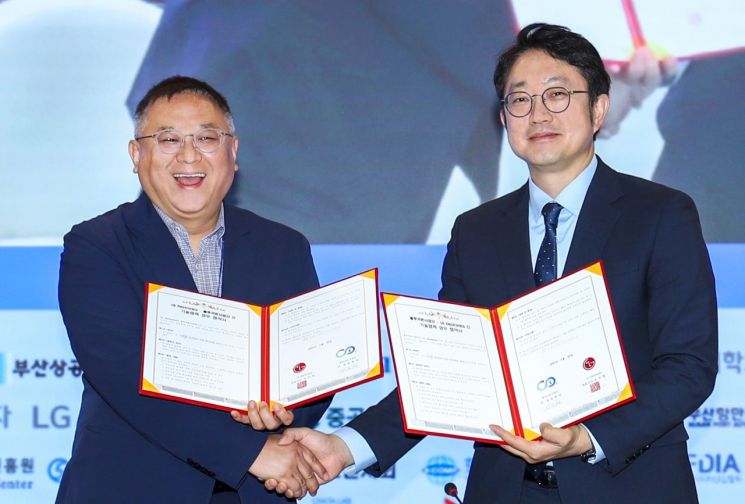 Jongseong Kim, Director of the Blue Carbon Project Group at Seoul National University (left), and Youngseok Kim, Head of the HS Functional Materials Business Division at LG Electronics (right), are taking a commemorative photo on the 26th. LG Electronics. Photo by LG Electronics.
The mineral ions serve as nutrients for seaweed and microalgae, which can help restore marine forests that are being destroyed by pollution and overexploitation of marine resources over the long term. Furthermore, they can contribute to marine ecosystem restoration and carbon reduction.
LG Electronics explained that Marine Glass not only allows for the adjustment of the dissolution rate, but also enables customization of the types and amounts of minerals, as well as the product's form. By manufacturing Marine Glass as solid, heavy beads or flat chips, the mineral components do not disperse easily even in fast-moving ocean currents, making it possible to quickly create dense marine forests within a certain area.
LG Electronics sees potential for various business opportunities by collaborating with other industries using Marine Glass. Microalgae living in the ocean are used as raw materials for pharmaceuticals and health supplements, and they also produce biomass, which is used as fuel for generators, making them a sustainable energy source.
LG Electronics has designated the advanced materials business as a new business-to-business (B2B) area and is strengthening its capabilities. To date, the company has filed 420 patents related to glass powder and has established production facilities with an annual capacity of 4,500 tons at its Smart Park in Changwon, Gyeongnam. Since 2023, LG Electronics has also started selling the antibacterial functional material "Purotech," expanding its business into major Asian markets such as Vietnam and India. This year, the company is pursuing technological cooperation to maintain food safety by applying Purotech to the transportation, processing, and packaging of Atlantic salmon at fish farms.
Baek Seungtae, Executive Vice President and Head of the Kitchen Solution Business Division at LG Electronics, said, "This agreement is the first step in demonstrating the technological capabilities of the new material 'Marine Glass' and exploring various applications," adding, "We will continue to develop new functional glass materials and strengthen our business competitiveness."
© The Asia Business Daily(www.asiae.co.kr). All rights reserved.

![Clutching a Stolen Dior Bag, Saying "I Hate Being Poor but Real"... The Grotesque Con of a "Human Knockoff" [Slate]](https://cwcontent.asiae.co.kr/asiaresize/183/2026021902243444107_1771435474.jpg)















