The 6th Future Culture and Arts Education Forum Held at Blue Square
Sharing Innovative Cases of Culture and Arts Education and Exploring Policy Directions
"La Villette was once an area filled with slaughterhouses, but in the 1980s, under the plan of President Francois Mitterrand, it was transformed into an urban cultural space."
The history of La Villette's transformation, as explained by Sylvestre Gosling, Head of Culture and Arts Education at La Villette, was dramatic. It seemed to eloquently illustrate the French government's growing recognition of the value of culture and the arts.
"La Villette was originally a small village where grapes were cultivated to produce wine for the people of Paris. When Napoleon III began the renovation of Paris in 1853, boulevards were constructed and the slaughterhouses scattered throughout Paris were relocated to La Villette. After the decline of the slaughterhouses, the area was left as vacant land, but President Mitterrand devised a plan to create a vast cultural city park here."
On May 23, the 6th Future Culture and Arts Education Forum, organized by the Ministry of Culture, Sports and Tourism and the Korea Arts & Culture Education Service, was held at NEMO, a complex cultural space in Blue Square, Yongsan-gu, Seoul.
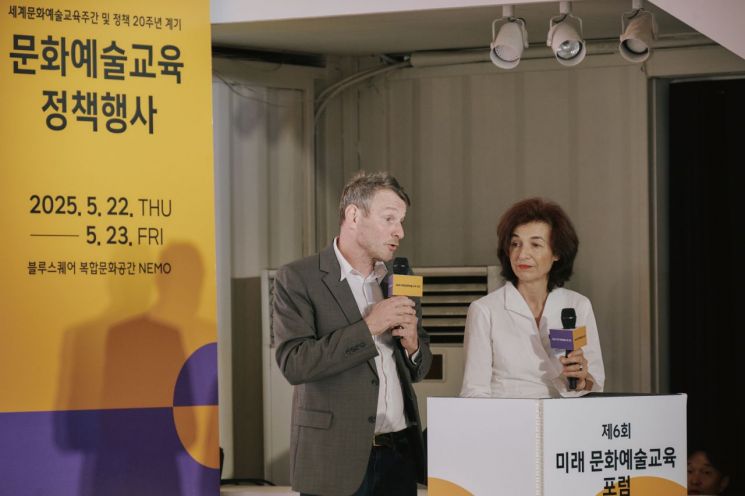 Sylvestre Gosling, Head of Culture and Arts Education at La Villette (left), and Jasmine Frank, Project Manager of Little Villette, explained about the urban cultural space 'La Villette' in northeastern Paris and the children-only space 'Little Villette' within La Villette at the 6th Future Culture and Arts Education Forum held on the 23rd at NEMO, a complex cultural space in Blue Square, Yongsan-gu, Seoul.
 Photo by Korea Arts & Culture Education Service
This year marks the 20th anniversary of the enactment of Korea's Culture and Arts Education Support Act. With the enactment of this law, culture and arts education policies began to be actively implemented. In celebration of the 2025 World Culture and Arts Education Week (May 22-28), an international forum was organized to share cases of culture and arts education from abroad. The forum was held under the theme "Innovation of Artistic Experiences and Cultural Spaces for Children and Families of Future Generations."
La Villette was built as part of President Mitterrand's large-scale architectural initiative, the Grands Projets, and opened in 1986.
Within La Villette, there is a children-only space called Little Villette. Jasmine Frank, Project Manager of Little Villette, explained, "The area of Little Villette exceeds 2,000 square meters." At Little Villette, performances, exhibitions, outdoor cinemas, fairs, and a variety of educational activities for children take place. Frank also stated that Little Villette operates a farm. She emphasized, "Children can directly experience the animals raised at Little Villette," and "This allows children to form real connections with nature."
Frank said that the highest priority value pursued by Little Villette is "to allow children to escape from anything that makes their lives difficult." She added, "When children enter Little Villette, they forget that they are in Paris."
Globally, awareness of the importance of culture and arts education is spreading. This is because, as society becomes faster and more complex, the number of people experiencing emotional instability and depression is increasing. Culture and the arts are gaining attention as a means of providing psychological stability. In particular, more parents around the world are focusing on culture and arts education for the emotional development of their children.
Kim Bungnyun, Professor of Child and Adolescent Psychiatry at Seoul National University College of Medicine, who delivered the keynote speech at the forum, emphasized the importance of culture and arts education, stating, "Research from various regions around the world consistently shows that many students participating in culture and arts education experience positive changes in emotion, sociality, and behavior," and "especially, multiple studies have confirmed a marked improvement in empathy." Professor Kim added, "Research consistently reports that affinity for forming social relationships improves, that depression and anxiety decrease, and that aggression related to impulse control is reduced."
As a result, there are increasing cases of expanding culture and arts education spaces in countries around the world. Little Villette opened in 2016.
The Victoria and Albert (V&A) Museum in London, which opened during the Victorian era, also opened the children's museum "Young V&A" in July 2023. In just 18 months since its opening, it has recorded over one million visitors and is establishing itself as a new landmark.
 Participants of the 6th Future Culture and Arts Education Forum held on the 23rd at NEMO, a complex cultural space in Blue Square, Yongsan-gu, Seoul, are having a discussion.
 Photo by Korea Arts & Culture Education Service
Katherine Littman Smith, Head of Learning and Participation at the children's museum, said that the most important consideration was that it is a space entirely for children and youth.
"The children's museum was opened to meet the demand for providing creative education and a child-centered culture. Through collaboration with children and youth, we considered what their dedicated space should look like."
Smith emphasized, "The world is becoming more complex, and there are growing concerns about children's digital environments," and "Our vision is to foster creative confidence in children, inspire them, and connect them to diverse relationships to have a positive impact."
Park Eunsil, President of the Korea Arts & Culture Education Service, stated, "As values such as the restoration of relationships and sustainability are highlighted amid the rapidly changing sociocultural environment and the rise of generative artificial intelligence (AI), the importance of spaces for culture and arts education has grown even more." She added, "The Korea Arts & Culture Education Service will contribute to building a foundation and expanding the ecosystem for culture and arts education with public value and sustainability, so that anyone, including future generations, can experience culture and arts education in everyday life."
© The Asia Business Daily(www.asiae.co.kr). All rights reserved.












