Attendance of 88 Out of 126 Judges’ Representatives Meets Quorum
Discussion Focuses on Judicial Independence and Trust in the Judiciary
Attention on Whether Opinions Will Be Expressed Regarding the 'Lee Jaemyung Election Law Verdict'
An extraordinary session of the National Judges Representatives Meeting, which will discuss the controversies that have arisen following the Supreme Court's en banc ruling on the election law violation case involving Lee Jaemyung, the Democratic Party of Korea candidate, began on the morning of May 26 at the Judicial Research and Training Institute in Goyang, Gyeonggi Province. There was considerable skepticism among judges about holding the meeting itself on this day, raising questions about whether the quorum would be met. However, 88 out of 126 members attended (including online participants), allowing the meeting to proceed. Previously, in an unofficial vote conducted via a group chat for convening the judges’ meeting, it was reported that around 70 representatives had opposed holding the session. On the court's internal network, 'Courtnet', a post was also uploaded suggesting that the meeting be postponed until after the presidential election due to concerns that it might reveal political bias.
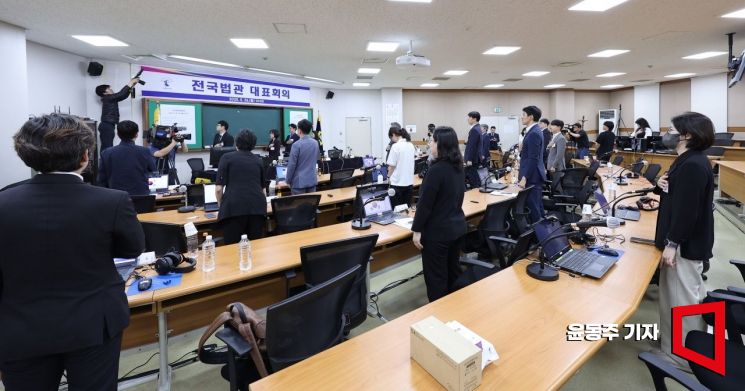 On the 26th, during the National Judges Representatives Meeting held at the Judicial Research and Training Institute in Goyang, Gyeonggi Province, Chairperson Kim Yeyeong and attendees are performing the national ceremony. Photo by Yoon Dongju
This meeting was prompted when some judges, citing a 'violation of political neutrality', called for its convening after the Supreme Court's en banc panel, by a vote of 10 to 2, remanded Lee's case with a guilty verdict. However, the two agenda items selected are not directly related to this. The first agenda item is to confirm that 'judicial independence in a democratic nation must be absolutely guaranteed, and at the same time, to declare efforts to uphold the fairness of trials and the democratic accountability of the judiciary.' The second agenda item is to 'seriously recognize that trust in the judiciary, which forms the basis of judicial independence, has been shaken by the unusual procedures in a particular case, and to express deep concern that various demands for accountability and institutional changes based on individual cases could threaten judicial independence.'
However, it remains possible that opinions regarding the Supreme Court's ruling on Lee's case may be raised during the judges' meeting. In a press release, the Judges Representatives Meeting stated, "We have determined that it would be inappropriate to express opinions on the merits of individual trials and procedural progress regarding the case at the center of the Supreme Court controversy." In other words, they will not directly mention the en banc ruling. Nevertheless, the meeting materials distributed to judges included the phrase, 'seriously recognize that trust in the judiciary has been shaken by the unusual procedures in a particular case,' which itself sparked further controversy. It is known that if more than ten judges present at the meeting agree, additional agenda items can be introduced on the spot.
Ahn Eunji, a judge at the Changwon District Court who serves as secretary of the representatives meeting, told reporters before the start of the extraordinary session, "If, in addition to the proposer, nine others agree, an agenda item can be introduced on the spot," adding, "It is expected that three to four additional items will be proposed."
© The Asia Business Daily(www.asiae.co.kr). All rights reserved.

















