Utilizing Immune Cell-Based Delivery Technology
Enhancing Drug Delivery Efficiency to Inflammatory Sites
Improving Drug Persistence

A new platform has been developed that increases drug delivery efficiency by transporting drugs to target sites using immune cells, rather than delivering the drugs directly.
A research team led by Professors Sung Hakjoon and Yoo Seungeun of the Department of Medical Engineering at Yonsei University College of Medicine, along with doctoral student Kim Jueun and Instructor Jung Seyong of the Division of Cardiology at Severance Hospital, announced on May 26 that when aspirin is loaded onto monocytes, a type of immune cell, and transported to inflamed sites, the rate of drug delivery to cells increases by up to 30 times.
The results of this study were published in the renowned materials science journal 'Advanced Functional Materials' (IF 18.5).
Aspirin is a drug that simultaneously inhibits inflammation and platelet aggregation. It is widely used for inflammatory and cardiovascular diseases. However, because it is rapidly metabolized in the liver, its duration of action is short, and it is difficult to precisely target tissues or vascular lesions where inflammation is localized.
To overcome these limitations of drug delivery systems, the research team developed a new system that allows drugs to be loaded onto carriers and transferred between cells.
First, aspirin was loaded onto small spherical nanoparticles and injected into the tail vein of mice. The injected aspirin and nanoparticles then migrated to the spleen, which is responsible for immune function, where they were absorbed by monocytes. The monocytes moved to the lesion sites where inflammatory signals occurred, carrying the aspirin-loaded nanoparticles with them.
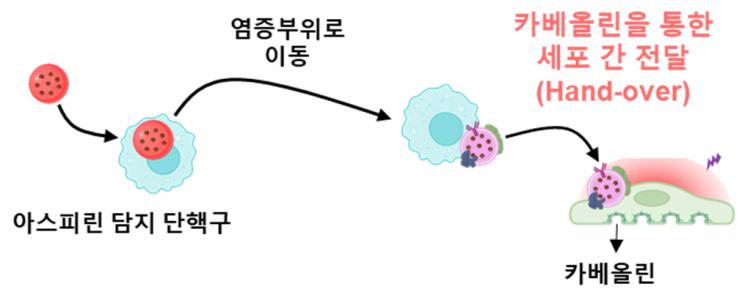
Afterward, the monocytes activated a 'handover' mechanism by generating extracellular vesicles to deliver the internalized aspirin to surrounding inflammatory cells and platelets. Extracellular vesicles are structures that package substances within cells and deliver them to neighboring cells. At this stage, inflammatory cells express a protein called caveolin to accept the aspirin. The study visually confirmed that the more severe the inflammation, the greater the expression of this protein, and that it plays a key role in intercellular drug delivery.
The research team verified the effectiveness of the developed system in mice induced with inflammation in various tissues, including leg muscles, liver, and blood vessels. When aspirin was administered using the handover method, the inhibitory effect on the inflammatory marker COX-2 enzyme was 30 times higher than with aspirin alone, resulting in a 90% improvement in drug delivery. In addition, when aspirin was delivered to platelets via extracellular vesicles, a single intravenous injection produced an antithrombotic effect that lasted for more than seven days. In contrast, the effect of aspirin alone lasted only two hours and 30 minutes.
Professor Sung Hakjoon stated, "This study is significant in that it visually elucidated the intercellular drug delivery mechanism activated by inflammatory responses," adding, "It is a precision treatment platform that can spread therapeutic effects to surrounding cells, going beyond simple targeted delivery, and can be widely applied to various diseases such as cancer and cardiovascular conditions."
© The Asia Business Daily(www.asiae.co.kr). All rights reserved.
![Clutching a Stolen Dior Bag, Saying "I Hate Being Poor but Real"... The Grotesque Con of a "Human Knockoff" [Slate]](https://cwcontent.asiae.co.kr/asiaresize/183/2026021902243444107_1771435474.jpg)

















