Kim Moonsoo, the People Power Party candidate, announced his national defense and security pledges on the 25th, which include strengthening preparations for cyber warfare and improving the treatment of military personnel.
On this day, at the Gyeryong Military Experience Center in Chungnam Province, Kim stated, "Cyber warfare and electronic warfare are the core of future battlefields." He pledged to strengthen cyber warfare capabilities by training 10,000 white-hat hackers and to establish a nationwide cyber security control tower by enacting the "National Cyber Security Act" (tentative name). The aim is to thoroughly investigate and respond to the backgrounds and intentions behind cyber threats, such as the SK Telecom incident, by establishing a permanent response system. He also promised to implement a rotation system for managerial positions and to appoint compliance officers in intelligence agencies, in order to strengthen democratic oversight and restore public trust.
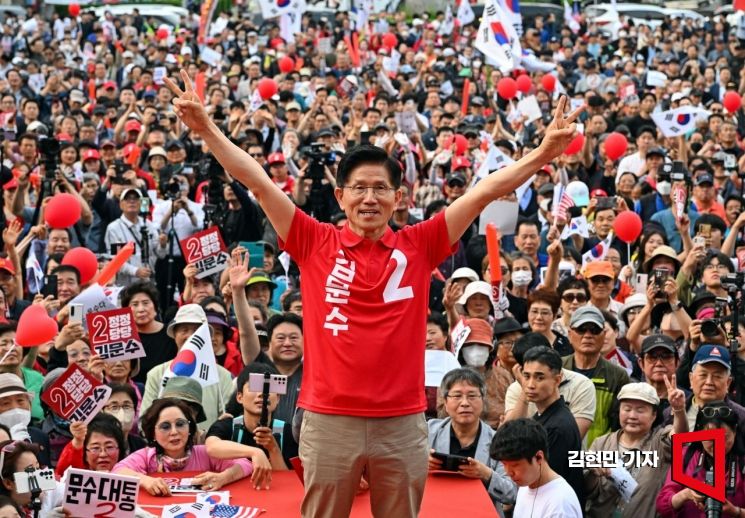 Kim Moonsoo, the presidential candidate of the People Power Party, is appealing for support from citizens at a concentrated campaign rally held on the 22nd at Bucheon Station Maru Square in Bucheon City, Gyeonggi Province. Photo by Kim Hyunmin
Kim emphasized his commitment to improving military treatment, saying, "Boosting the morale of soldiers is more important than anything else for Korea to become a future strong military power." His pledges include introducing a military bonus point system regardless of gender, implementing a voluntary service system for women, and improving the treatment of junior officers by increasing budgets for duties and training meals. Additionally, he promised to expand opportunities for non-commissioned officers to become officers, improve military service environments such as barracks, increase the number of military legal officers to protect victims of internal violence and human rights violations, and implement a state responsibility system for accidents occurring during service.
He stated, "Military service should be a source of pride," and promised to introduce a military service certification system that would provide specialized education in fields such as hacking, drones, and robotics during service, as well as tax incentives for companies that hire these individuals. He also emphasized that he would enhance respect for national merit recipients, soldiers, and other uniformed personnel by increasing allowances, providing livelihood support payments to spouses of war veterans, and expanding the designation of veterans’ commissioned hospitals.
He also presented a direction for advancing a high-tech scientific military, including the early establishment of an artificial intelligence (AI)-based manned-unmanned integrated combat system. He pledged to select ten key defense high-tech fields and increase research and development (R&D) budgets and support, with a vision to make Korea one of the world’s top four defense exporters. He also announced plans to create a Presidential Office Secretary for Defense Acquisition to serve as the "K-Defense Export Strategy Control Tower."
In addition, Kim stated that he would establish and operate specialized guard units for General Outpost (GOP) security using advanced technology, in order to professionalize standing forces. He also promised to introduce a Private Military Company (PMC) system, outsourcing non-combat areas such as perimeter security, aviation maintenance (MRO), catering and transportation, and reserve force training support to the private sector, so that the military can focus on maintaining core combat capabilities.
He emphasized the need to revise the Espionage Act. The main point is to expand the scope of legal sanctions to include so-called "white" and "gray" spies who disguise themselves as academic, cultural, or economic exchanges, and to address legal loopholes regarding international industrial espionage and the leakage of advanced technology to foreign countries. To this end, he stated he would explicitly define the purpose of espionage as "infringement of national security or national interests" and specify technology espionage as an act of espionage.
He also announced plans to establish a "National Maritime Committee" directly under the Presidential Office. This is intended to actively respond to infringements on maritime sovereignty, such as China’s West Sea Project and maritime boundary disputes. In addition, he pledged to innovate the military medical system by training military safety specialists and creating a National Armed Forces Medical Evacuation Squadron, as well as to reform the defense organization to guarantee the political neutrality of the military.
© The Asia Business Daily(www.asiae.co.kr). All rights reserved.

![Clutching a Stolen Dior Bag, Saying "I Hate Being Poor but Real"... The Grotesque Con of a "Human Knockoff" [Slate]](https://cwcontent.asiae.co.kr/asiaresize/183/2026021902243444107_1771435474.jpg)















