"Restoring the People's Livelihood and Economy Is the Top Priority...
Judicial Reform Comes Second"
"No Political Retaliation...
I Will Not Resort to Pettiness"
Lee Jaemyung, the presidential candidate of the Democratic Party of Korea, announced that he would prioritize the recovery of the people's livelihood and economy if elected, including the operation of an Emergency Economic Response Task Force (TF). While he acknowledged that judicial and prosecutorial reforms are also important issues, he stated that they are not matters to focus on under the current circumstances.
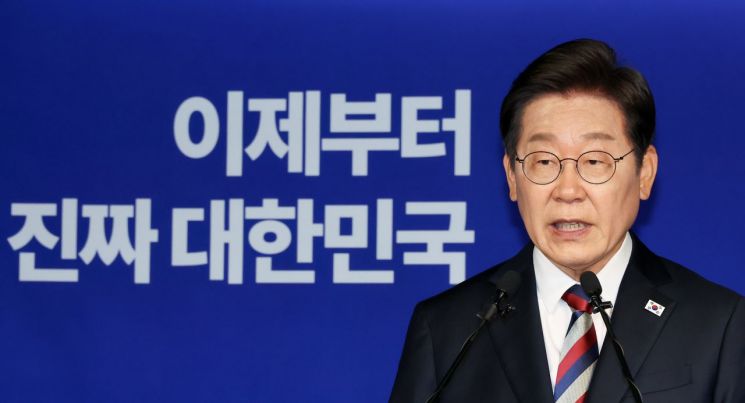
At a press conference held at the Democratic Party headquarters in Yeouido, Seoul, on the 25th, he announced that he would establish an "Emergency Economic Response Task Force (TF)" led by the president to boost the economy if elected. He said, "We will swiftly prepare immediately actionable measures for the people's livelihood and economy, and respond proactively to the domestic economic downturn with the determination to wage an all-out battle against the recession."
He also pledged to invest in advanced industries such as artificial intelligence (AI) and deep tech, and to consider shifting to a negative regulatory system. However, regarding an extra budget to support industries, he said, "For now, it is time to focus on an extra budget for the people's livelihood," adding, "We need to address the urgent issues first through short-term economic stimulus." In addition, he promised to implement an energy highway policy and to usher in the era of KOSPI 5000.
While he acknowledged the need for judicial and prosecutorial reforms, such as adjusting investigative powers, he insisted that these should be secondary to the recovery of the people's livelihood and economy. He said, "I don't think this is a situation where we should be expending our energy here," and added, "The public is divided and experiencing conflict and confrontation, so we need to focus the nation's energy on resolving these issues. If we concentrate on less urgent matters, it will be difficult to gather that energy." Regarding media reform, he briefly replied, "It's not an urgent matter, so let's consider it later."
He also presented a blueprint for restoring democracy. Lee stated, "We will strengthen National Assembly control over emergency martial law, limit the president's veto power, introduce a system for the National Assembly to recommend the prime minister, and establish parliamentary consent procedures for appointments to the prosecution, police, and Korea Communications Commission."
He emphasized strengthening communication with the public through measures such as the "People's Recommendation System," which hires talent recommended by the people, and the establishment of a "People's Participation Digital Platform." Explaining the "People's Recommendation System," Lee said, "Sometimes I ask for opinions on social media with restricted visibility, and often the suggestions are better than those from my aides. The idea is to designate each position, receive recommendations for them, accept anonymous reports for verification, and thereby give the public as much choice and decision-making power as possible."
Regarding concerns that, if elected, a "ruling party majority and opposition minority" situation would effectively allow the administration and legislature to be monopolized, he dismissed them as "absurd," arguing that "such a situation has been the norm throughout most of constitutional history." Lee added, "There are control systems such as media oversight, and I will not act like the People Power Party. I don't even like drinking, and my family does not engage in corruption, so there will be no need to use power to cover up crimes." He further stated, "In fact, a ruling party majority and opposition minority is desirable for stable governance."
Lee promised, "We will punish those involved in rebellion, but there will be no political retaliation." He said, "If given the opportunity, there is so much to do in a short five-year term. If someone draws a line and mobilizes national resources for sanctions and retaliation, resistance and conflict will arise, and unity will not be achieved." He continued, "It's childish to say, 'You did this in the past, you did that too.' I will not stoop to such petty political retaliation." Regarding the scope of those involved in rebellion, he shared his intention to focus on punishing the main parties, while excluding frontline commanders and soldiers.
Meanwhile, regarding the possibility of a unified conservative candidacy between Kim Moonsoo of the People Power Party and Lee Junseok of the Reform New Party, he said, "The Reform New Party is ultimately a derivative of the People Power Party," and predicted, "There will likely be a unification of those involved in rebellion." He added, "There are rumors that they have discussed giving party leadership or the prime minister position in case of victory. I don't know how much synergy there will be, but I am almost certain that political unification will be mutually beneficial."
© The Asia Business Daily(www.asiae.co.kr). All rights reserved.












