Eight Out of Ten Say "4.5-Day Workweek Influences Job Decisions"
However, More Would Reject It If Salaries Are Reduced
Eight out of ten Generation Z job seekers in South Korea (born in the mid-1990s to early 2000s) are aware of the 4.5-day workweek and would consider it as a condition for employment. However, the key factor for the successful implementation of the 4.5-day workweek is that it must be operated without any reduction in salary.
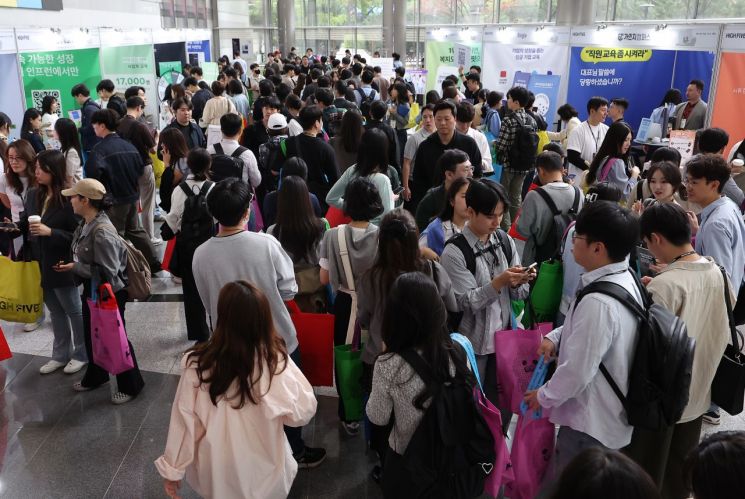 Office workers at COEX in Gangnam-gu, Seoul on the 19th. The photo is not related to any specific expression in the article. Photo by Yonhap News
On May 23, Jinhaksa Catch, a recruitment platform, released the results of a survey on the 4.5-day workweek conducted among 1,630 Generation Z job seekers in South Korea. According to the survey, 83% of respondents said they were aware of the 4.5-day workweek. Additionally, 84% responded that the 4.5-day workweek would influence their decision to join a company. This means that more than eight out of ten Generation Z job seekers consider the 4.5-day workweek an attractive working condition.
However, the adoption of the 4.5-day workweek comes with the prerequisite that there must be no reduction in salary. Among all respondents, 62% cited "operation without salary reduction" as the most important condition for the future success of the 4.5-day workweek. This was followed by "efficient work management" (33%), "flexible implementation according to job type" (22%), and "minimizing side effects such as overtime work" (16%).
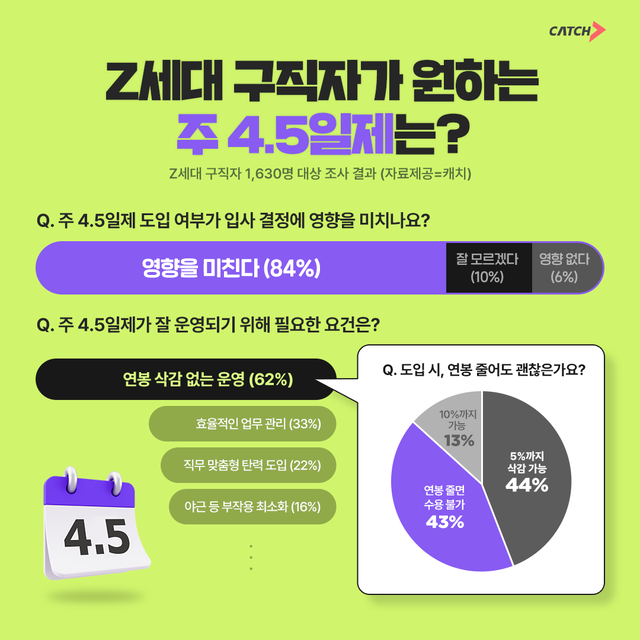
If the introduction of the 4.5-day workweek were to require a salary reduction, to what extent would Generation Z be willing to accept a pay cut? The most common response was "I can accept up to a 5% reduction," at 44%. This was followed by "up to 10% is acceptable," at 13%. However, 43% responded that "if my salary is reduced, I cannot accept the 4.5-day workweek."
As for how they would spend their extra free time after the implementation of the 4.5-day workweek, 47% of respondents chose "sufficient rest" as their preferred option. This was followed by "self-development" (18%), "exercise and health management" (12%), "time with family" (9%), "hobbies and cultural activities" (9%), and "side jobs or financial investments" (5%).
Regarding the survey results, Kim Junghyun, head of Jinhaksa Catch, said, "This survey confirmed the high level of interest among Generation Z job seekers in the 4.5-day workweek," adding, "When introducing the system, practical factors such as salary, work intensity, and operational methods must be thoroughly considered in advance."
© The Asia Business Daily(www.asiae.co.kr). All rights reserved.
![Clutching a Stolen Dior Bag, Saying "I Hate Being Poor but Real"... The Grotesque Con of a "Human Knockoff" [Slate]](https://cwcontent.asiae.co.kr/asiaresize/183/2026021902243444107_1771435474.jpg)

















