Korail stated on the 23rd that the aging of the KTX-1 trains has become severe and argued that the introduction of next-generation vehicles can no longer be delayed.
On this day, Korail attended the Spring Academic Conference of the Korean Railway Society, held at the Gwangju Kim Daejung Convention Center, and held a policy forum on the theme of "Introduction of Next-Generation KTX-1 Vehicles." The conference was supported by related organizations such as the Ministry of Land, Infrastructure and Transport, the National Railway Authority, Korail, and the Korea Railroad Research Institute.
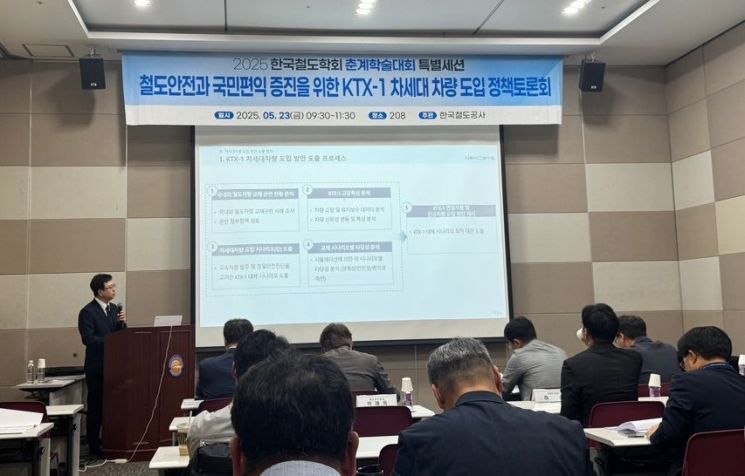 Korail held a policy forum on the introduction of the next-generation KTX-1 trains for railway safety and public convenience at the Spring Academic Conference of the Korean Railway Society, held on the 23rd at the Gwangju Kim Daejung Convention Center. Photo by Korail
KTX-1 is a high-speed train that has been in operation since 2004. It is currently the oldest among the KTX trains. Although its design lifespan is 30 years, clear signs of aging have already appeared. The forum was chaired by Lee Eunho, a researcher at the Korea Agency for Infrastructure Technology Advancement. Choi Jinyu, a researcher at the Korea Railroad Research Institute; Moon Jinsu, a researcher at the Korea Transport Institute; Hong Jungyeol, a professor at Keimyung University; and Lee Changwoon, director of the Infrastructure Economics Research Institute, participated in the discussion.
The participants unanimously stated that the condition of the trains has reached its limit. Maintenance costs have steadily increased over the past five years, and the frequency of breakdowns has also risen. The maintenance burden has grown, and train operation delays have become more frequent. Korail said, "If we do not begin preparations for replacement now, the costs will be even higher."
Introducing the next-generation high-speed trains will require 5 trillion won. It takes at least seven years from placing an order to putting the actual trains into operation. Without the allocation of government budget and regulatory improvements, it will be difficult to proceed. Kim Hyun, a professor at Korea National University of Transportation, said, "It is an issue that requires consideration of economic feasibility, operational stability, and maintenance efficiency," and added, "If the government delays its decision, the harm will ultimately fall on the public."
Park Chaeok, head of the Korail Railroad Research Institute, said, "Due to the aging of the trains, the frequency of breakdowns and maintenance costs are on the rise," and requested, "We ask for greater interest and support for the introduction of safer and more convenient next-generation high-speed trains for the public."
© The Asia Business Daily(www.asiae.co.kr). All rights reserved.

![Clutching a Stolen Dior Bag, Saying "I Hate Being Poor but Real"... The Grotesque Con of a "Human Knockoff" [Slate]](https://cwcontent.asiae.co.kr/asiaresize/183/2026021902243444107_1771435474.jpg)















