South Korea's Solar Capacity Reaches 36.77GW
A 626.6% Increase Compared to 2017
Annual Solar Market Growth Rate at 26.4%
Faster Than the United States, Italy, and Japan
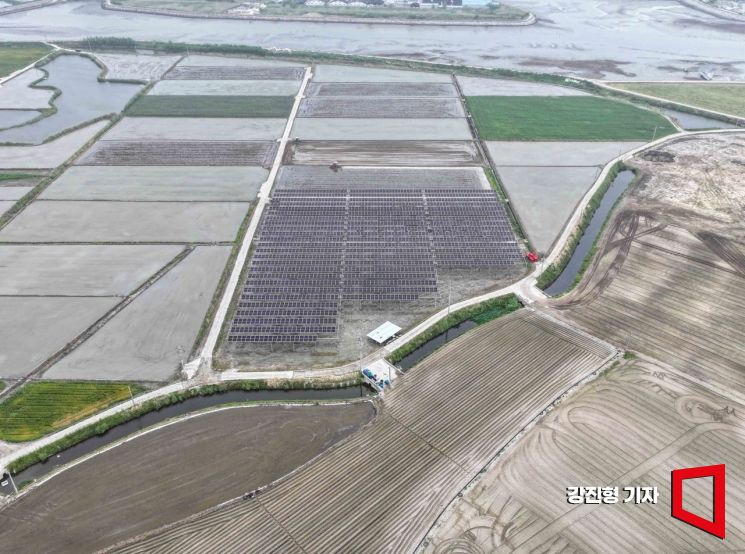 A solar power plant for agricultural use installed in farmlands of Wolpyeong-eup, Yeomsan-myeon, Yeonggwang-gun, Jeollanam-do. The photo is unrelated to the article content. Photo by Kang Jin-hyung
The pace of solar power adoption in South Korea is progressing more rapidly than in major advanced countries.
According to global solar adoption statistics provided by the UK-based think tank Ember on May 23, South Korea's installed solar capacity stood at 36.77 gigawatts (GW) as of April. This represents a sharp 13.7% increase from 32.32GW in April of last year. Compared to December 2017, when statistics were first compiled and capacity was 5.06GW, this marks a 626.6% surge.
The speed of solar adoption in South Korea is faster than in G7 countries (the United States, Japan, Germany, the United Kingdom, France, Italy, and Canada). South Korea's compound annual growth rate (CAGR) for solar, which indicates market growth, was 26.45%. This is higher than the United States (26.09%) and nearly double that of Italy (14.09%). There were also significant differences compared to Japan (11.45%), Germany (11.20%), France (10.94%), and the United Kingdom (6.54%).
The sharp increase in installed solar capacity began in earnest during the Moon Jae-in administration. In 2018, the average monthly increase in solar capacity was just 0.17GW, and there were many days when there was no increase at all. However, with the implementation of nuclear phase-out and eco-friendly energy policies, the monthly increase in installed capacity began to reach 0.28GW in 2019. In June of the same year, solar capacity surged by 0.88GW in just one month.
With the policy direction to expand the share of renewable energy included in the draft of the Basic Plan for Electricity Supply and Demand, South Korea's solar market is expected to continue expanding. The Yoon Suk-yeol administration raised the 2030 target for installed solar and wind capacity from 65.8GW to 72GW in the 10th Basic Plan for Electricity Supply and Demand. By the final year of the 10th plan in 2036, the target is to expand capacity to 99.8GW. In the 11th plan, finalized in February, the government announced a further increase in the target, aiming to expand solar and wind capacity to 115.5GW by 2038.
However, when considering all 25 countries for which statistics are available, South Korea's CAGR ranked 13th, placing it in the middle of the pack. Brazil ranked first with a CAGR of 115.7%, followed by Poland (78.9%). Argentina (77.0%) and the Netherlands (61.9%) also recorded high CAGRs. In terms of installed solar capacity, China led with 1,135.58GW. The United States followed with 237.04GW, about five times less than China. India (137.3GW), Germany (103.92GW), and Japan (91.79GW) followed in order.
Although South Korea's solar adoption is increasing rapidly, the absolute share of solar power generation remains low. Ember analyzed, "South Korea's largest source of electricity is nuclear power (30%)," and added, "The share of wind and solar generation (6%) is less than half the global average (15%)."
© The Asia Business Daily(www.asiae.co.kr). All rights reserved.

![Clutching a Stolen Dior Bag, Saying "I Hate Being Poor but Real"... The Grotesque Con of a "Human Knockoff" [Slate]](https://cwcontent.asiae.co.kr/asiaresize/183/2026021902243444107_1771435474.jpg)















