Announcement of Ten Major Constitutional Amendment Proposals
Including the Spirit of the May 18 Democratization Movement in the Preamble
Lee Junseok, the presidential candidate of the Reform New Party, proposed a set of ten constitutional amendments on May 23, 2025, with a focus on introducing a four-year presidential term with the possibility of one consecutive re-election and a runoff voting system.
In a policy briefing released that morning, Lee stated, "By introducing a four-year presidential term with the possibility of one consecutive re-election, we will establish a structure for voters to renew their mandate and realize both continuity in state affairs and responsible governance."
Lee pointed out, "Under the current system of a single five-year presidential term, once power is delegated by the people, there is no way to retract or control it during the term." He added, "As a result, presidents are not held accountable for policy failures, early lame-duck periods and a lack of policy consistency arise, and the privatization of power continues to recur." He emphasized that "by introducing a four-year presidential term with the possibility of one consecutive re-election, we will transform elections from a one-time grant of power into a structure of continuous evaluation and accountability in governance."
He also pledged to introduce a runoff voting system. Lee explained, "For presidential and metropolitan mayoral elections, we will introduce a runoff voting system so that if no candidate secures a majority in the first round, a runoff will be held between the top two candidates to ensure greater integration and representation." He stated that this would "improve the current structure in which candidates can be elected without majority support from voters and strengthen the legitimacy of the electoral process."
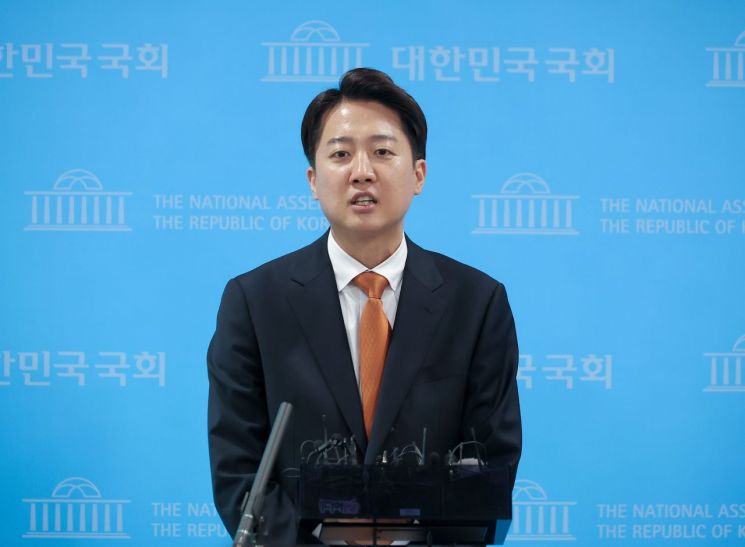 Candidate Lee Junseok Stands Before Reporters to Announce Position on Unification
(Seoul=Yonhap News) Photo by Ryu Youngseok - Lee Junseok, the presidential candidate of the Reform New Party, is responding to reporters' questions after holding a press conference at the National Assembly Communication Office in Yeouido, Seoul on May 22, 2025, regarding demands for unification with Kim Moonsoo, the presidential candidate of the People Power Party. ondol@yna.co.kr (End)
Lee also aims to enshrine the spirit of the 5·18 Democratization Movement in the preamble of the Constitution to ensure the legitimacy of democracy. He said, "Although the 5·18 Democratization Movement is a historic event that laid the foundation for democracy in Korea today, its absence from the constitutional preamble has created a historical and symbolic gap." He added, "It is necessary to explicitly state the historical roots and values of democracy in order to reinforce the legitimacy and educational function of the Constitution."
He further explained, "By specifying the 'spirit of 5·18' in the preamble, we will establish the legitimacy of democracy, national unity, and educational standards for future generations at the constitutional level, and we will consider including a phrase stating 'inheriting the spirit of the 3·1 Movement, the 4·19 Revolution, and the 5·18 Democratization Movement.'"
Other proposals include: ▲ securing the foundation for balanced national development by explicitly stating the capital's functions in the Constitution ▲ strengthening oversight of the executive branch by transferring the Board of Audit and Inspection under the authority of the National Assembly ▲ revising the election schedule through constitutional amendment ▲ introducing provisions to prevent abuse of parliamentary power and to safeguard judicial independence ▲ restricting presidential pardon powers to ensure limitations and accountability of authority ▲ introducing a flexible constitutional amendment procedure to enhance constitutional adaptability ▲ and ensuring global alignment by specifying future industries and regulatory standards in the Constitution.
Lee emphasized, "This constitutional amendment proposal will democratically redesign the structure of power and restore checks and balances among the legislative, executive, and judicial branches." He added, "It is centered on reorganizing the political system based on public participation and establishing a constitutional framework that aligns with technological and industrial transformation."
© The Asia Business Daily(www.asiae.co.kr). All rights reserved.
![User Who Sold Erroneously Deposited Bitcoins to Repay Debt and Fund Entertainment... What Did the Supreme Court Decide in 2021? [Legal Issue Check]](https://cwcontent.asiae.co.kr/asiaresize/183/2026020910431234020_1770601391.png)
















