System Demonstration and Q&A Session
A Platform for Open Communication
Busan Port Authority (BPA, President Song Sangkeun) held a briefing session on May 21 for all carriers engaged in transshipment operations at Busan Port, introducing the 'Transshipment Shuttle System (TSS)'.
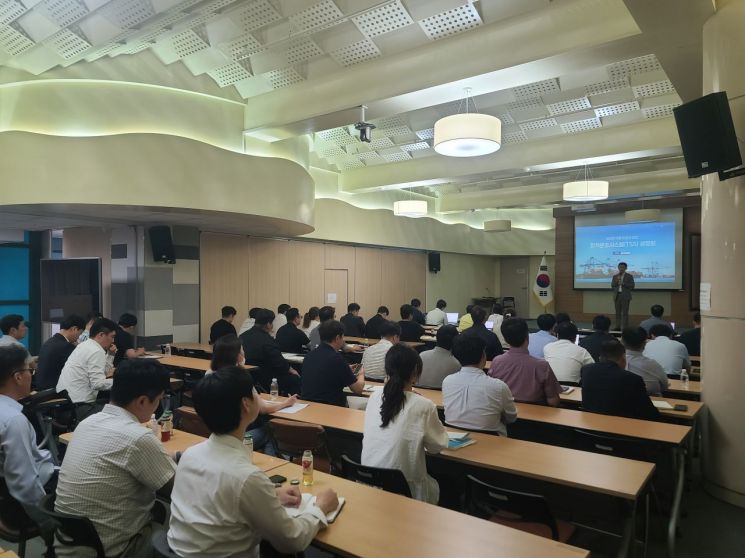 Briefing Session for Carriers on the Use of Transshipment Transport System. Provided by Busan Port Authority
This session was organized to share the background of the system's introduction, its practical benefits, and usage methods, as well as to strengthen communication with carriers.
Although Busan Port is the world's second-largest transshipment port, it is divided into multiple terminals, resulting in approximately 5 million TEUs of transshipment cargo being moved between different piers annually.
The additional logistics costs and operational inefficiencies arising from such inter-terminal transshipment have long been recognized as challenges that need to be addressed at Busan Port.
In response, BPA developed the TSS system to enhance the efficiency of transshipment between terminals by linking carriers' transport orders and terminal data in real time. Notably, the introduction of the 'group transport order' function, which automatically matches multiple trucks and cargoes and assigns them in the optimal sequence, has further increased the system's effectiveness.
Since the planning stage in 2020, BPA has continuously communicated with carriers for about five years, providing information on the system's features and benefits, listening to various carrier requirements, and refining the system accordingly.
After completing system development in 2022, BPA conducted two rounds of on-site pilot applications. These pilots confirmed that using TSS led to a reduction of truck waiting times within the port by about half, a threefold increase in the consolidation rate, and a significant decrease in re-handling within terminals, resulting in benefits for carriers, truck drivers, and terminals alike.
The consolidation rate refers to the percentage of cases in which both import and export operations are handled simultaneously at the same terminal (minimizing empty truck runs).
Since November 2023, TSS has been officially implemented throughout Busan Port, and its effectiveness has been demonstrated in actual operations. The usage rate of the system continues to increase.
BPA organized this session to enable more carriers to adopt the TSS system, whose effectiveness in improving transshipment cargo transport efficiency has been verified.
During the session, BPA not only introduced the main features and benefits of TSS but also provided a live demonstration, helping carriers better understand and utilize the system. In addition, ample time was allotted for Q&A with participating carriers to address user questions and to share the purpose of the system's introduction.
Taking into account the diverse circumstances of carriers, BPA has prepared three flexible options for utilizing TSS: (1) using the BPA-provided free system, (2) using a network operator's system, or (3) using an Open API when developing TSS functions within a carrier's own system. Carriers can choose any of these three options according to their needs.
Song Sangkeun, President of BPA, stated, "Securing transshipment competitiveness is more important than ever for Busan Port to maintain its position as the world's second-largest transshipment port. Digital transformation, including the TSS system, is expected to significantly enhance Busan Port's competitiveness. We will continue to provide practical support tailored to the field by maintaining close communication and cooperation with port stakeholders."
© The Asia Business Daily(www.asiae.co.kr). All rights reserved.
!["The Woman Who Threw Herself into the Water Clutching a Stolen Dior Bag"...A Grotesque Success Story That Shakes the Korean Psyche [Slate]](https://cwcontent.asiae.co.kr/asiaresize/183/2026021902243444107_1771435474.jpg)
















