Korea Post announced on May 22 that it will issue 560,000 commemorative stamps featuring four species of "Marine Protected Species" whose populations are rapidly declining.
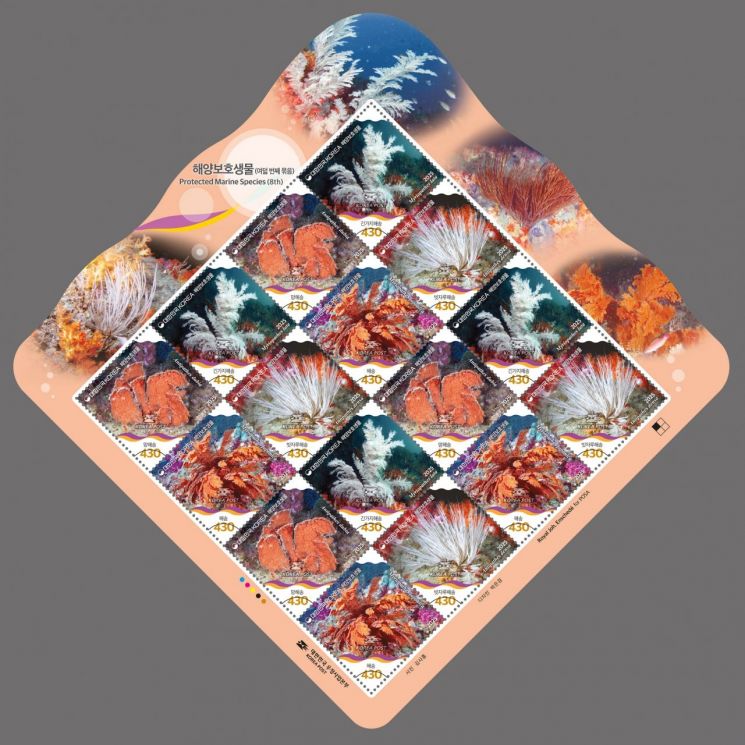 Korea Post will issue commemorative stamps featuring the shapes of four "Marine Protected Species" starting from the 30th of this month. Photo by Korea Post
The commemorative stamps, which will be released on the 30th, depict the shapes of four invertebrates: Gingaegihesong, Manghaesong, Bitjaruhaesong, and Haesong. These marine protected species are recognized internationally for their high academic and economic value, and are regarded as having significant conservation importance.
Among them, Gingaegihesong is a type of coral that was designated as a Natural Monument in March 2005. Primarily inhabiting the waters of Korea and Japan, Gingaegihesong has longer branchlets than Haesong, as its name suggests, and resembles a pine tree in appearance. In Korea, it is mainly found around the waters of Jeju, the southern coast, and some islands in the southern part of the West Sea.
Manghaesong is a coral species mainly distributed in the waters of Japan and the South Pacific. In Korea, it is a rare species found only around Munseom in Jeju, and its shape resembles a round fan. Its branches and branchlets spread out to form a net-like structure. The stem and branches are light brown, and the overall height is about 40 cm.
Bitjaruhaesong is widely distributed in Japan, eastern Australia, northern New Zealand, and the South Pacific. In Korea, it was previously found only in the waters around Munseom, Jeju, but recent surveys show it is now frequently discovered in various locations. The colony is broom-shaped, as its name implies, and the long, extended branches are soft and flexible.
Haesong inhabits regions such as Japan, Taiwan, and Australia. In Korea, it grows on rocky substrates at depths of 20 to 50 meters, ranging from the southern part of Jeju to the eastern part of the South Sea. Haesong was registered as a Natural Monument in March 2005, and in 2012, it was designated as a Class II Endangered Wildlife Species and has been protected since then.
The Ministry of Oceans and Fisheries has designated Gingaegihesong and the other three species as marine protected species, and manages them by prohibiting their capture or collection unless there are special circumstances.
The commemorative stamps can be purchased at central post offices or through the online post office.
© The Asia Business Daily(www.asiae.co.kr). All rights reserved.

















