36.5% of Households in Gwangju Are Single-Person... Up 7.7 Percentage Points in 8 Years
Donggu District Tops the Nation with 43.6% Single-Person Households
Clear Shift in Housing: Fewer Detached Houses, More Apartments
Steady Rise in Single-Person Households Among Women and Those Aged 60 and Older
Honam Regional Statistics Office Reports on Changes in Single-Person Households
As of 2023, single-person households accounted for more than one-third of all households in the Honam and Jeju regions, including Gwangju, Jeonnam, Jeonbuk, and Jeju. In particular, Donggu District in Gwangju recorded the highest proportion of single-person households among all districts nationwide, with 43.6% of all households being single-person households.
According to the "Trends in Single-Person Households in the Honam and Jeju Regions" released by the Honam Regional Statistics Office on May 22, 2025, the proportion of single-person households in Gwangju in 2023 was 36.5% of all households, up 7.7 percentage points from 2015. Jeonbuk recorded 37.7% (up 7.9 percentage points), Jeonnam 37.1% (up 6.7 percentage points), and Jeju 33.7% (up 7.2 percentage points), all showing an upward trend.
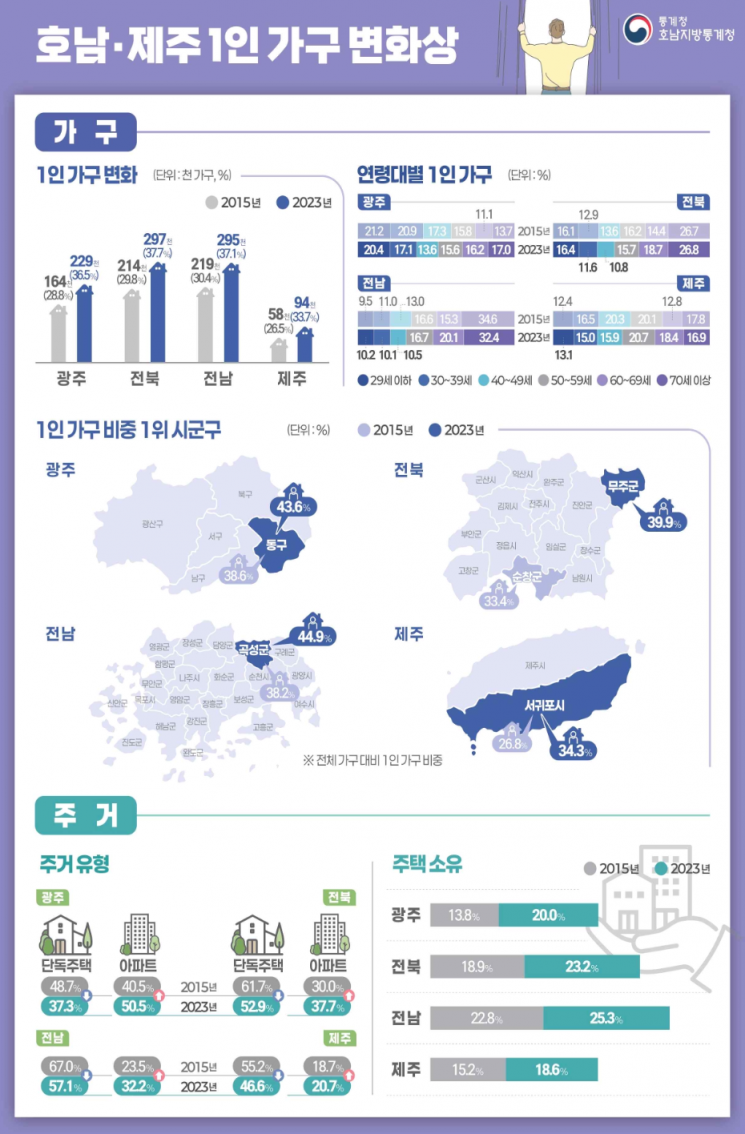 Infographic showing the trend of single-person households in Honam and Jeju regions. As of 2023, Donggu District in Gwangju had the highest proportion of single-person households nationwide at 43.6%. Provided by Honam Regional Statistics Office
By 2052, the proportion of single-person households in all these regions is projected to exceed 40%. Jeonbuk is expected to reach 43.5%, Jeonnam 42.8%, Gwangju 42.5%, and Jeju 39.3%, meaning that "four out of every ten households will be single-person households."
In Gwangju, women have led the increase in single-person households. As of 2023, women accounted for 50.3% of single-person households in Gwangju, an increase of 1.2 percentage points compared to 2015. In contrast, in Jeonbuk, Jeonnam, and Jeju, the number of male single-person households has increased more rapidly.
By age group, those under 29 accounted for the highest proportion of single-person households in Gwangju; in Jeonbuk and Jeonnam, it was those aged 70 and older; and in Jeju, those aged 50 to 59. Projections indicate a sharp increase in elderly single-person households aged 70 and older. In Gwangju, it is expected that 37.6% of single-person households in 2052 will be in this age group.
Housing types are also changing. In Gwangju, the proportion of single-person households living in apartments was 50.5% in 2023, an increase of 10 percentage points from 2015. In contrast, the proportion living in detached houses decreased by 11.4 percentage points over the same period, reaching only 37.3%. This indicates a higher dependency on apartments compared to the national average.
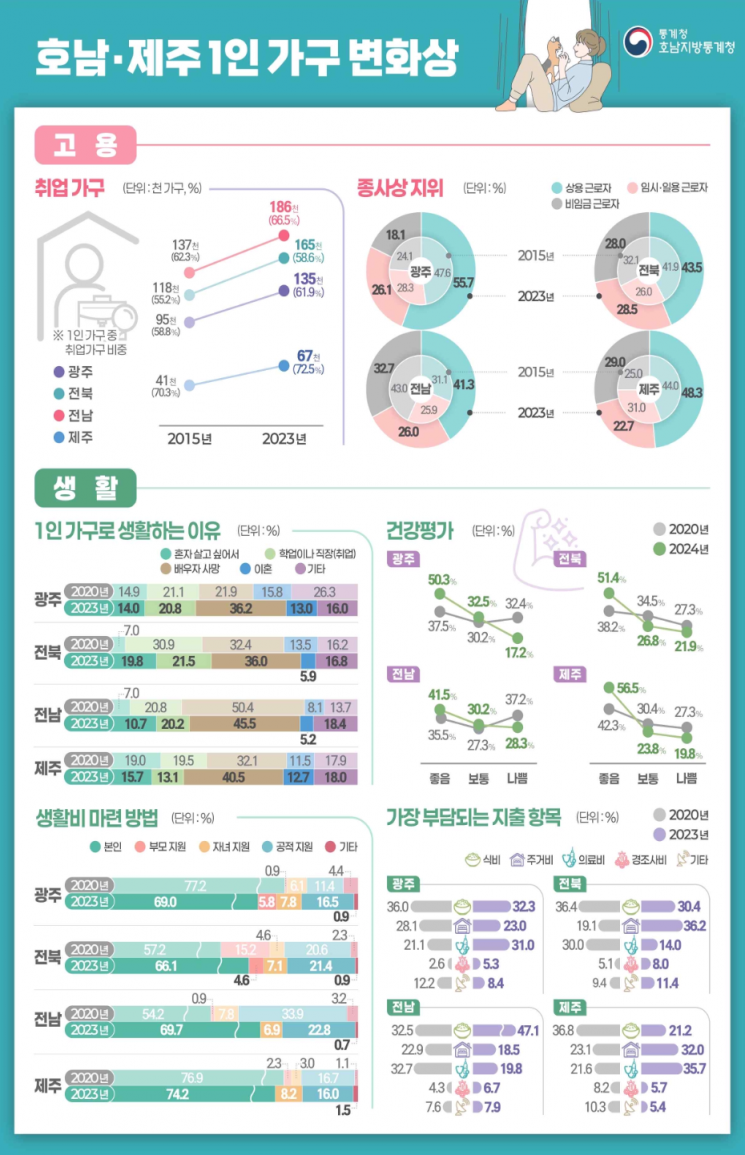 An infographic summarizing employment, health, and living expense burdens of single-person households in the Honam and Jeju regions. In Gwangju, the proportions of women and elderly among single-person households, as well as the apartment residence rate, have all increased. Provided by Honam Regional Statistics Office
In terms of home ownership, the proportion of single-person households in Gwangju owning their own homes was 20.0%, an increase of 6.2 percentage points from 2015. During the same period, the apartment ownership rate also rose by 6.6 percentage points to 18.8%.
The number of employed single-person households has also increased. In 2023, 61.9% of single-person households in Gwangju were employed, up 3.1 percentage points from 2015. However, this employment rate is still lower than that of Jeju (72.5%) and Jeonnam (66.5%).
The main reason cited for living alone among single-person households was "spouse’s death." In Gwangju, 36.2% of single-person households gave this reason, an increase of 14.3 percentage points compared to 2020. In contrast, in Jeonbuk and Jeonnam, the reason "wanting to live alone" increased by 12.8 percentage points and 3.7 percentage points, respectively.
Perceptions of health have improved. The proportion of single-person households in Gwangju who rated their own health as "good" increased by 12.8 percentage points compared to 2020.
Most single-person households rely on "personal income" to cover living expenses, but in Gwangju, dependency on public support (such as basic living allowances) increased by 5.1 percentage points. The most burdensome expense item for single-person households was "food expenses" in Gwangju and Jeonnam, "housing expenses" in Jeonbuk, and "medical expenses" in Jeju.
The structural increase in single-person households has become an inevitable reality. An official from the Statistics Korea stated, "Due to changes in the population structure, such as aging and the spread of non-marriage, the proportion of single-person households is expected to continue to rise, and we hope this will serve as a useful reference for related policy development."
© The Asia Business Daily(www.asiae.co.kr). All rights reserved.

![A Woman with 50 Million Won Debt Clutches a Stolen Dior Bag and Jumps... A Monster Is Born [Slate]](https://cwcontent.asiae.co.kr/asiaresize/183/2026021902243444107_1771435474.jpg)
















