Sales of Small Businesses Decline Due to Prolonged Contraction in Consumer Spending
Profit Margins Remain Steady as Owners Focus on Cost Reduction
Food Service Sector Experiences Largest Drop in Sales
First Quantitative Analysis of Carbon Emissions in Food Service Industry Included in Report
Due to prolonged contraction in consumer spending, small business owners saw their sales decline in the first quarter of 2025 compared to both the previous quarter and the same period last year. However, their profit margins remained steady. This suggests that small business owners are continuing their operations by reducing costs in response to falling sales.
On May 22, Korea Credit Data (KCD) announced the release of the "Korea Credit Data Small Business Trend Report (Q1 2025)," which analyzes the management data of small businesses nationwide for the previous quarter. The report is based on data from 160,000 business locations out of the 1.8 million nationwide that use KCD's business management service, Cashnote.
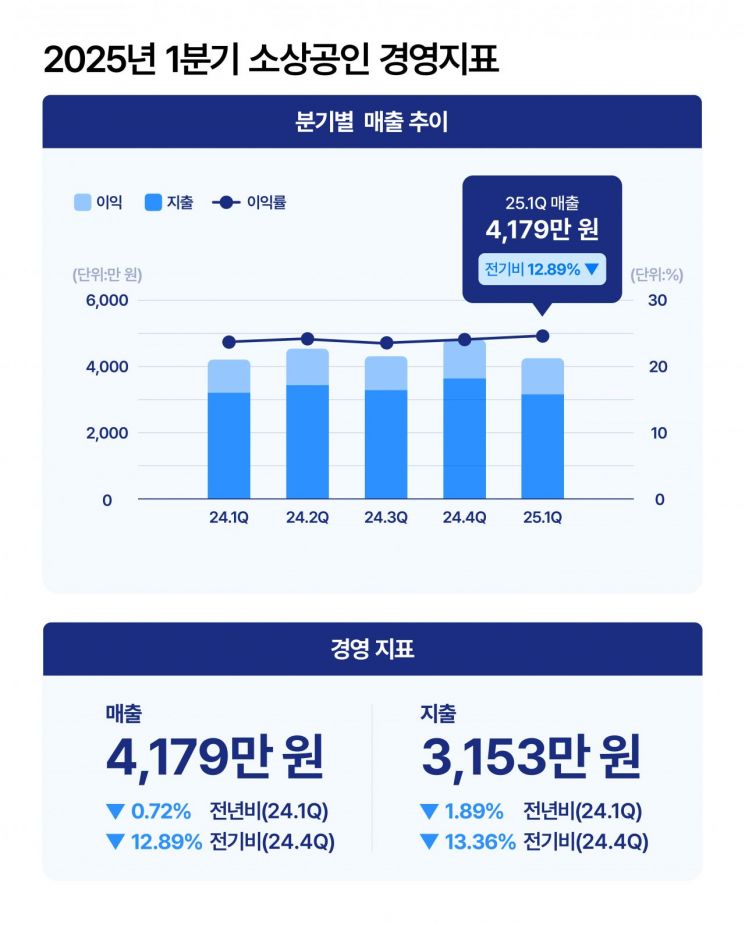
According to the report, the average sales of small businesses nationwide in the first quarter was 41.79 million KRW. This represents a decrease of 12.9% compared to the previous quarter and a 0.7% decrease compared to the same period last year. Multiple factors contributed to the decline in small business sales. These include seasonal factors following the end of the year-end peak season, contraction in consumer spending due to high inflation, and delayed recovery in domestic demand. By industry, the decline in sales was most pronounced in the food service sector. Across all food service categories, sales fell by up to 13.6% quarter-on-quarter and up to 11.1% year-on-year. Among food service businesses, the largest year-on-year sales declines were seen in bars, snack bars, bakeries and dessert shops, and fast food outlets, in that order. In addition, the accommodation and travel service sector saw an 11.8% year-on-year decrease, while arts, sports, and leisure-related service businesses declined by 6.8% compared to the previous year.
As sales continue to decline, small business owners are cutting their expenses. The average expenditure per store for small business owners was 31.53 million KRW, down 13.4% from the previous quarter and 1.9% from the previous year. Average profit was 10.26 million KRW, up 3.1% year-on-year but down 11.4% quarter-on-quarter. The profit margin was 24.6%, which is an increase of 0.9 percentage points year-on-year and 0.4 percentage points quarter-on-quarter. Ultimately, this indicates that businesses are continuing to operate by reducing their operating costs.
Kang Yewon, Chief Data Officer at Korea Credit Data, said, "With low expectations for an expansion in demand, small business owners have no choice but to adopt store management strategies focused on profitability," adding, "Unless the economy improves, small business owners will face a crossroads between closing their businesses and cutting costs."
This report also, for the first time, includes a quantitative analysis of carbon emissions from food service businesses, based on data provided by KCD. KCD and the Seoul National University Climate Tech Center analyzed the trend of average carbon emissions per food service business from the first quarter of 2022 to the second quarter of 2024. The analysis found that, within Seoul, the districts with the highest average carbon emissions per business were Yeongdeungpo-gu, Gangnam-gu, and Seongbuk-gu, in that order. The district with the lowest emissions was Dobong-gu.
In addition, when examining carbon emissions by detailed food service sector and carbon emissions relative to purchase amounts, Chinese restaurants had the highest average carbon emissions per business, while buffets had the highest carbon emissions relative to purchase amounts. By emission type, the highest carbon emissions came from food ingredients, followed by electricity and fuel, while the lowest emissions were from waste. Kang added, "This quarter's data is significant in that it highlights not only the business trends of small businesses but also the environmental impact of the food service sector from a climate response perspective," and continued, "We will continue to contribute to the development of better policies and strategies through data."
© The Asia Business Daily(www.asiae.co.kr). All rights reserved.

















