"Charged Domain Walls in Hafnium Oxide More Stable Than Bulk Regions"
UNIST Professor Junhee Lee's Team Publishes in Physical Review Letters on April 22
An analysis has emerged suggesting that domain walls, previously considered unstable structures in ferroelectrics, may actually represent the most stable state.
This opens the door to the development of high-density semiconductor memory devices that store information as 0s and 1s depending on the presence or absence of domain walls.
The research team led by Professor Junhee Lee at the Graduate School of Semiconductor Materials and Components, UNIST, announced on May 22 that they have demonstrated through quantum mechanics-based calculations that "charged domain walls" in ferroelectrics can exist more stably than the bulk regions, which are considered to have the lowest energy states.
 Professor Junhee Lee, UNIST. Provided by UNIST
Ferroelectrics are next-generation semiconductor materials in which the polarization direction inside the material can be changed by applying an external electric field. Within these materials, domain walls?boundaries where different polarization directions meet?are formed. It has been known that a high amount of energy is required for their formation, and even when they do form, they are unstable and tend to disappear easily.
Professor Lee's team theoretically confirmed that charged domain walls formed along certain crystal directions in hafnium oxide (HfO₂) ferroelectrics can actually have a lower total energy state than the bulk region.
This phenomenon, which contradicts conventional knowledge in solid-state physics, is due to a unique physical property known as "negative gradient energy." Typically, the gradient energy at a domain wall?where the polarization direction changes abruptly?has a positive value, which hinders wall formation. However, in the case of hafnium oxide, under certain vibrational modes, this energy becomes negative, creating conditions that make domain wall formation easier.
In this way, the negative gradient energy partially offsets the electrostatic energy generated by charging, and the remaining energy can be compensated through doping. As a result, a domain wall that is more stable than the bulk region can form overall.
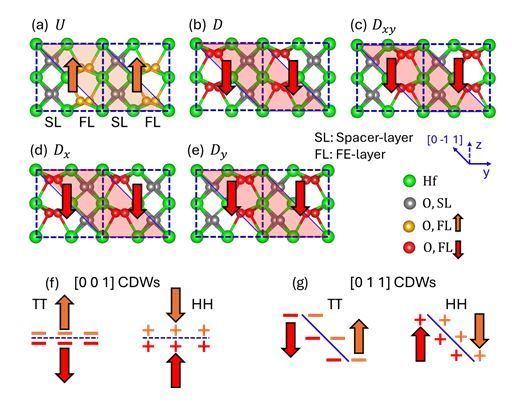 Schematic diagram of the structure and charge distribution of the "charged domain wall" within oxidized hafnium ferroelectric.
Professor Junhee Lee said, "This research theoretically identifies the conditions under which charged domain walls in ferroelectrics can be energetically stabilized," adding, "It will serve as a clue for developing high-density memory devices that store information as 0s and 1s, depending on the presence or absence of domain walls."
This study was conducted with Researcher Pawan Kumar as the first author and Researcher Dipti Gupta as a co-author, both at UNIST.
 Researcher Deepti Gupta at UNIST. Photo by UNIST
The research results were published on April 22 in Physical Review Letters, the most prestigious journal in the field of physics.
This research was supported by the National Research Foundation of Korea under the Ministry of Science and ICT, and the Korea Institute for Advancement of Technology under the Ministry of Trade, Industry and Energy.
© The Asia Business Daily(www.asiae.co.kr). All rights reserved.
!["The Woman Who Threw Herself into the Water Clutching a Stolen Dior Bag"...A Grotesque Success Story That Shakes the Korean Psyche [Slate]](https://cwcontent.asiae.co.kr/asiaresize/183/2026021902243444107_1771435474.jpg)
















