Single Entity Responsible for Both Development and Operation
Streamlined Approval Process for Faster Project Execution
Concerns Over Corporate Rentals Driving Up Monthly Rents
"Not Attractive for Operators Focused Solely on Sales"
Going forward, public land in station areas of the third-generation new towns will be preferentially supplied to "project REITs." The government has set a condition: "We will provide good land, but you must take full responsibility for operation until the end." This means that only operators who commit not just to development but also to long-term management will receive these benefits, instead of those pursuing short-term sales and exiting after development. The pilot project will begin in second-generation new towns that already have transportation infrastructure.
On May 21, the Ministry of Land, Infrastructure and Transport held a "REITs and PF Policy Briefing for the Advancement of the Real Estate Industry" at the Korea Financial Investment Association in Yeongdeungpo-gu, Seoul, and announced these plans for project REITs, which are set to be implemented in the second half of this year. The event was organized after related real estate legislation passed the National Assembly’s plenary session on May 1. More than 600 people crowded into a venue with 250 seats, prompting the briefing to be held twice. The hallways were filled with attendees standing due to a lack of available seats.
An official from the Ministry of Land, Infrastructure and Transport said, "As the real estate development market has been stagnant for a long period, uncertainty has increased across the industry," and added, "With growing demand for stable asset management, interest in project REITs has risen accordingly."
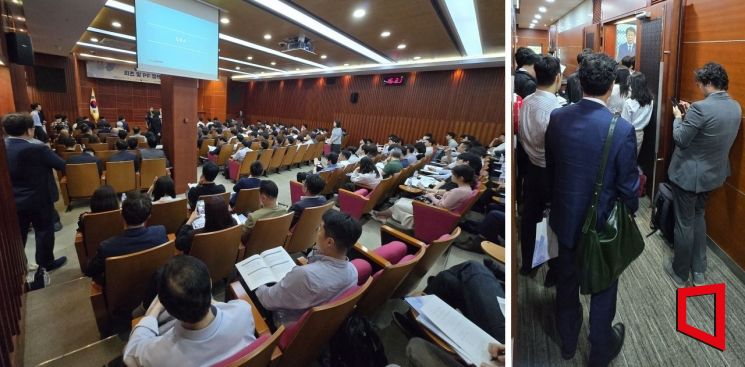 Industry officials from REITs, housing, construction, and real estate development sectors attending the 'REITs and PF Policy Briefing for the Advancement of the Real Estate Industry' held by the Ministry of Land, Infrastructure and Transport on the 21st at the Korea Financial Investment Association in Yeongdeungpo-gu, Seoul. The venue was crowded, with attendees standing in the hallways to listen to the explanations. Photo by Choi Seoyoon
Simplified Procedures for 'Project REITs'... Fostering Comprehensive Developers by Boosting Market Trust
REITs (Real Estate Investment Trusts) are joint-stock companies that pool funds from multiple investors to purchase real estate properties such as buildings, then distribute rental income or capital gains to shareholders. General investors can also participate easily. Project REITs are based on this model but can be established simply by filing a report, without needing business approval, and the disclosure (17 cases) and reporting (22 cases) requirements during development are each reduced to just one, easing the burden. This allows development projects to proceed more quickly. Another difference from general REITs is that project REITs can participate from the development stage.
The Ministry of Land, Infrastructure and Transport explained that the idea for project REITs came from meetings with asset management companies. An official said, "Under the current system, it is difficult for REITs to participate directly in development, so they must first develop through a Project Financing Vehicle (PFV), then after completion, have the REIT acquire the property after revaluation. There have been many complaints from the field that this is cumbersome and inefficient."
The key point is to encourage developers or asset management companies not just to sell units and exit, but to take direct responsibility for operations. The goal is to have a single company handle everything from development to operation, thereby boosting market trust and fostering comprehensive developers centered on their own capital. An official from the ministry said, "The biggest problem with Korea’s real estate project financing (PF) is that projects are launched with low equity and rely excessively on loans backed by guarantees," and continued, "In advanced countries, it is rare for developers to bring 30-40% of their own capital; limited partners (LPs) usually play that role. However, in Korea, the business structure is unstable, so LPs are reluctant to invest easily." The official added, "We are also reviewing additional measures such as improving the guarantee system."
Various incentives will be provided to operators who take responsibility for long-term management. Some prime land in public housing sites, including third-generation new towns, will be preferentially supplied through a public offering (private contract) method. In addition, the government is discussing with tax authorities a plan to defer corporate or capital gains taxes to the point when profits are realized if landowners contribute idle urban land as in-kind investment. If developers directly operate the real estate after completion, the government plans to revise the PF Management Act next year to provide special provisions such as increased floor area ratio and reduced public contribution requirements. A ministry official said, "Developers will be encouraged to consider stable rental income or asset value appreciation from the design stage," and added, "Ultimately, this can promote developments that enhance urban competitiveness, such as landmark buildings or high-quality office spaces."
Previously, the focus on sales profits led to repeated side effects such as oversupply of retail space, poor management, and shifting risks onto general buyers. Especially in prime station areas, land was subdivided and sold off, making it difficult to attract companies and resulting in many vacancies. A ministry official said, "If responsible management development projects become established, the PF model, which carries high interest burdens, will gradually shift to a more stable, equity investment-centered model." Japan’s largest real estate company, Mitsui Fudosan, maintains a stable profit structure by dividing its business into 30% leasing, 30% sales, and 30% management and other activities.
 Seungbeom Kim, Director of the Real Estate Investment System Division at the Ministry of Land, Infrastructure and Transport (far right), is answering questions during the Q&A session at the "REITs and PF Policy Briefing for the Advancement of the Real Estate Industry" held on the 21st at the Korea Financial Investment Association in Yeongdeungpo-gu, Seoul. Photo by Seoyoon Choi
Concerns Over 'REITs Raising Rents'... "Significant Restrictions for Short-Term Sales-Focused Operators"
Some have raised concerns that the spread of corporate long-term rentals could stimulate rent increases. If well-capitalized companies enter the housing rental market, they may be able to withstand vacancies without lowering rents, which could push up overall market prices. Project REITs are not penalized even if they are dissolved after completing the building but before obtaining business approval.
In response, the Ministry of Land, Infrastructure and Transport explained, "Although residential land can be developed through project REITs, operators must take responsibility for management, so there is little incentive for those pursuing simple sales to choose this model," and added, "For short-term sales-oriented operators, this approach actually imposes more restrictions." REITs must obtain business approval 18 months after completion and must go public within five years. There are also significant entry barriers, such as equity capital regulations and disclosure obligations. Project REITs can borrow up to twice their equity, and up to ten times with a special resolution. Even in that case, they must maintain at least 9% equity capital.
However, the government is considering supplying residential land together with commercial or office sites in cases where the business viability of commercial or office projects needs to be supplemented. For example, since housing can generate sales revenue quickly, this can be used to cover the initial costs of non-residential facilities established through REITs. A ministry official said, "We are considering a cross-subsidy structure that packages residential and non-residential land together to balance profitability."
To eliminate blind spots in development projects, the government will establish an integrated management system to provide an overview of PF projects. Legislation covering these measures, the Act on the Management of Real Estate Development Projects, was also passed at the National Assembly’s plenary session earlier this month. Project operators must report the project status to the ministry within 60 days of the earliest milestone among signing the project agreement, land acquisition, PFV or REIT establishment, or permit application. Reporting items include project overview, permit progress, construction and sales rates, and all key financial information related to PF such as financial agreements, interest rates, balances, and delinquency status. Based on this information, the government will build a PF integrated management system. This system will be fully implemented from June 2027. Until then, the ministry plans to actively gather industry feedback during the process of preparing subordinate regulations.
© The Asia Business Daily(www.asiae.co.kr). All rights reserved.












