A Surprise Robot Show Welcomes Visitors at the Entrance
Experience OLED Advantages Firsthand Through Weight and Temperature Comparisons
Expanding Supply of 27-Inch UHD Monitors Long Awaited by Gamers
Samsung Display's Quantum Dot Organic Light Emitting Diode (QD-OLED) panels for gaming monitors, which have landed in Taiwan, are receiving an enthusiastic response locally. Samsung Display has focused on highlighting the distinctions between its OLED panels and conventional Liquid Crystal Display (LCD) panels, emphasizing the unique advantages of OLED technology.
From May 20 to 23, Samsung Display set up its first private booth at 'Computex 2025,' the largest IT exhibition in Asia, held at the Nangang Exhibition Center in Taipei, Taiwan. Upon entering the booth, visitors are greeted by a mobile dual-arm robot from Rainbow Robotics performing a simple show. The robot shakes both OLED and LCD panels in its hands before placing each panel into a large cylindrical container and blowing air to launch the ultra-light 18g OLED panel into the air. This performance is themed as a 'lottery drawing,' tailored to local Taiwanese culture.
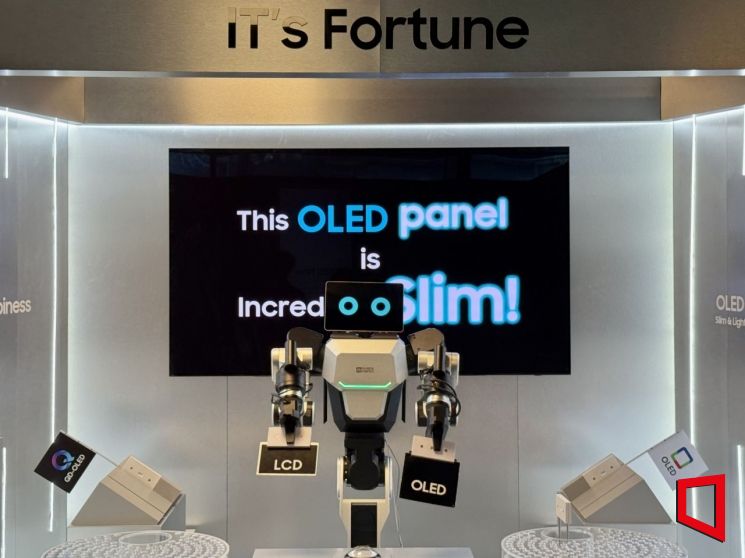 When entering the booth set up by Samsung Display at Computex 2025 exhibition hall, a mobile biped robot from Rainbow Robotics performs a show holding OLED and LCD panels to demonstrate how lightweight the OLED panel is. Photo by Heejoon Jang
Since the beginning of this year, Samsung Display has been supplying 27-inch UHD QD-OLED panels to its clients. According to market research firm Omdia, shipments of this product reached approximately 150,000 units in the first quarter. This accounts for 27% of all monitor OLED shipments during the same period. Leading monitor manufacturers, including Samsung Electronics, ASUS, MSI, and Dell, have already released products equipped with this panel.
A Samsung Display representative explained, "As UHD resolution has been applied to the 27-inch size that many gamers have been waiting for, customer demand is now concentrated on this segment." This explanation is visually demonstrated in the 'gaming room' set up in one corner of the booth. The exhibition allows visitors to compare the differences in actual gameplay, such as the much clearer picture quality and the absence of afterimages that OLED panels provide compared to LCDs.
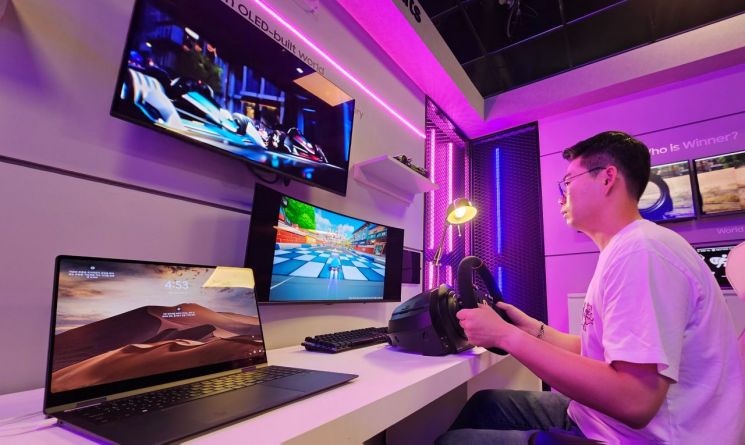 Samsung Display booth gaming room at 'Computex 2025' offering differentiated gaming experience opportunities with various sizes of QD-OLED and OLED for laptops. Samsung Display
In addition, Samsung Display is introducing 'Ultra Thin (UT) One,' a next-generation low-power technology that enables the IT OLED panel industry's first '1 Hertz (Hz) variable refresh rate.' The ultra-thin structure of 'UT' OLED uses a glass substrate (bottom) and an upper thin film of organic and inorganic materials, unlike conventional products that use two glass substrates. As a result, it is 30% thinner and 30% lighter than existing products. Power consumption is also reduced by 30% compared to previous models.
A Samsung Display representative stated, "The 27-inch size is the most widely used standard in the monitor market. The launch of UHD high-resolution products at reasonable prices in this standard size has resulted in explosive demand, and the company is expanding supply to meet this demand."
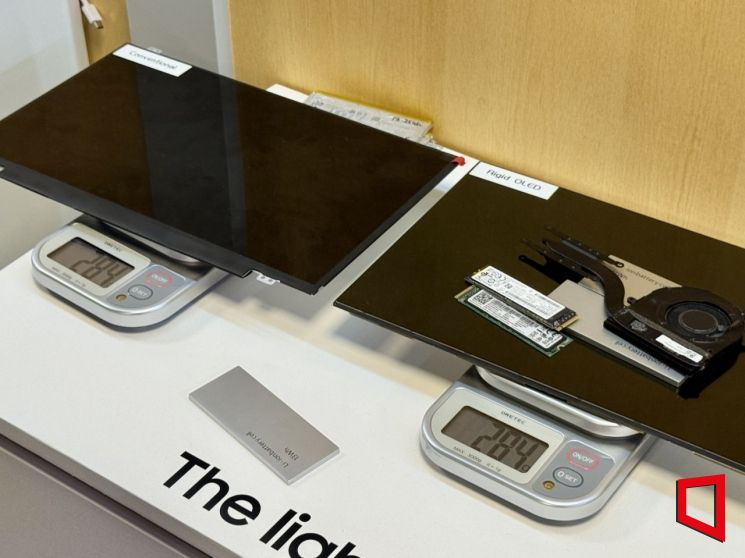 A scale prepared by Samsung Display to demonstrate to clients that adopting lightweight OLED panels allows for the inclusion of additional components such as batteries. Photo by Jang Heejun
Furthermore, a scale was prepared to demonstrate that adopting lightweight OLED panels allows for the design of thinner products or the addition of extra components such as batteries, thanks to the reduced weight. The exhibition also confirms that OLED panels offer vivid color reproduction while generating less heat.
Lee Jonghyuk, head of Samsung Display's Large Display Division and IT Business Team (Executive Vice President), said, "The IT market is currently transitioning rapidly from LCD to OLED, and this change can be felt firsthand at Computex. We will proactively respond to customers' technical requirements with a variety of IT solutions and lead market transformation."
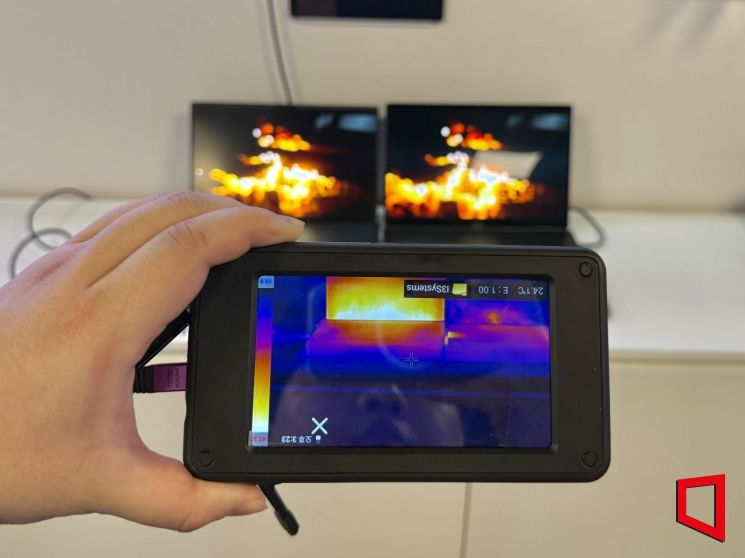 The OLED panel on the right can be seen to generate significantly less heat compared to the existing LCD panel. Photo by Jang Heejun
© The Asia Business Daily(www.asiae.co.kr). All rights reserved.













