POSCO Future M Ranked 6th in 2020
Falls Out of Top 10 in Five Years
Due to Price Competition with Chinese Graphite
Last year, as China dominated the global anode materials market, POSCO Future M, the only Korean company to have ranked among the top players, fell out of the top 10. Both Korean and Japanese companies are struggling as they lose out in price competition against low-cost Chinese graphite.
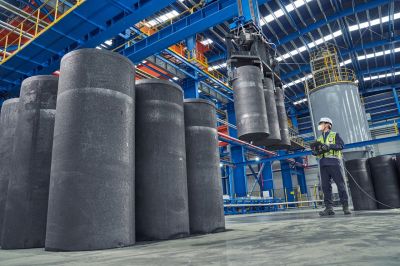
According to SNE Research on May 21, total shipments of lithium-ion battery anode materials last year reached 2,111,000 tons. Artificial graphite accounted for 1,756,000 tons (83.2%), natural graphite for 294,000 tons (13.9%), and silicon-based anode materials for 41,000 tons (1.9%).
POSCO Future M, which had previously ranked among the top 10 global anode material suppliers, dropped to 11th place last year. The company had ranked 6th in 2020, 8th in 2021, and 10th in both 2022 and 2023.
Last year, all of the top 10 anode material suppliers by shipment volume were Chinese companies. BTR ranked first with more than 432,000 tons shipped, followed by Shanshan with 340,000 tons in second place, Shinzoom with 213,000 tons in third, and Shangtai with 208,000 tons in fourth.
POSCO Future M has been supplying natural graphite to Korea's three major battery manufacturers?LG Energy Solution, Samsung SDI, and SK On?and is also expanding its production capacity in the artificial graphite business. However, the company was impacted by the U.S. government's suspension of Chinese graphite anode material supplies, and it also struggled to compete on price against Chinese graphite products.
As part of its market response, POSCO Future M plans to reduce manufacturing costs by 30% by 2027 and is also counting on government support policies such as the designation of economic security items and related subsidies.
Japanese anode material companies are facing similar challenges to their Korean counterparts. Resonac has halted production of graphite electrodes for steelmakers in China and Malaysia and has downsized its production lines. The company has also been reluctant to expand its business in the lithium-ion battery anode material sector.
An SNE Research representative stated, "This year, Chinese artificial graphite is expected to remain dominant, and Chinese anode material suppliers are likely to maintain or even strengthen their market position. Silicon-based anode materials are expected to increase, targeting high-efficiency batteries for electric vehicles, next-generation batteries, and some small device markets. There will also be some demand for hard carbon for sodium-ion batteries (NIB) and high-power lithium titanate (LTO) battery products."
© The Asia Business Daily(www.asiae.co.kr). All rights reserved.












