UK and EU Consider Suspending Economic Cooperation with Israel
Citing Worsening Humanitarian Crisis in Gaza Strip
As Israel expands its military operations in the Palestinian Gaza Strip, the United Kingdom and the European Union (EU), which had previously maintained a cautious stance, are now issuing strong criticism and considering suspending economic cooperation.
On May 20 (local time), the United Kingdom announced that it would suspend free trade agreement (FTA) negotiations with Israel, citing the worsening humanitarian situation in the Gaza Strip as a result of Israel's expanded military operations.
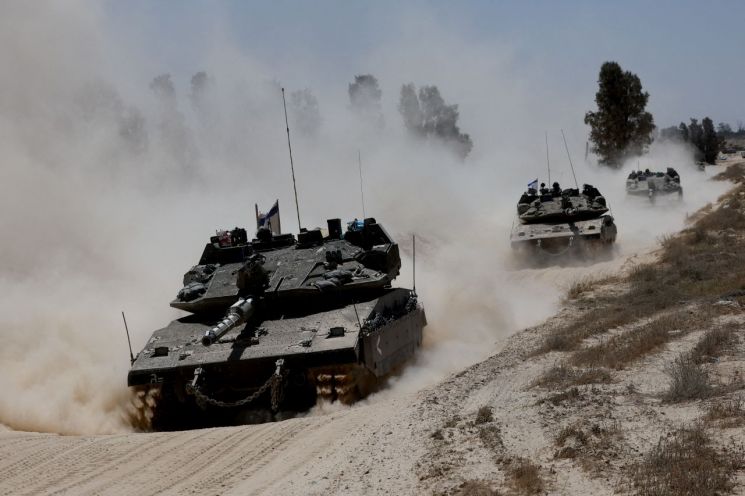 Military vehicles are heading from the Israeli side of the Israel-Gaza border toward the Gaza Strip. Photo by Reuters and Yonhap News.
David Lammy, the UK Foreign Secretary, told the House of Commons that day, "We cannot stand by and watch such deterioration. It is incompatible with the principles that underpin our bilateral relationship," thereby announcing the suspension of FTA negotiations.
The UK summoned the Israeli ambassador to London to lodge a protest and also announced additional sanctions against settlers in the West Bank. Last year, the UK had also sanctioned Israeli settlers who incited violence in the West Bank.
Israel had blockaded the Gaza Strip for nearly three months and has only begun to allow limited entry of humanitarian aid this week. However, there are still concerns that aid is not being properly delivered to Gaza residents. According to the Integrated Food Security Phase Classification (IPC) supported by the United Nations, 93% of children in the Gaza Strip are at risk of famine.
EU member states have also begun to reconsider economic cooperation with Israel. Kaja Kallas, the EU High Representative for Foreign Affairs and Security Policy, said at a press conference in Brussels, Belgium, after a meeting of foreign ministers, that member states had agreed to review the EU-Israel agreement in light of the human rights situation in the Gaza Strip.
High Representative Kallas said that Israel's decision to allow some supplies was insufficient and emphasized, "Pressure is needed to change the situation." She added that a majority of the 27 member states supported the review. According to Reuters, EU sources said that 17 out of 27 countries expressed support for the review during the meeting.
The Israel-EU Association Agreement, which was signed in 2000, serves as the legal foundation for bilateral relations and functions similarly to a free trade agreement (FTA) by establishing a mutual free trade area. Since the EU accounted for the largest share of Israel's total trade in 2022, nullifying the agreement could impact the Israeli economy. The United Kingdom is Israel's eighth-largest export market.
Recently, the Netherlands requested a review of the agreement on humanitarian grounds. Previously, in the past year, Ireland, a pro-Palestinian member state, had requested a review based on Article 2 of the agreement, but there were disagreements among member states at that time.
Jose Manuel Albares, Spain's Foreign Minister, argued that the EU should use diplomatic measures to pressure Israel and even consider sanctions to force Prime Minister Benjamin Netanyahu to halt the attacks.
The previous day, foreign ministers from 22 countries issued a joint statement urging Israel to fully resume the entry of humanitarian aid into the Gaza Strip. The statement was joined by Germany, the United Kingdom, France, Australia, Japan, New Zealand, and three EU commissioners, including High Representative Kallas.
Meanwhile, Israel maintains that it will not change its policy despite external pressure. The Israeli Ministry of Foreign Affairs stated, "External pressure will not divert Israel from the path of fighting enemies that threaten its existence and security." An Israeli official, speaking on condition of anonymity, told Bloomberg that Israel has the support of 10 key allies among major EU countries.
© The Asia Business Daily(www.asiae.co.kr). All rights reserved.












