After Visiting 15 Major Station Restrooms
Complaints About Illegal Flyers Double in Two Years
"Even if I scrape off the illegal flyer stickers, they reappear just a few days later. It's a real headache."
This is what a sanitation worker in his 60s, surnamed Lee, sighed as he spoke at Mia Station on Line 4 in Gangbuk-gu, Seoul, on May 20. Inside the restroom stalls at this station, illegal flyer stickers with phrases implying prostitution, such as "Dongseong Kangkang" and "24-hour outcall," were posted. In some places, the strong adhesive of the illegal stickers left visible marks even after removal. Lee said, "Since I can't remove them completely, I at least try to scrape them off as much as possible so that the phone numbers can't be recognized."
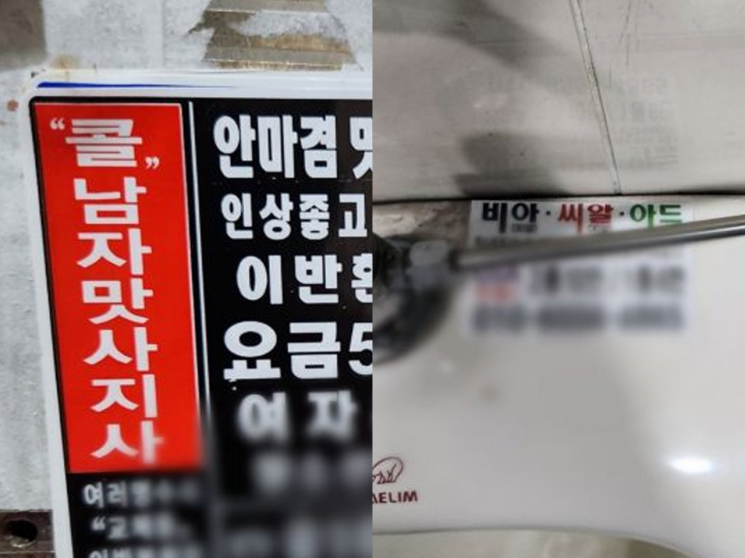 As reporters toured the restrooms of major stations on Seoul Subway Lines 1, 4, 5, and 8, they easily found illegal flyers. Photo by Byun Seonjin
Restrooms throughout the Seoul subway are plagued by illegal flyers.
On this day, reporters randomly visited 15 major restroom facilities at stations on Lines 1, 4, 5, and 8. Illegal flyers related to prostitution brokerage (9 cases) and illegal drug sales (7 cases) were found in the restrooms of 14 out of 15 stations. The only station where no flyers were found was Munjeong Station on Line 8.
When the number on one of the flyers for a same-sex massage business was called, a man with an elderly voice answered. He explained in detail, saying, "The customer can choose the location." The possibility of prostitution brokerage was clear. When contacting a business selling illegal drugs, the response was, "Viagra (a medication for erectile dysfunction) is 60,000 won per bottle and is only available through direct transaction." When asked if he could prove the authenticity of the drugs, he became angry and abruptly hung up. It is widely known that the vast majority of illegal drugs sold by these businesses are counterfeit, manufactured in unauthorized facilities. Taking them can pose serious health risks, such as stroke or heart attack, due to non-standard ingredients.
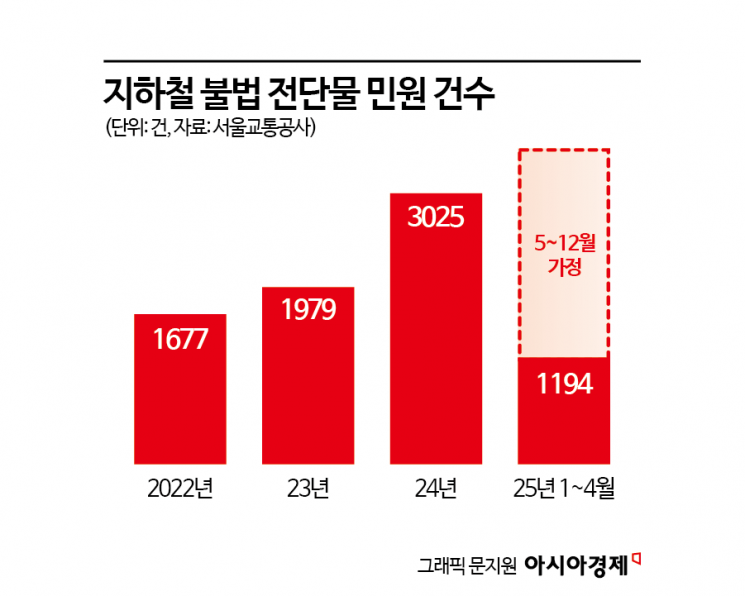
Complaints related to illegal flyers in the Seoul subway are on the rise. According to Seoul Metro, there were 1,677 complaints about illegal flyers in 2022, 1,979 in 2023, and 3,025 last year. As of April this year alone, 1,194 complaints had already been filed. Song, a 49-year-old man met at Seoul Station, said, "Even 10 years ago, there were prostitution flyers with certain unpleasant phrases in the station restrooms, and I still see them now," adding, "Since the subway is a place used by people of all ages, strict crackdowns and penalties are necessary."
Posting illegal flyers in the subway is punishable under the Minor Offenses Act. However, since the fine is only 50,000 won and it is especially difficult to enforce in restrooms, Seoul Metro says it is realistically hard to eradicate the problem entirely.
Nevertheless, the company is implementing various measures to prevent subway users from being lured by the businesses advertised on illegal flyers. For example, in the case of illegal drug-related flyers, they block the seller's phone numbers using a system called "Daepo Killer" (unlimited automatic call sender) and actively request police investigations. Manufacturing or selling unauthorized drugs can result in up to five years in prison or a fine of up to 50 million won.
A Seoul Metro official stated, "We urge subway users not to call the businesses listed on illegal flyers, even out of curiosity," and added, "If you find illegal flyers, please report them to us."
© The Asia Business Daily(www.asiae.co.kr). All rights reserved.
!["The Woman Who Threw Herself into the Water Clutching a Stolen Dior Bag"...A Grotesque Success Story That Shakes the Korean Psyche [Slate]](https://cwcontent.asiae.co.kr/asiaresize/183/2026021902243444107_1771435474.jpg)

















