Daegu Anshillyeon Safety Survey Findings
The Daegu Safety Living Practice Citizens’ Coalition (hereinafter referred to as Daegu Anshillyeon) announced on the 20th that, after inspecting the safety ratings and installation status of safety facilities at reservoirs in the Daegu area to prepare for heavy rainfall and water-related safety accidents during the summer season, it found that a significant number of reservoirs are being neglected. These include locations that require urgent repairs and reinforcements, as well as many reservoirs that lack even basic safety equipment such as life jackets or tubes for emergency rescue operations.
According to the results of Daegu Anshillyeon’s investigation through information disclosure, out of the 522 reservoirs in the Daegu area, 352 are in Gunwi-gun, 86 in Dalseong-gun, 47 in Dong-gu, 17 in Suseong-gu, 16 in Buk-gu, and 4 in Dalseo-gu, in that order.
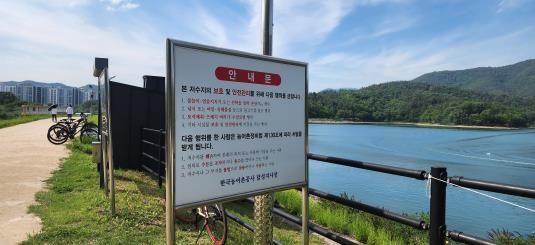
By safety rating, there are 44 rated as grade A, 316 as grade B, 148 as grade C, 10 as grade D, and 4 as grade E. The most serious issue is that all 10 grade D and 4 grade E reservoirs are located in Gunwi-gun. Since these reservoirs have a high risk of flooding and collapse during heavy summer rains, urgent preventive measures are required.
The reservoir safety rating system is divided into five levels: A (excellent), B (good), C (average), D (poor), and E (very poor). Grade C indicates that repairs and reinforcements are needed to prevent deterioration in durability and functionality. Grade D means urgent repairs and reinforcements are necessary, and a decision must be made on whether to restrict use.
Grade D means that defects have occurred in major components, requiring urgent repairs and reinforcements, and a decision must be made on whether to restrict use. Grade E indicates that severe defects have occurred in major components, posing a risk to facility safety, so immediate prohibition of use and reinforcement or reconstruction are required.
Meanwhile, only 8 out of the 522 reservoirs in Gunwi-gun, or 1.5%, have seismic designs, which is an extremely low rate. Notably, among the 29 reservoirs subject to detailed safety inspections (those over 50,000 square meters), only 8 have seismic designs. Of these 29 reservoirs, 4 are rated A, 18 are rated B, and 7 are rated C. By district and county, there are 13 in Dalseong-gun, 12 in Gunwi-gun, 2 in Buk-gu, 1 in Suseong-gu, and 1 in Dong-gu.
In January, a tragic accident occurred at the Seojae Reservoir in Dalseong-gun, where the absence of a water safety information board and the lack of basic safety equipment such as life jackets or tubes resulted in a person drowning without rescue. Even after four months, there are still locations where not even the minimum safety facility, an information board, has been installed, highlighting the urgent need for supplementary measures such as installing essential life-saving equipment that requires mandatory management.
According to the investigation of the installation status of water safety information boards, life-saving equipment boxes, fences, and CCTV, information boards have been installed at 515 out of 522 reservoirs, resulting in an installation rate of 98.6%. All 7 reservoirs without information boards are in Dong-gu.
The most serious problem is that only 161 out of 522 reservoirs, or 30.8%, have installed life-saving equipment boxes containing basic safety equipment (life jackets, tubes) for water rescues. Despite the accident in January, there has been no improvement, revealing ongoing neglect and a lack of safety awareness by local governments.
By district and county, all 16 reservoirs in Buk-gu and all 4 in Dalseo-gu have equipment boxes installed, achieving a 100% installation rate. Dalseong-gun has installed 83 out of 86 (96.5%), and Dong-gu has installed 41 out of 47 (87%). However, in Gunwi-gun, none of the 352 reservoirs have equipment boxes installed, which is a very serious situation. Even so, only 29 installations are planned for the first half of this year.
Meanwhile, only 8 out of 522 reservoirs in Suseong-gu have fences installed, resulting in an installation rate of 1.5%. CCTV has been installed at only 2 reservoirs in Suseong-gu and 5 in Dalseong-gun, totaling 7 installations for an installation rate of 1.3%. This clearly shows that many reservoirs are left as blind spots in safety management.
According to the Reservoir Dam Act, mayors, county heads, or district chiefs are required to establish disaster prevention measures for dangerous reservoirs and are also obligated to issue corrective actions through facility safety inspections. The installation of safety facilities and safety equipment at each reservoir is managed by the reservoir management authority (Korea Rural Community Corporation) in accordance with the Agricultural and Fishing Villages Improvement Act, including safety railings, fences, and life jackets.
Daegu Anshillyeon urged, "Daegu City and Gunwi-gun must take proactive measures such as special inspections and urgent repairs or reinforcements for the 14 reservoirs (10 grade D, 4 grade E) with high risks of flooding and collapse during heavy and extreme rainfall in the summer season." They also called for "the prompt installation of information boards and life-saving equipment boxes containing basic safety equipment such as life jackets and tubes at all reservoirs, and the gradual expansion of fences and CCTV installation, prioritizing reservoirs most frequently used by citizens."
© The Asia Business Daily(www.asiae.co.kr). All rights reserved.

















