Labor-Management Standoff Continues
Both Sides Release 'Fact Check' Materials to Sway Public Opinion
With the bus labor union announcing a nationwide simultaneous strike scheduled for the 28th, there is no sign of progress in negotiations between labor and management. Both sides, as well as the Seoul Metropolitan Government?which provides financial support to bus companies through the quasi-public management system?have begun releasing 'fact check' materials in an effort to sway public opinion.
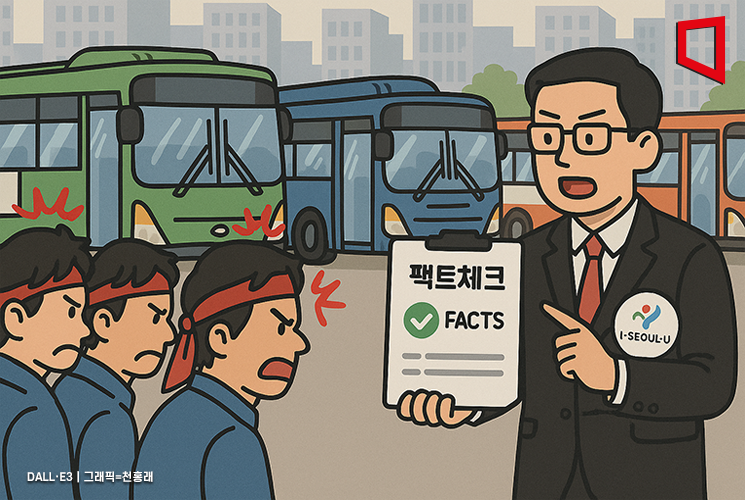
On the morning of the 20th, the Seoul City Bus Transportation Business Association, representing management, held a press conference near Seoul City Hall and stated, "We have continued working-level negotiations with the union until last week, but we still have not found common ground. We had refrained from speaking to the media due to concerns that it could negatively impact the negotiations, but since so much misinformation is circulating, we decided to hold this briefing."
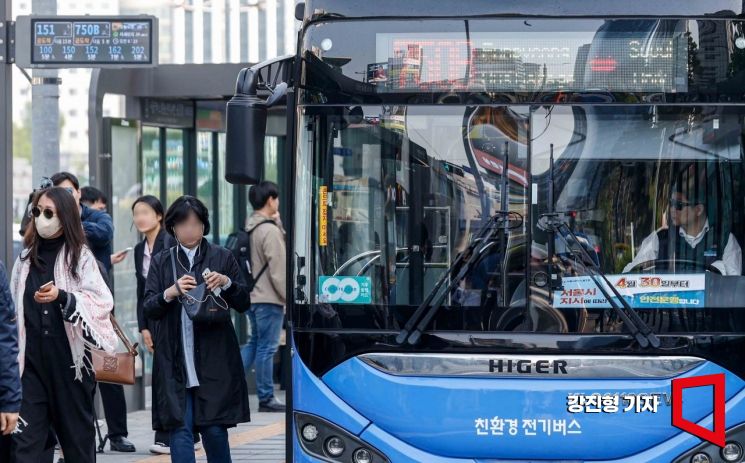 On April 30, 2025, as negotiations between the Seoul city bus labor union and management broke down and the union began a lawful operation strike, citizens are seen waiting for buses at Seoul Station Bus Transfer Center in Jung-gu, Seoul. Photo by Kang Jinhyung
The association emphasized that the Supreme Court's ruling on ordinary wages in December of last year was intended to reduce legal disputes over wages between labor and management. Kim Junghwan, chairman of the association, said, "The intention of the precedent is for labor and management to cooperate to simplify the complex wage structure, including ordinary wages, and to create a future-oriented wage system. Right now, whether it is a large or small company, labor and management are asking the courts to decide company wages, but the ruling is telling us not to do this."
Kim added, "What we are proposing is also to simplify the wage structure for these contentious issues and then determine the rate of increase. I do not think it is right to prolong this unstable situation by waiting for lawsuits that, as the union claims, may never end."
The main sticking point remains the issue of 'ordinary wages.' Last December, the Supreme Court en banc ruled that regular bonuses must be included in ordinary wages. The current wage system for city bus drivers consists of base salary, bonuses, and allowances. If bonuses are recognized as ordinary wages under this system, Seoul estimates that an additional 170 billion won would be required. Therefore, management has proposed maintaining the total annual salary at the current level of 62 million won, but simplifying the wage structure to only base salary and allowances.
On the other hand, the union argues that this would deprive workers of rights they have already secured and effectively amounts to a "wage cut." The union also maintains that, since lawsuits regarding ordinary wages are already underway at individual transportation companies, the issue cannot be addressed in collective bargaining.
The association stressed that reforming the wage structure is essential for the coexistence of labor and management. Kim stated, "In the bus industry, labor costs make up such a high proportion of total expenses that this issue (ordinary wages) is inevitably sensitive. Labor costs and fuel expenses account for nearly 80 to 90 percent of a company's costs. Of course, it would be good to pay workers more, but companies also need to survive together."
Kim also warned that if the wage structure is not reformed and bonuses are recognized as ordinary wages, restructuring may become unavoidable. He said, "If bus company costs increase significantly, the financial burden on the Seoul Metropolitan Government?which must cover deficits?will also grow. In that case, operators would inevitably have to tighten spending in other areas. In the worst-case scenario, we are concerned that there could even be extreme attempts to cut costs."
The association also claimed that Seoul city bus drivers are already receiving high pay relative to their working hours. According to the association, drivers are paid based on a 'contractual working hour' system, which assumes nine hours of work per day. However, a survey conducted on April 28 found that the average actual driving time per driver was 7 hours and 47 minutes. The association stated, "As a result, drivers have been receiving additional pay for 16 minutes of basic work, 57 minutes of overtime, and 1 hour and 43 minutes of night work. The working conditions and pay levels for drivers in Seoul are also higher than in other regions."
Since the breakdown of mediation by the Seoul Regional Labor Relations Commission at midnight on April 29, there has been no breakthrough in labor-management negotiations for nearly a month. Since the 19th, the association, the Seoul Metropolitan Government, and the bus union have each released 'fact check' materials to support their respective positions on issues such as whether the union's demanded wage increase exceeds 20 percent, whether wage structure reform constitutes a wage cut, and whether wage structure reform was discussed during negotiations.
On the 19th, the Seoul City Bus Labor Union sent an official letter to the association requesting the resumption of wage and collective bargaining negotiations starting from the 21st. In response, the association stated, "Of course, we will meet."
© The Asia Business Daily(www.asiae.co.kr). All rights reserved.













