"Reflecting Ordinary Wage Calculation and Wage Increase
Would Require an Additional 280 Billion Won in Funding"
Amid the breakdown of wage and collective bargaining negotiations between labor and management of Seoul city buses, the Seoul Metropolitan Government claimed that if it accepts all union demands, wages would increase by 25%, resulting in an additional financial burden of approximately 280 billion won.
On the 19th, the Seoul Metropolitan Government held a briefing at City Hall regarding the city bus wage negotiations and refuted each of the union’s claims.
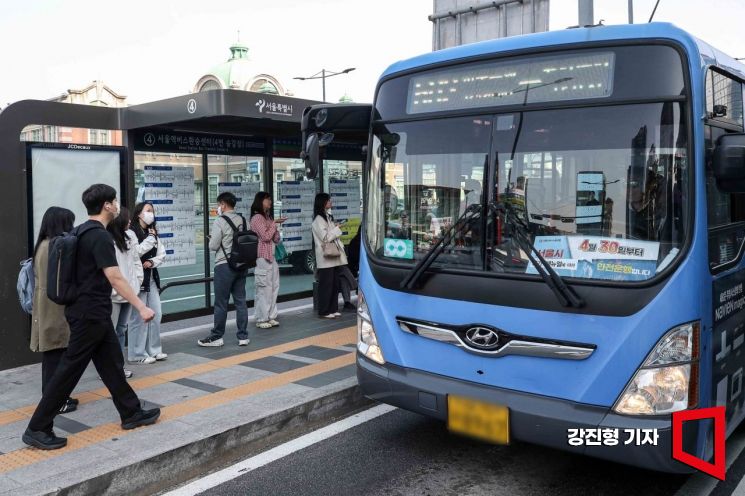 On April 30, as negotiations between labor and management of Seoul city buses broke down, the union began a work-to-rule protest. A notice related to the protest was posted on a bus at the Seoul Station Bus Transfer Center in Jung-gu, Seoul. 2025.4.30. Photo by Kang Jinhyung
First, regarding the union’s claim that it never demanded a wage increase of more than 20%, the city explained that the actual wage increase effect would reach 25%. The union is demanding an 8.2% increase in base salary in this round of negotiations. According to the city, if bonuses are reflected in ordinary wages in accordance with the Supreme Court’s en banc decision, monthly wages would rise by 800,000 won. If the union’s requested increase is added to this, the monthly wage would increase by about 25% in total.
According to the city, reflecting bonuses in ordinary wages would require an additional 170 billion won. If the 8.2% wage increase is included, an additional 280 billion won would be needed. The city explained that if this is resolved through fare increases instead of budget spending, fares would have to rise by about 300 won.
The city also countered the union’s claim that “allowances must be recalculated and paid immediately in accordance with the Supreme Court ruling,” arguing that the precedent does not mean that all workers’ wages must be raised and paid immediately. The city cited the Ministry of Employment and Labor’s labor-management guidance, stating, “Based on the Supreme Court en banc ruling and the guidance, we have set a direction to minimize conflict through dialogue and compromise, and to reform the wage system in a future-oriented manner.”
The city also refuted the union’s claim that management is effectively demanding wage cuts. The management’s proposal is to simplify the current wage structure, which consists of base salary, bonuses, and allowances, into just base salary and allowances. The union argues that if bonuses are counted as ordinary wages under the current system, wages would rise, but if the wage structure is revised, this increase would disappear, which they claim amounts to a “de facto cut.” A Seoul city official stated, “Based on an average annual salary of 62 million won, the proposal is to convert bonuses into base salary to maintain the total amount, and then discuss the wage increase rate,” adding, “So far, wage negotiations between management and labor have always been based on the total amount.”
Regarding the union’s claim that there have been no discussions about ordinary wages during the negotiations, the city responded, “Management expressed its intention to reform the wage structure during the 8th round of autonomous negotiations.” The city explained that the issue of ordinary wages was raised during the 8th round, but the union declared a halt to negotiations in the 9th round, which followed immediately after.
The union also claims that the city is pushing for wage structure reform to create favorable evidence for ongoing ordinary wage lawsuits at each transportation company. The union is currently involved in lawsuits demanding payment of overdue wages due to the recognition of bonuses as ordinary wages at each company, while management argues that bonuses do not qualify as ordinary wages. The union states, “The management wants the union to agree to delete the bonus provision or to change it so that bonuses are not considered ordinary wages during these negotiations, and then use this as evidence in court.” In response, the city said, “The lawsuits are disputes over the past, while we are discussing the system for the future,” and added, “There is no possibility that wage structure reforms made after the lawsuits were filed will be used as evidence in those lawsuits.”
Regarding the ordinary wage issue, 11 unions affiliated with the National Automobile Workers’ Union Federation in Seoul, Incheon, Gyeonggi, and other regions jointly applied for mediation on the 12th, and have announced a simultaneous strike on the 28th if mediation fails. A Seoul city official stated, “We are working to minimize inconvenience to citizens by extending the last subway train times and coordinating with KORAIL and metropolitan subway lines.”
© The Asia Business Daily(www.asiae.co.kr). All rights reserved.












