Jaywalking, Drunk Driving, and Even Public Urination
Jeju Sees an 18-Fold Increase in Crimes Committed by Foreigners
The "clean island" of Jeju is suffering due to excessive illegal acts and crimes committed by foreign tourists. In particular, violations of basic public order and serious crimes by tourists, especially those from China, have been occurring one after another, leading to growing anxiety and anger among local residents.
According to the Jeju Provincial Police Agency on May 19, a shocking incident recently occurred in which a Chinese national stole an urn from a temple columbarium and demanded money. Last month, a Chinese man in his 50s was arrested by police for breaking into a neighbor's residence and stealing cash. Three other Chinese men, who were staying in the same hideout and were in the country illegally, were handed over to the Immigration and Foreigners Office. In addition, there have been continuous incidents involving foreign nationals disregarding basic public order, such as drunk driving, driving without a license, crossing the center line, illegal dumping, public urination, and smoking on city buses.
In fact, during the 50 days of the "Special Public Security Measures to Respond to Foreign Crime," which has been implemented since March, Jeju police arrested a total of 115 foreign criminals. This represents a 53.3% increase compared to the same period last year, when 75 arrests were made. Through joint crackdowns with the Immigration and Foreigners Office, 56 illegal immigrants, who were abusing the visa-free entry system to stay in Jeju, were also caught.
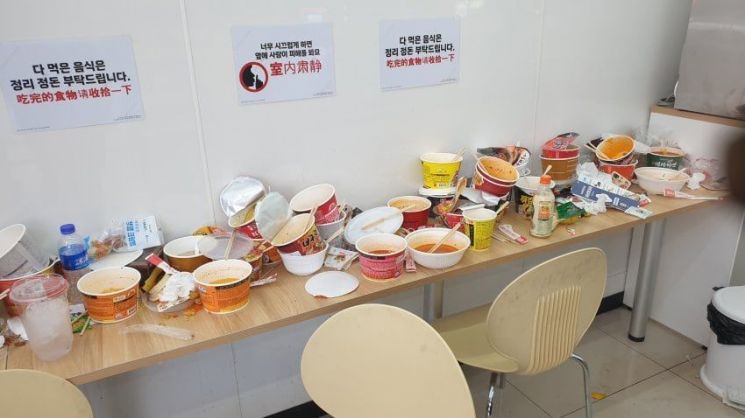 A convenience store in Jeju frequently visited by Chinese tourists is suffering from the trash left behind by tourists. Online community
Violations of traffic regulations are also at a serious level. An average of 50 cases of jaywalking are detected each day, and the number of jaywalking violations during this period reached 2,480, which is more than 18 times higher than the 141 cases recorded during the same period last year. In addition, there were 3 cases of drunk driving, 14 cases of driving without a license, and 18 cases of crossing the center line, all of which are serious illegal acts that were detected in succession. There were also 56 cases of illegal dumping and 1 case of public urination.
The Jeju Provincial Police Agency stated, "Recently, not only crimes committed by foreigners but also cases of violations of basic public order are rapidly increasing," and added, "We will enforce strict crackdowns regardless of whether the offenders are locals or foreigners, to instill the perception that 'violating basic public order in Jeju will inevitably lead to punishment.'"
Foreign media outlets have also expressed concern about this situation. The Taiwanese newspaper Liberty Times strongly warned last year that "Jeju is becoming an island of China." The outlet pointed out that "since the introduction of the visa-free entry system in 2008, Jeju has emerged as a major travel destination for Chinese tourists," and added, "Their activities have expanded beyond tourism to include real estate purchases and investment immigration."
Liberty Times analyzed that "as of the end of 2019, Chinese nationals owned about 9.81 million square meters of land in Jeju, accounting for 43.5% of all foreign-owned land," and explained, "Because Korea's investment immigration requirements are much lower than those of Australia or New Zealand, the influx of Chinese nationals has surged." Currently, the minimum investment required to obtain permanent residency (F-5) in Korea is about 1.5 billion won, which is significantly lower than the approximately 4 billion won required in Australia.
The problem is that a significant number of these individuals are indifferent to local order or cause cultural conflicts. Liberty Times cited an incident in which a Chinese child defecated on a street in Jeju and criticized, "While boasting of a long history, they do not hesitate to behave barbarically in public places." Seo Kyungduk, a professor at Sungshin Women's University, stated, "The inconsiderate behavior of Chinese nationals in Jeju is becoming a problem," and emphasized, "Rather than simply watching, measures must be taken to impose penalties for such inconsiderate acts as misdemeanors to ensure that these incidents do not recur."
© The Asia Business Daily(www.asiae.co.kr). All rights reserved.














