Emergency Market Inspection Meeting Held by Ministry of Economy and Finance, Financial Services Commission, and Financial Supervisory Service
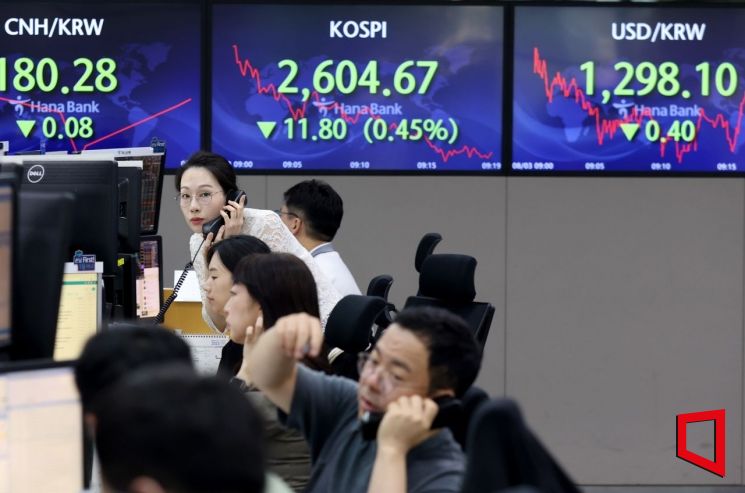 On the 3rd, the stock market started with a slight rise followed by a downward trend. The impact of the U.S. credit rating downgrade was not significantly reflected. Employees are working in the dealing room of Hana Bank. Photo by Heo Younghan younghan@
The government assessed that the impact of the U.S. credit rating downgrade on Korea's financial and foreign exchange markets would be limited.
On the 19th, the Ministry of Economy and Finance held a conference call with related agencies to review the market impact of the U.S. credit rating downgrade by Moody's, a global credit rating agency. The call was chaired by Vice Minister Yoon Indae of the Ministry of Economy and Finance, and participants included the Bank of Korea, the Financial Services Commission, the Financial Supervisory Service, and the Korea Center for International Finance.
Previously, on the 17th, Moody's, one of the world's top three credit rating agencies, downgraded the U.S. sovereign credit rating from the highest grade of 'Aaa' to 'Aa1', one notch below, and changed the rating outlook from 'negative' to 'stable'. With this, following the downgrades by S&P in 2011 and Fitch in 2023, the United States has lost its top-tier status from all three major rating agencies. The reasons cited by Moody's for the downgrade were chronic increases in national debt and fiscal deficits.
The government predicted that market volatility resulting from Moody's credit rating downgrade would not be significant. Participants evaluated, "Moody's downgrade of the U.S. credit rating is a belated move to align with other rating agencies, and given that Moody's had already maintained a 'negative' outlook on the U.S. rating, this action was largely anticipated and its impact on the market is expected to be limited."
However, they also noted, "This downgrade, in conjunction with existing external uncertainties such as tariff negotiations between major countries and the United States and the U.S. economic situation, could serve as a factor increasing short-term volatility in financial and foreign exchange markets." They added, "We will closely monitor domestic and international financial and foreign exchange market trends based on close cooperation among relevant agencies, including the Macroeconomic and Financial Issues Meeting (F4 Meeting)."
© The Asia Business Daily(www.asiae.co.kr). All rights reserved.
![User Who Sold Erroneously Deposited Bitcoins to Repay Debt and Fund Entertainment... What Did the Supreme Court Decide in 2021? [Legal Issue Check]](https://cwcontent.asiae.co.kr/asiaresize/183/2026020910431234020_1770601391.png)
















