With the advent of the artificial intelligence (AI) era, Nvidia, which has been generating massive revenues, is reportedly shifting its management strategy.
According to Yonhap News and foreign media outlets on May 18, Nvidia is making moves to reduce its dependence on major technology companies such as Microsoft (MS), Amazon, and Google, and to diversify its revenue streams.
In the most recent fiscal year, 89% of Nvidia's total revenue came from the sale of chips used in AI computing and networking. Among this, the share of revenue from 'hyperscalers'?companies like MS, Amazon, and Google that operate large-scale data centers?accounted for more than half.
However, it has been reported that Nvidia is preparing for the possibility that these big tech companies may eventually develop and use their own semiconductors in the long term.
Currently, these companies are heavily reliant on Nvidia's AI chips, but there are concerns that, over the long term, they could develop their own chips that would compete with Nvidia.
In fact, Anthropic, an AI startup invested in by Amazon, is training and operating its next-generation models using Amazon's custom-designed AI chip, 'Trainium2.'
Amid these circumstances, Nvidia is expanding its collaborations with AI cloud-based startups such as CoreWeave, Neuvias, Crusoe, and Lambda.
In particular, CoreWeave became the first cloud company to commercialize Nvidia's latest data center processor, the 'GB200 NVL72,' and Nvidia has also made an equity investment in CoreWeave.
Additionally, Nvidia is working to increase sales to traditional enterprise customers that operate their own IT infrastructure, such as Cisco, Dell, and HP.
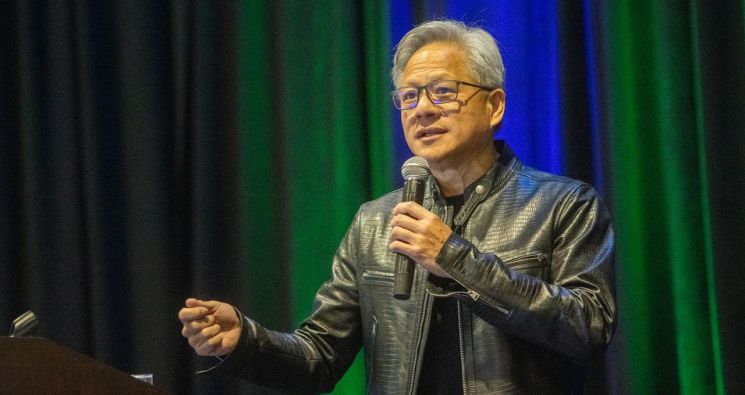
Nvidia CEO Jensen Huang recently expressed confidence, stating, "I am much more confident than a year ago about expanding our business outside of big tech."
Meanwhile, 'sovereign AI projects' being promoted by governments around the world are also emerging as new growth markets for Nvidia.
Nvidia recently agreed to supply more than 18,000 units of its 'GB300 Blackwell' chips to 'Humane,' an AI company led by Saudi Arabia's de facto ruler, Crown Prince Mohammed bin Salman.
These chips are scheduled to be installed in a 500-megawatt (MW) data center to be built in Saudi Arabia.
CEO Huang recently visited the Middle East, including Saudi Arabia and the United Arab Emirates (UAE), together with former U.S. President Donald Trump, demonstrating a strong commitment to business diversification.
G42, based in Abu Dhabi, UAE, is working with U.S. companies to build a 5GW-scale data center, and if cooperation with Nvidia is established, a significant increase in revenue is expected.
Experts predict that Nvidia could achieve additional annual revenue in the trillions of won through cooperation with Saudi Arabia and the UAE. However, there are also analyses that it remains uncertain how successful this revenue diversification strategy will actually be.
© The Asia Business Daily(www.asiae.co.kr). All rights reserved.












