Visits to Martyrs' Graves Continue After the Ceremony
"Husband's Life Was Full of Sorrow... Call for Inclusion in the Constitution"
Tribute Paid to Moon Jaehak, Protagonist of "Human Acts"
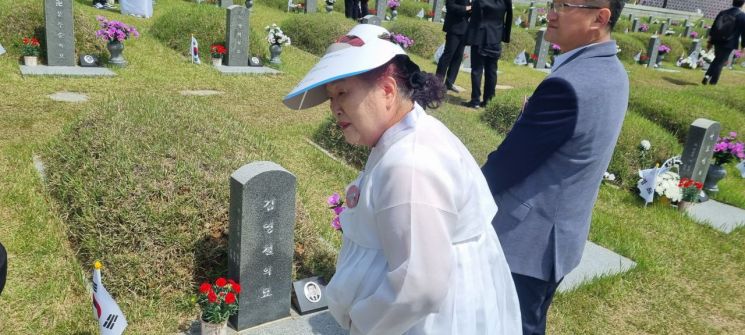 On the morning of the 18th, Kim Sunja (72) is paying respects at the grave of her late husband, martyr Kim Youngchul, at the National May 18 Democratic Cemetery in Unjeong-dong, Buk-gu, Gwangju.
"You spent your whole youth suffering... I'm so sorry it's been so long since I last came."
On the morning of the 18th, at the National May 18 Democratic Cemetery in Unjeong-dong, Buk-gu, Gwangju.
After the ceremony commemorating the 45th anniversary of the May 18 Democratic Uprising, bereaved families stood before the graves of the martyrs, sighing in grief.
Kim Sunja (72), who gently touched the headstone of her late husband, martyr Kim Youngchul, said, "It's been far too long since I came," and, her eyes welling with tears, added, "He spent his whole life suffering."
Kim Youngchul's wife, Kim Sunja, and his son, Kim Dongmyung (50), looked at a photo of the martyr in his youth placed beside the headstone and wailed, "He suffered so much when he was young. It's heartbreaking to think of how pitiful his life was."
Kim Youngchul, who led the Deulbul Night School, participated in the May 18 Democratic Uprising, published the Tusaehwebo (Fighters' Bulletin), and defended the old Jeonnam Provincial Office until the final resistance on May 27.
On May 27, 1980, Kim was the oldest among those defending the provincial office at age 32, and the only one who was officially married and the head of his household. He personally witnessed the death of fellow martyr Yoon Sangwon, and though he himself was shot seven times by martial law troops, he miraculously survived. However, this joy was short-lived, as he suffered from the aftereffects of severe torture and spent the rest of his life bedridden, passing away 19 years later.
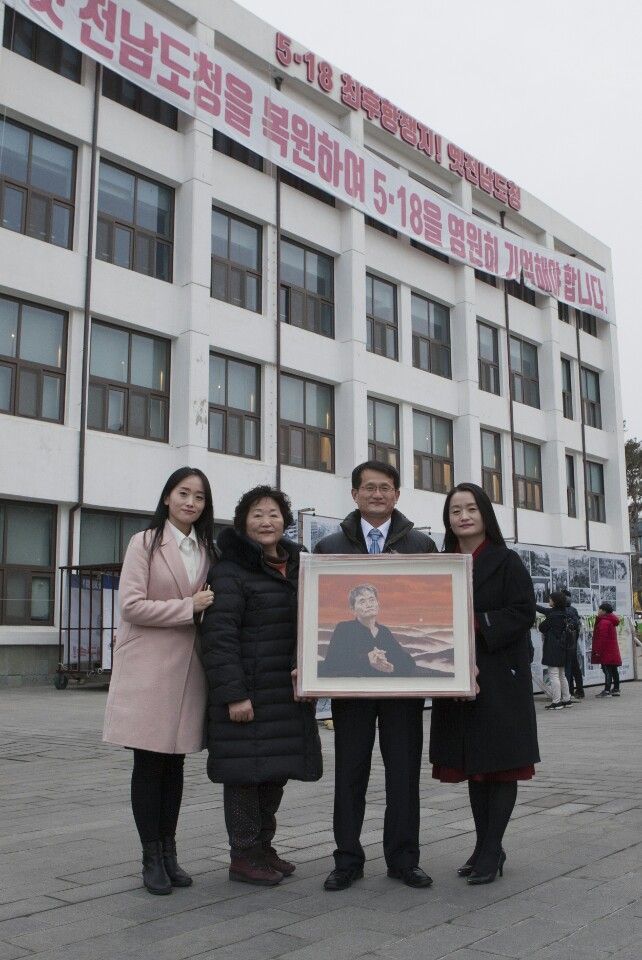 The family of martyr Kim Youngchul is taking a commemorative photo holding a painting depicting Kim during his lifetime in front of the old provincial government building in Donggu, Gwangju. Photo by a reader
Kim Dongmyung said, "Because of the aftereffects of torture, my father could hardly sleep at night," and added, "We three siblings would massage his left arm and leg, where he felt the most pain, praying for him to get better."
He continued, "When my daughter, who is a high school sophomore, saw photos of my father as a Deulbul Night School teacher and in the square during May 1980 published in her textbook, she asked if that was her grandfather. At that moment, I was overwhelmed with longing, but also proud of my father."
His wife, Kim Sunja, also recalled, "When Kim said he was going to defend the provincial office, I was eight months pregnant with our youngest daughter, the third of our three children," and added, "When he survived being shot by martial law troops, I was so grateful to the heavens."
She said, "But because of the brutal beatings and aftereffects inflicted by the martial law troops, he spent the rest of his youth fighting illness until he passed away. It is heartbreaking that he devoted his youth to Deulbul Night School and democracy. I can only hope that the spirit of May 18 will be enshrined in the preamble of the Constitution so that such a tragedy never happens again."
There was also a steady stream of visitors to the grave of Moon Jaehak, the protagonist of Han Kang's Nobel Prize-winning novel "Human Acts," and they offered words of comfort to Moon's mother, Kim Kilja, who greeted the mourners.
With the help of the Korean Modern History Research Association, about 30 Japanese visitors who came to Korea for a four-day trip spoke in halting Korean, saying, "Stay strong," and embraced Kim, joining in remembrance of the May 18 martyrs.
© The Asia Business Daily(www.asiae.co.kr). All rights reserved.
![User Who Sold Erroneously Deposited Bitcoins to Repay Debt and Fund Entertainment... What Did the Supreme Court Decide in 2021? [Legal Issue Check]](https://cwcontent.asiae.co.kr/asiaresize/183/2026020910431234020_1770601391.png)
















