NHIS Reaffirms Harmful Effects of Smoking Using Genetic Information for the First Time in Korea
Smoking Accounts for 88.0% of Squamous Cell Laryngeal Cancer and 86.2% of Squamous Cell Lung Cancer Cases
A study has found that even without any special genetic factors, individuals who smoke for more than 30 years and have a smoking history of one pack per day for 20 years have a risk of developing small cell lung cancer that is more than 54 times higher than that of non-smokers.

According to a joint study released on May 18 by the National Health Insurance Service (NHIS) Health Insurance Research Institute and Yonsei University Graduate School of Public Health, individuals who have smoked for more than 30 years and have a smoking history of at least 20 pack-years (one pack per day for 20 years) have a 54.49 times higher risk of developing small cell lung cancer compared to non-smokers. The study also found that smoking accounts for 98.2% of the risk of developing small cell lung cancer.
This research tracked and analyzed 136,965 people who underwent health screenings at 18 private screening centers nationwide between 2004 and 2013. The study linked health examination data, polygenic risk scores (PRS), national cancer registry data, and health insurance eligibility data, and followed the subjects until 2020.
The NHIS explained that this study is significant because, for the first time in Korea, genetic information was used to analyze the causes of lung and laryngeal cancers. The study demonstrated that genetic factors have little to no impact, thereby reaffirming the harmful effects of smoking.
First, the analysis of the risk of lung and laryngeal cancers due to smoking showed that the risk of developing small cell lung cancer, squamous cell lung cancer, and squamous cell laryngeal cancer was higher than for other types of cancer. The risk was also higher among current smokers than former smokers, and the risk increased with greater smoking history.
Even when general characteristics such as gender, age, type of medical coverage, income level (insurance premium quantile), and alcohol consumption were the same, and the polygenic risk scores for lung and laryngeal cancer were at the same level, those who had smoked for more than 30 years and had at least 20 pack-years had a 21.37 times higher risk of developing squamous cell lung cancer and an 8.30 times higher risk of developing squamous cell laryngeal cancer compared to non-smokers.
On the other hand, when general characteristics and smoking history were the same, having a high polygenic risk score only increased the overall risk of lung cancer by 1.20 to 1.26 times, and the risk of squamous cell lung cancer by 1.53 to 1.83 times, which is a relatively modest increase.
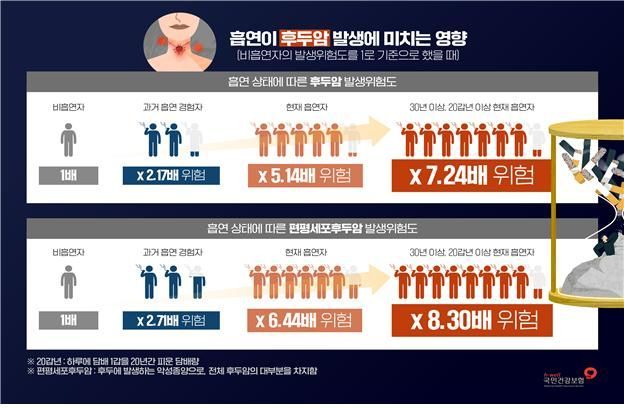
In the analysis of the extent to which risk factors contribute to disease incidence in exposed groups, smoking accounted for 98.2% of the risk of developing small cell lung cancer among those who had smoked for more than 30 years and had at least 20 pack-years, while the impact of genetic factors was not statistically significant. For squamous cell laryngeal cancer, smoking contributed 88.0% of the risk, and for squamous cell lung cancer, 86.2%.
Genetic factors were found to have a statistically significant effect only on the development of overall lung cancer and squamous cell lung cancer, but the extent was only 0.7% and 0.4%, respectively.
Um Sangwon, professor of pulmonology at Samsung Medical Center, stated, "Lung cancer is known to be primarily caused by somatic mutations due to acquired factors such as smoking. This study is the first in Korea to scientifically demonstrate that innate genetic factors have a minimal impact on the development of lung cancer, and that smoking contributes 98.2% and 86.2% to the development of small cell lung cancer and squamous cell lung cancer, respectively, which is highly significant."
Lee Sunmi, director of the Health Insurance Policy Research Department at the Health Insurance Research Institute, emphasized, "This is the first domestic study to not only control for the influence of genetic factors in the causal analysis between smoking and the incidence of lung and laryngeal cancers, but also to quantify the contribution of genetic factors to the development of these cancers. The results reconfirm that genetic factors have little or no association with the incidence of lung and laryngeal cancers, whereas smoking is a powerful risk factor for cancer development."
© The Asia Business Daily(www.asiae.co.kr). All rights reserved.