74 mm of Rain in One Hour Hits Namyangju
38 mm Falls in Seoul Jung-gu
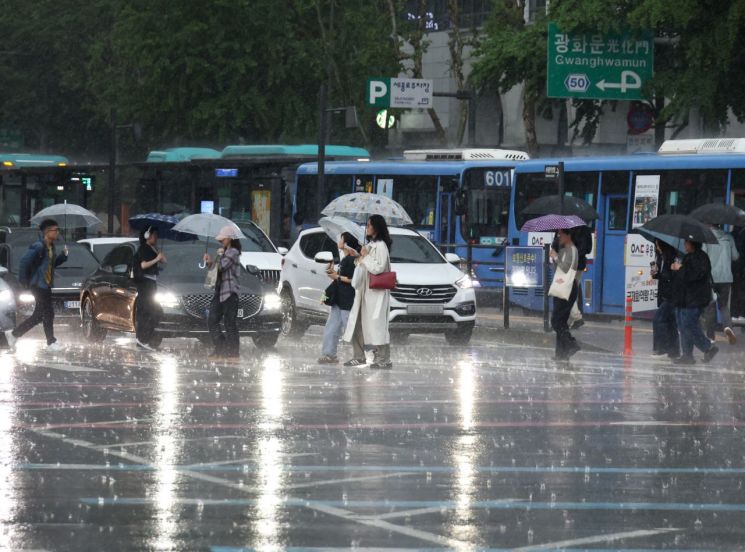
On May 16, heavier-than-expected rainfall hit Seoul and the surrounding metropolitan area, prompting the first "heavy rain emergency disaster alert text" of the year to be issued.
At approximately 4:29 p.m. that day, a heavy rain emergency disaster alert text was sent to the Onam-eup area of Namyangju, Gyeonggi Province.
According to records from the Korea Meteorological Administration's Automatic Weather System (AWS), Onam-eup in Namyangju received 74 mm of rain between 3:31 p.m. and 4:31 p.m. Of the total 105 mm of rainfall recorded in the area by 5:00 p.m. that day, 70% fell within just one hour.
The heavy rain emergency disaster alert text is sent directly by the Korea Meteorological Administration when the hourly rainfall exceeds 50 mm and the three-hour rainfall exceeds 90 mm. It is also issued if the hourly rainfall exceeds 72 mm.
Last year, a total of 129 heavy rain emergency disaster alert texts were issued for the Seoul metropolitan area, North Gyeongsang, and South Jeolla regions.
In addition to Namyangju, Hallasan Jindallaebat in Jeju recorded 44.0 mm of rainfall over one hour from 2:46 p.m., while Seoul’s Jung-gu district saw 38 mm of heavy rain over one hour starting at 3:35 p.m.
The rainfall in the Seoul metropolitan area that day was not anticipated. Initially, the forecast expected heavy rain of 20?30 mm per hour to occur mainly along Jeju and the southern coast, as a low-pressure system approaching from Shanghai, China was expected to pass close by those regions.
The reason for the heavy rain in the metropolitan area appears to be that cold air, which entered the upper atmosphere of the region from behind a trough that passed to the north of Korea the previous day, remained in the upper layers, while a low-pressure system passing over southern Korea that day brought warm and humid air into the lower atmosphere.
When cold air is present in the upper atmosphere and warm air remains in the lower layers, atmospheric instability increases, causing rain clouds to develop rapidly. The Korea Meteorological Administration had also predicted that showers caused by atmospheric instability would affect the metropolitan area and the Chungcheong region that day.
Rain is expected to fall across most regions nationwide through the night. Central and southern Gangwon, inland Chungcheong, inland Jeolla, Yeongnam, and Jeju may continue to see rain through the early morning of May 17.
Seoul, northern Gyeonggi, the southern coast and eastern inland of South Jeolla, the southern coast and southwestern inland of South Gyeongsang, and Jeju (excluding the northern part) may experience heavy rain of 20?40 mm per hour through the night. Caution is advised.
© The Asia Business Daily(www.asiae.co.kr). All rights reserved.

















