Unanimous Support for Restoring WTO-Centered Multilateral Trade Order
Korea Secures International Backing for 'AI for Trade Initiative'
Strengthening Public-Private Cooperation to Respond to Supply Chain Restructuring
Amid escalating tensions between the United States and China and the spread of protectionism, trade ministers from the Asia-Pacific Economic Cooperation (APEC) gathered in Jeju and unanimously adopted a joint statement focusing on the restoration of the multilateral trading system, AI-based trade cooperation, and the establishment of sustainable supply chains.
Jin Ingyo, Director General for Trade Negotiations at the Ministry of Trade, Industry and Energy, stated in a briefing on the 16th, "Despite sharp differences in positions regarding the global trade environment, we achieved a historic agreement that could be called the 'Miracle of Jeju.' We will strive to achieve tangible results in the negotiations leading up to the Foreign and Trade Ministers' Meeting and the Summit in the second half of this year."
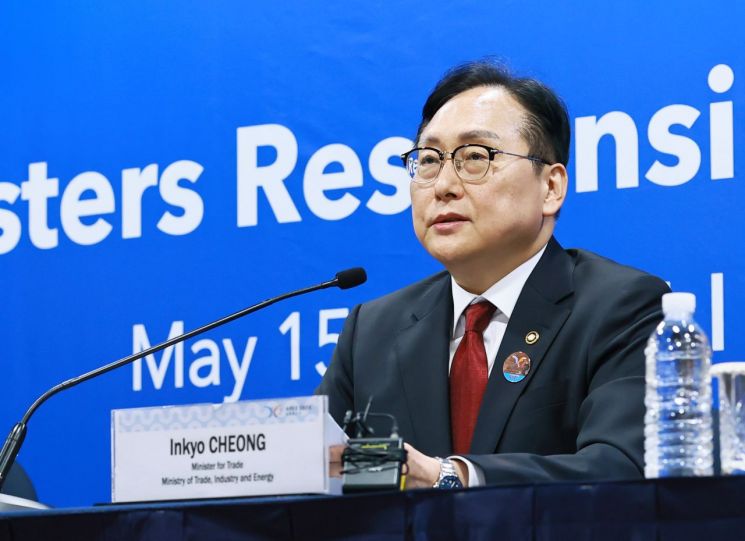 Jin Ingyo, Director General of Trade Negotiations at the Ministry of Trade, Industry and Energy, is briefing on the results of the APEC Trade Ministers' Meeting at the Jeju International Convention Center on the 16th.
First, APEC members expressed shared concerns about the global trade environment, which faces fundamental challenges, and reaffirmed the importance of the World Trade Organization (WTO), which has provided the legal foundation for the global trading system.
Ngozi Okonjo-Iweala, Director-General of the WTO, stated during the meeting that the WTO is determined to reestablish itself as a relevant institution in creating a stable and predictable trade environment. She also called for political support from APEC trade ministers to help the WTO achieve comprehensive and meaningful reforms. Member economies agreed to continue related discussions until the 14th WTO Ministerial Conference (MC-14), scheduled for March next year.
At this meeting, Korea officially proposed the 'AI for Trade Initiative' and secured broad support for it. Jin introduced three main tasks to reach consensus: expanding the introduction of AI-based customs and clearance administration, enhancing private sector understanding of AI policies, and voluntary sharing of standards and technical information.
As a follow-up, an 'AI for Trade Public-Private Dialogue' will be held in Incheon this August to further specify implementation plans. In addition, APEC members reaffirmed that digital technologies, including AI, are central to regional economic growth and agreed to continue cooperation on promoting paperless trade, strengthening digital infrastructure, and boosting consumer trust.
Strengthening public-private cooperation and building sustainable supply chains were also key agenda items. Just before the meeting, on May 9, Korea held the 'Sustainable Supply Chain Forum,' proposing private sector participation across industries, which received support from member economies.
In particular, members reaffirmed their commitment to implementing the 'APEC Connectivity Blueprint 2015-2025' to enhance physical, institutional, and people-to-people connectivity, and agreed to expand the introduction of the 'APEC Virtual ABTC (Virtual APEC Business Travel Card).' This card will enable visa-free and fast-track entry between member economies.
Although the meeting initially faced difficulties due to stark differences in positions during early working-level negotiations, it is assessed that, under the coordination of Korea as the chair, major member economies showed flexibility and achieved a dramatic consensus.
Jin, who presided over the two-day meeting, said, "Reaching an agreement at this Trade Ministers' Meeting was a major challenge for myself as chair, for the trade ministers of the 20 member economies, and for the more than 100 members of the joint statement negotiating team. Although fundamental differences in perspectives on the global trade order remained contentious until the end, we reaffirmed support for multilateralism and a rules-based trading system through ministerial-level consultations," emphasizing the significance of the agreement.
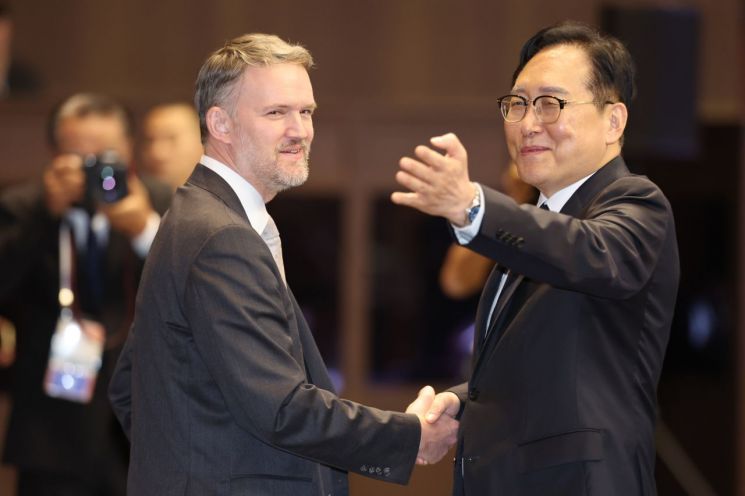
Jin also partially disclosed the contents of his one-on-one meeting with Jamieson Greer, the U.S. Trade Representative. He said, "I emphasized the role of the United States in ensuring the successful hosting of the APEC Summit, and, above all, we reviewed previous discussions and coordinated future consultation schedules regarding tariff issues between Korea and the United States." However, he added, "It is difficult to disclose the details due to security reasons."
When asked whether there were any suggestions from some member economies for a joint response to U.S. tariff measures, he explained, "There were no official discussions on a joint response, and the interests of each country are too different for us to agree on such a matter."
Regarding discussions on the restoration of the WTO Appellate Body, he said, "This meeting did not lead to specific discussions on the issue," but added, "Since it is impossible without U.S. cooperation, further in-depth discussions will be needed in the future."
On the possibility of U.S. President Donald Trump attending the APEC Summit in October, Jin stated, "There were no related discussions with Representative Greer, and for now, it is a matter that requires a decision from the White House."
© The Asia Business Daily(www.asiae.co.kr). All rights reserved.
![Clutching a Stolen Dior Bag, Saying "I Hate Being Poor but Real"... The Grotesque Con of a "Human Knockoff" [Slate]](https://cwcontent.asiae.co.kr/asiaresize/183/2026021902243444107_1771435474.jpg)












