U.S. Marine Corps Aviation Assets Participate in GOC Exercise for the First Time
The Ground Operations Command, which also serves as the Ground Component Command (GOC), announced on May 16 that it has been conducting the "2025 First Half Combined Joint Aerial Resupply Exercise" since May 9. This combined joint aerial resupply exercise is a regularly scheduled training led by the GOC, designed to overcome poor ground supply lines in wartime and to maintain and enhance the military's operational sustainment capabilities.

Approximately 220 service members from both South Korea and the United States participated in this exercise, including the GOC's subordinate 2nd and 5th Corps (Logistics Support Brigade and Special Forces Regiment), the 2nd Rapid Response Division, the Army Aviation Command, the Air Force Operations Command, the Air Mobility and Reconnaissance Command, the Air Force Logistics Command, and the U.S. Marine Corps 1st Marine Aircraft Wing. In addition, ten combined joint air assets were mobilized, including C-130 transport aircraft from both countries, the South Korean CN-235 transport aircraft, and CH-47 helicopters. These assets conducted large-scale exercises across both front and rear areas, including Gyeonggi, Gangwon, and Gyeongnam provinces.
Notably, this exercise expanded its scope from the traditional cargo drop method, which uses parachutes to deliver small supplies from the air, to include "equipment airdrop," which involves dropping mobile equipment such as military vehicles. The exercise also included "airlift sling operations," where vehicles are airlifted and transported by transport helicopters, allowing participants to practice a variety of mission types. Furthermore, U.S. Marine Corps aviation assets (KC-130J transport aircraft) participated in a GOC exercise for the first time.

The exercise simulated a scenario in which the tactical movement routes of maneuver units in each region were cut off, and emergency supplies (combat rations, ammunition, drinking water, medical supplies, etc.) and equipment were rapidly and accurately resupplied using aircraft. In the cargo drop phase, resupply materials and equipment (including military vehicles) were packaged and rigged, then airdropped by aircraft to precise target points, where friendly operational units would recover them. In the airlift sling operation, transport helicopters airlifted "light tactical vehicles" for resupply to operational units, which then recovered them at the designated locations.
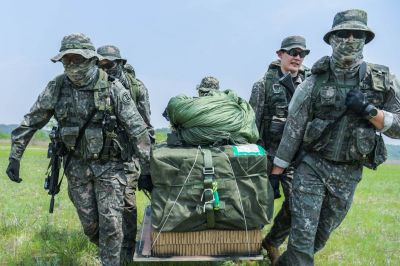
Lieutenant Colonel Choi Munyong, Battalion Commander of the 2nd Corps Special Forces Regiment, stated, "Through this exercise, we were able to experience firsthand the excellence of our combined joint aerial resupply capabilities." He added, "All members of the unit have gained pride and confidence in knowing that, with the robust sustainment support of our military, we can accomplish our missions under any circumstances."
Lieutenant Colonel Kim Gahi, Commander of the 5th Logistics Support Brigade's Transportation Battalion, said, "I was once again reminded that, with the united strength of Korean and U.S. service members, we can flawlessly execute any mission." She added, "We will do our utmost to enhance our 'sustainment capability' so that we can transport supplies and equipment whenever and wherever our forces need them."
© The Asia Business Daily(www.asiae.co.kr). All rights reserved.



















