On May 15, the won-dollar exchange rate closed sharply lower, falling to the 1,390 won level. This was due to heightened caution over the possibility of U.S. pressure for won appreciation.
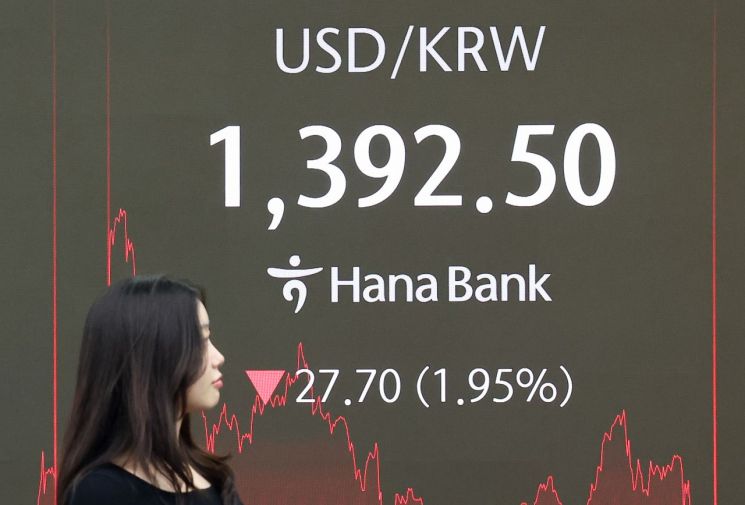
On this day, the won-dollar exchange rate in the Seoul foreign exchange market ended weekly trading at 1,394.5 won as of 3:30 p.m., down 25.7 won from the previous trading day.
The won-dollar exchange rate plummeted to as low as 1,390.8 won during overnight trading after news broke that South Korean and U.S. foreign exchange authorities had met in person for currency negotiations. However, as additional reports indicated that the exchange rate would not be included as an agenda item in the bilateral trade talks, the rate recovered some of its losses and opened at 1,410.9 won in the morning. Nevertheless, the market continued to anticipate significant U.S. pressure for won appreciation, causing the rate to fall again in the afternoon. At 12:38 p.m., it dropped to as low as 1,391.5 won. The dollar index, which measures the value of the U.S. dollar against the currencies of six major countries, stood at 100.709. After falling to 100.266 the previous day and rebounding above the 101 level, it has resumed its downward trend.
Experts believe this volatile trend will continue for the time being. Wi Jaehyun, an economist at NH Futures, said, "Recently, despite expectations for a gradual fall in the exchange rate due to a weaker dollar in the second half of the year, the mere mention of currency issues being discussed in trade talks has led to excessive and rapid position unwinding, causing a supply-demand imbalance in the market." He added, "At this point, the key question is whether the U.S. genuinely wants to artificially appreciate Asian currencies." He explained that in order to force an artificial appreciation, the U.S. would need to intervene by selling dollars and buying the local currency. However, if selling dollars leads to selling U.S. Treasury bonds, the U.S. may not want this outcome, and this is something that should be noted.
© The Asia Business Daily(www.asiae.co.kr). All rights reserved.