Korea-U.S. Bilateral Meeting on the Sidelines of the APEC Trade Ministers' Meeting
Full-Scale Negotiations on Tariffs and Non-Tariff Barriers Begin
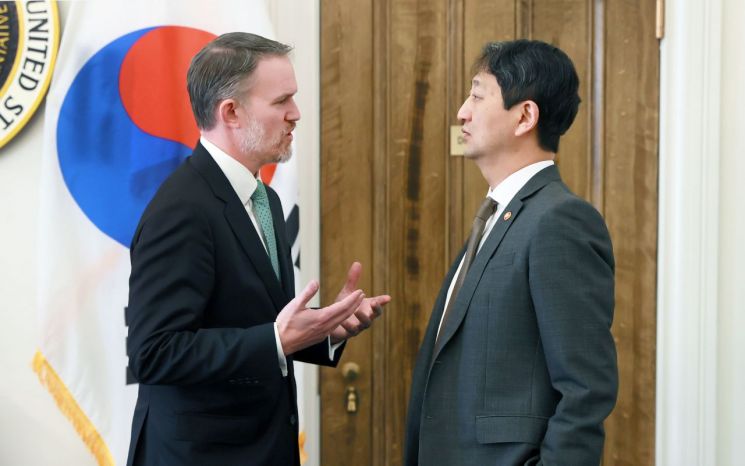
Minister of Trade, Industry and Energy Ahn Dukgeun and Jamieson Greer, the representative from the United States Trade Representative (USTR), will hold a high-level Korea-U.S. trade meeting in Jeju on May 16. With the recent easing of the "tariff war" following significant mutual tariff reductions between the United States and China, this meeting is expected to mark a major turning point in Korea's trade strategy.
According to the Ministry of Trade, Industry and Energy on May 14, Minister Ahn will hold a separate bilateral meeting with Representative Greer, who is attending the APEC meeting, on May 16. They plan to coordinate key trade issues between Korea and the United States, including tariffs, non-tariff barriers, and economic security.
This discussion serves as an interim review of the working-level talks established through the Washington "2+2 Tariff Consultation." The main point of interest is whether the United States will show a certain level of flexibility toward Korea following the recent U.S.-China tariff reduction agreement.
Currently, Korea and the United States are pursuing negotiations to abolish mutual and item-specific tariffs, a process known as the "July Package." Initially, five to six working groups were to be formed to conclude negotiations by July 8. However, due to the complex structure of the agenda and the negotiation environment of the USTR, the approach has shifted to sequential, sector-by-sector consultations. This adjustment reflects the fact that the United States is simultaneously negotiating with 18 countries.
Above all, the upcoming meeting in Jeju is expected to serve as the first major test that could determine the direction of Korea-U.S. trade consultations. In particular, Korea is expected to present proposals for industrial cooperation in sectors such as shipbuilding and energy to the United States, and will focus its negotiating power on securing a 25% mutual tariff exemption and reductions in tariffs on key items such as automobiles and semiconductors.
The United States has already demonstrated an active negotiating stance this month, reaching its first trade agreement with the United Kingdom and agreeing to tariff reductions with China. As a result, there is cautious optimism that tangible results could also emerge from the Korea-U.S. discussions.
Meanwhile, the upcoming APEC Trade Ministers' Meeting will be attended by trade ministers from 21 countries, including Korea, the United States, China, and Japan, as well as senior officials from international organizations such as the World Trade Organization (WTO) and the Organisation for Economic Co-operation and Development (OECD). During the meeting, various combinations of bilateral talks are likely to take place, including U.S.-China, Korea-U.S., Korea-China, and Korea-Japan meetings.
Notably, both Jamieson Greer, the key U.S. negotiator in the U.S.-China "Geneva negotiations," and Li Chenggang, Vice Minister of Commerce of China, will be present in Jeju. If a U.S.-China bilateral meeting is additionally held in Jeju, attention will be focused on whether discussions will advance regarding further tariff reductions or the easing of export controls.
© The Asia Business Daily(www.asiae.co.kr). All rights reserved.











