Interpreting Brainwaves with the Stentrode
Apple Expected to Compete with Musk's Neuralink
Apple is working to introduce technology that would allow users to control its devices, such as the iPhone, using brainwaves through a brain implant.
According to the Wall Street Journal (WSJ) on May 13 (local time), Apple has begun early-stage development of technology that would enable people with disabilities who cannot use their hands to operate Apple devices. This project is in collaboration with Synchron, a brain-computer interface (BCI) startup that has developed a brain implant. The brain implant is a device that reads brainwaves and transmits stimuli.
The WSJ reported, "With next-generation brain implants, tens of thousands of people who cannot use their hands due to severe spinal cord injuries or diseases such as amyotrophic lateral sclerosis (ALS, also known as Lou Gehrig's disease) will be able to use Apple devices more easily." The report also cited Morgan Stanley's estimate that in the United States alone, about 150,000 people could be initial candidates for BCI devices.
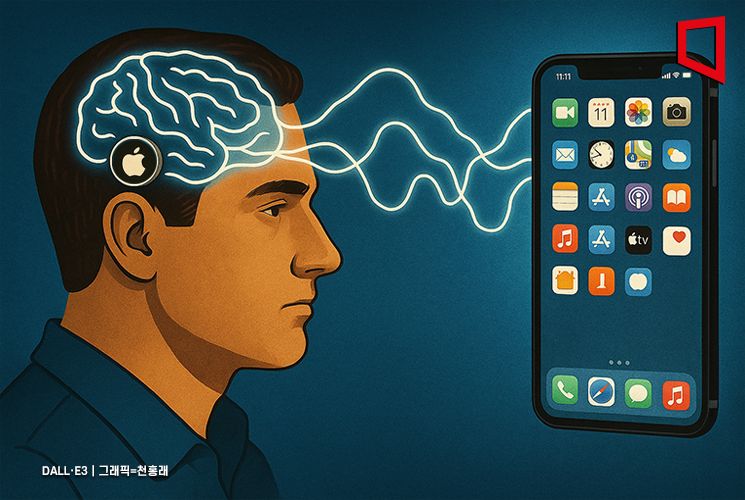
While smartphones currently rely on 'touch' as the user's input, brain implants would allow devices to be controlled by brain signals without any physical movement. To achieve this, Apple is developing a new technology standard to connect Synchron's 'Stentrode' implant device to the iPhone and other Apple devices.
The Stentrode, which contains electrodes that read brainwaves, is a stent-shaped implant inserted into a vein above the brain's motor cortex. This device interprets user input from brainwaves and is used to control icons and other elements on a device's screen. However, Synchron's technology is still in its early stages, so it is currently difficult to move the cursor freely or operate devices quickly like a mouse. At present, it allows for basic screen navigation and icon selection.
The WSJ predicted that Apple will unveil a new BCI-specific interface standard later this year, which will further enhance functionality and accessibility. In 2014, Apple also developed a Bluetooth-based technology standard that allowed hearing aid users to better hear sounds from the iPhone.
Industry observers expect that Apple will face fierce competition in brainwave-based device control technology from Neuralink, the neurotechnology startup founded by Elon Musk, CEO of Tesla. Neuralink has enabled patients with paralysis to communicate through devices by implanting chips in their brains. Recently, the case of a third patient with paralysis who received a Neuralink chip implant was also made public.
© The Asia Business Daily(www.asiae.co.kr). All rights reserved.


















