Excessive Entrance Exam Competition Undermines Achievements in Seoul Education
..."Absolute Evaluation for CSAT" Proposed to Ease Overheated Competition
"We can no longer confine our children, who will live in the future, to problem-solving-oriented education and the framework of ranking-based entrance exams."
Jeong Geunsik, Superintendent of the Seoul Metropolitan Office of Education, stated this in a written interview with Asia Economy on May 14, emphasizing that "the current university entrance system, which centers on the College Scholastic Ability Test (CSAT), still remains within the confines of standardized multiple-choice exams."
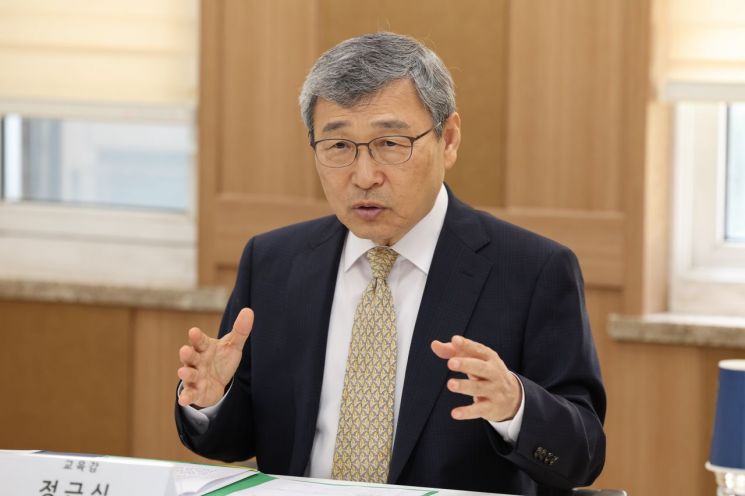 Jeong Geunsik, Superintendent of Seoul Metropolitan Office of Education. Seoul Metropolitan Office of Education
On May 13, Superintendent Jeong proposed and delivered the top 10 education tasks for the next administration to each political party, ahead of the 21st presidential election. The key points include improving the university entrance system, limiting the reduction rate of teacher staffing, and guaranteeing students' basic academic abilities.
Superintendent Jeong explained, "In preparation for the 21st presidential election, we have put together these proposals to proactively respond to rapidly changing educational environments such as declining school-age population, climate crisis, and digital transformation, and to request that the core policies necessary for the future of education in Korea be reflected in campaign pledges."
The most notable aspect is the proposal to change both school grades and the CSAT to an 'absolute evaluation' system regarding university admissions.
Superintendent Jeong believes that the current relative evaluation-based university entrance system leads to overheated competition, excessive private education, and a growing number of repeat test-takers. He argues that the university admissions system must be improved to normalize public education and reduce private education expenses.
Private education expenses for elementary, middle, and high school students in Korea have continued to rise, from 19.3532 trillion won in 2020 to 23.4158 trillion won in 2021, 25.9538 trillion won in 2022, and 27.1144 trillion won in 2023. Superintendent Jeong considers it problematic that such excessive spending on private education is being poured into problem-solving-oriented CSAT preparation.
Superintendent Jeong pointed out, "It is not easy to simultaneously achieve 'normalization of high school education' and 'ensuring discrimination' within the reality of entrance exams," but added, "The current university entrance system, centered on the CSAT, still remains within the framework of standardized multiple-choice exams in order to differentiate students." He further stated, "The entrance exam competition, where students must answer even one more question correctly than others no matter how well they do, undermines the achievements of Seoul's education, which emphasizes competency-based collaborative learning." He also noted, "This system generates social problems such as early advanced learning, excessive private education spending, repetitive problem-solving-based learning, and deepening educational polarization."
Superintendent Jeong said, "If we switch the CSAT and school grades to an absolute evaluation system, it can be one way to ease excessive competition and move toward education focused on student growth." He continued, "While simply switching to absolute evaluation will not solve all issues, I hope that the university entrance system will gradually improve so that students can focus not on 'competition with others' but on 'competition for their own growth.'"
To reduce private education expenses, the Seoul Metropolitan Office of Education formed a task force in March. Measures are being developed to strengthen public education so that it can absorb the demand for private education. Superintendent Jeong said, "We are devising detailed measures such as revitalizing Neulbom School and absorbing the demand for private education that is oriented toward the entrance exam system."
In addition, Superintendent Jeong identified guaranteeing students' basic academic abilities as a major task the next administration must address. To this end, he proposed expanding the 'Seoul Learning Diagnosis and Growth Center,' currently operated by the Seoul Metropolitan Office of Education, nationwide. The Seoul Learning Diagnosis and Growth Center conducts in-depth diagnosis and analysis of basic academic issues that are difficult to solve at the school level, such as dyslexia, dyscalculia, and borderline intelligence, and provides customized programs for each factor.
Superintendent Jeong said, "Educational polarization is a serious problem that undermines the sustainability of our community," and added, "Guaranteeing basic academic ability is a fundamental right of students, and the government must take responsibility and provide support." He continued, "Although we are operating the Learning Diagnosis and Growth Center at the city education office level, there are limitations due to regional imbalances in human and material resources, so securing stable funding is urgently needed."

Superintendent Jeong also included in his top 10 education policy proposals the redesign of the teacher estimation method, guaranteeing the basic political rights of educational public officials, strengthening teacher protection, maintaining local education finance grants, and improving outdated school facilities. He stated, "Local education finance grants, teacher staffing increases, and the university entrance system are all decided at the national level and affect city and provincial education offices," adding, "I hope this will be the starting point for building an educational ecosystem where the new government and Seoul education work together in cooperation."
© The Asia Business Daily(www.asiae.co.kr). All rights reserved.


















